Is solar worth it in ATCO Electric territory?
For most properties around ATCO Electric territory, the math works. A typical 10 kW residential or acreage system here produces about 10,900 kWh a year and trims roughly $2,500 off your first-year power bill, which puts payback at about 14.4 years. We size every system to your actual power bills and site conditions, not an inflated projection.
ATCO Electric is the wire service provider for a huge swath of Alberta: much of the central and eastern parts of the province and most of the north. If you live in or around towns like Stettler, Taber, Wainwright, or Provost, or on a farm or acreage in the surrounding counties, there is a good chance ATCO owns the distribution lines that serve your property, and that means your solar project connects to the grid through ATCO's micro-generation process. The good news is that Alberta's micro-generation regulation applies province-wide. The rules that let you generate your own power, export your surplus, and get credited for it are the same whether your wires belong to ATCO, FortisAlberta, or a municipal utility. What changes is who reviews your application, what their submission requirements look like, and how their timelines run. Getting that paperwork right the first time is the difference between a 2 to 6 week approval and a file that bounces back and forth all summer. Range Road Solar installs grid-tied solar for homes, acreages, farms, and shops, and we handle the ATCO application as part of every project in their territory. We prepare the site plan, the single-line diagram, and the equipment specifications ATCO wants to see, submit the package, and deal with any follow-up questions so you do not have to learn a utility's internal process to get your panels turned on.
Why Solar Works in East-Central and Northern Alberta
The parts of Alberta that ATCO serves get very good sun. East-central Alberta around Stettler, Wainwright, and Provost sees roughly 2,300 to 2,400 peak sun hours per year, and the south around Taber is even better, sitting in the sunniest region in Canada. A 10 kW system in ATCO territory typically produces in the neighbourhood of 10,800 to 11,500 kWh annually depending on latitude and siting. Cold winters help rather than hurt. Panels are more efficient in cold air, and the prairie wind does a decent job of clearing snow off well-tilted arrays. Production is naturally summer-weighted, but micro-generation credits earned in June carry forward on your bill to offset December, so the system is evaluated on annual production, not the worst month. The economics work the same way they do everywhere in Alberta's deregulated market. Every kilowatt-hour you generate and use on site is a kilowatt-hour you do not buy at the full stacked rate of energy, delivery, and riders. Every surplus kilowatt-hour you export earns a credit through your retailer. Rural ATCO customers often carry higher delivery charges than city customers, which makes the avoided-consumption side of the math stronger, not weaker.
Rural ATCO Sites: What We Check Before We Design
Line Capacity and Voltage Rise
ATCO's rural feeders can run long distances from the substation, and exporting solar pushes voltage up along those lines. If the design ignores this, the inverter derates or trips on high voltage and your production suffers. We assess the service and line situation during design so the system we submit to ATCO is one their review will actually approve.
Transformer Sizing
Your export capacity is limited by the transformer serving your site. A small pole transformer feeding a farmyard may cap how much a system can export even when the load justifies more panels. We identify the transformer rating early, and when an upgrade is genuinely worth it, we scope that conversation with ATCO before you commit to anything.
Single-Phase vs Three-Phase
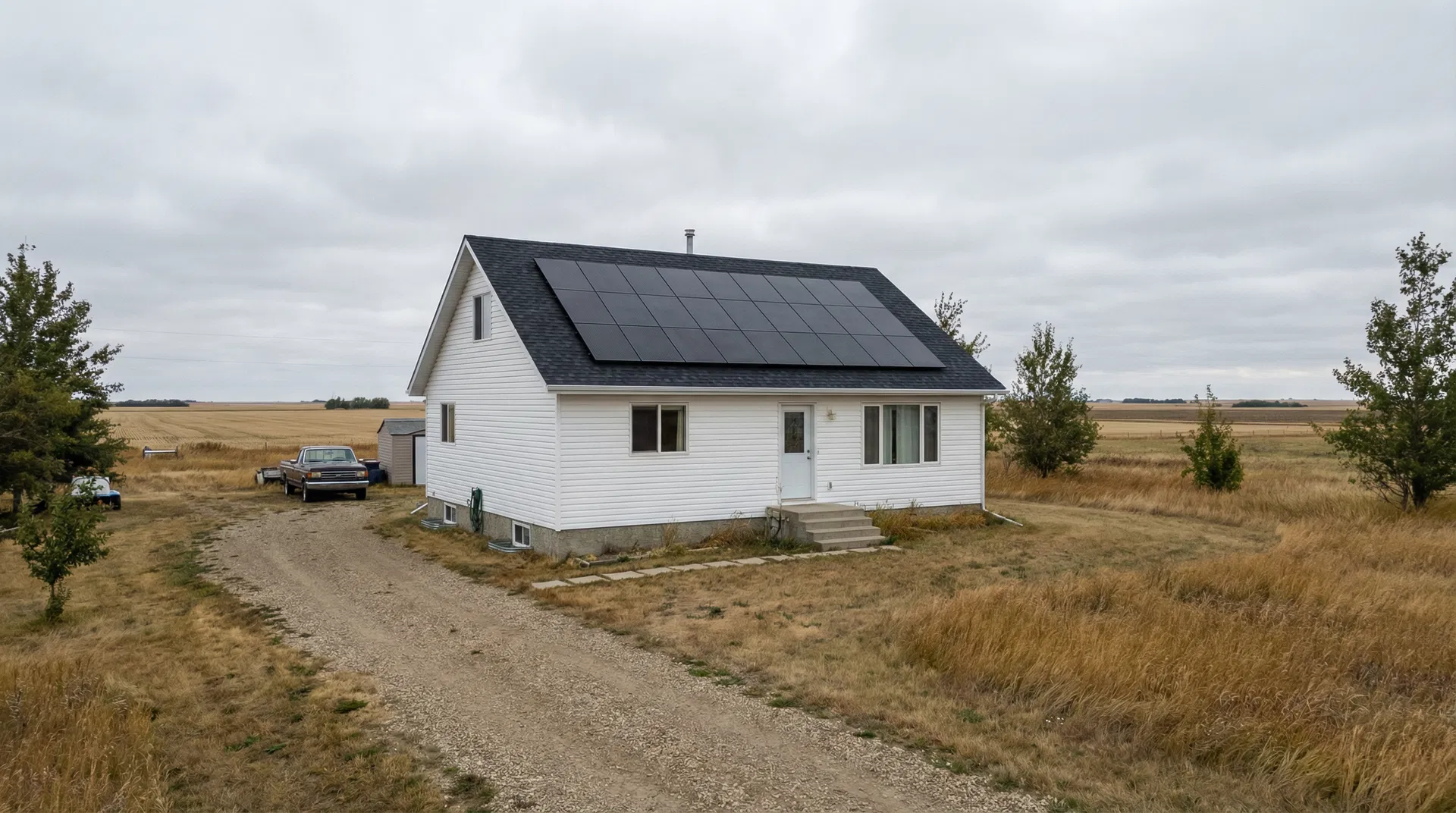
Grain handling, aeration fans, and shop equipment often mean three-phase service on ATCO farm sites, while most residences are single-phase. Inverter selection and maximum practical system size follow from which one you have, so it is one of the first things we confirm.
Meter Base Condition
ATCO will not hang a bi-directional meter on a service that does not meet current standards. We inspect the meter base and service entrance during the site review and flag any required upgrades up front, so the meter exchange happens on schedule instead of stalling your commissioning.
How the ATCO Micro-Generation Process Works
Under Alberta's Micro-Generation Regulation, a grid-tied solar system sized to your own consumption qualifies as a micro-generation unit, and ATCO Electric, as the wire owner, administers the interconnection. The process runs in a predictable sequence. First, design and application. We finalize your system design and submit the micro-generation application to ATCO with the single-line diagram, equipment certifications, and site details. Systems must be sized to your annual on-site consumption, which is one of several reasons we start from the 12-month usage history on your most recent bill. Second, review. ATCO reviews the application for grid compatibility, confirms your transformer and service can handle the export, and checks that the meter base is suitable for a bi-directional meter. On rural sites this is where line capacity and voltage rise questions get answered, and our designs account for them before submission. Typical approval time is 2 to 6 weeks for a complete application. Third, install and meter exchange. Once approval comes through, we complete the installation under electrical permit, and ATCO exchanges your meter for a bi-directional unit that measures energy flowing both directions. Fourth, net metering on your bill. Your retailer bills you for what you import and credits you for what you export. On an ATCO-territory bill, exported kilowatt-hours show up as an energy credit that offsets your consumption charges, with credits rolling forward month to month. Summer surpluses pay down winter usage, which is exactly how the regulation was designed to work.
Estimated Savings and Payback in ATCO Territory
| System Size | Annual Production | Year 1 Savings | Payback Period |
|---|---|---|---|
| 10 kW residential or acreage | 10,900 kWh | $2,500 CAD | 14.4 years (based on $36,000 installed) |
Estimates based on a 10 kW system at typical east-central Alberta irradiance and current all-in electricity costs. Southern ATCO territory sites around Taber produce more. Your numbers depend on your site, rates, and consumption.
How We Work in ATCO Electric territory
Bill and Load Review
We review your power bill to understand your energy use in ATCO Electric territory and size the system to your actual consumption, not a generic estimate.
Site Assessment
We assess your roof or ground area, south-facing exposure, electrical service, and utility interconnection requirements specific to your property.
Design and Utility Application
We produce a system layout, production estimate, and cost summary, then submit your micro-generation application to your utility on your behalf.
Installation and Commissioning
Our crew installs racking, panels, inverter, and electrical connections. All work is performed by licensed electricians. We commission and test before handoff.
Frequently Asked Questions
Get a Solar Assessment for ATCO Electric territory
Submit a recent power bill and we will review your consumption and provide an honest assessment for your ATCO Electric territory property. No obligation.
(587) 330-7502 Book a CallRelated Resources