
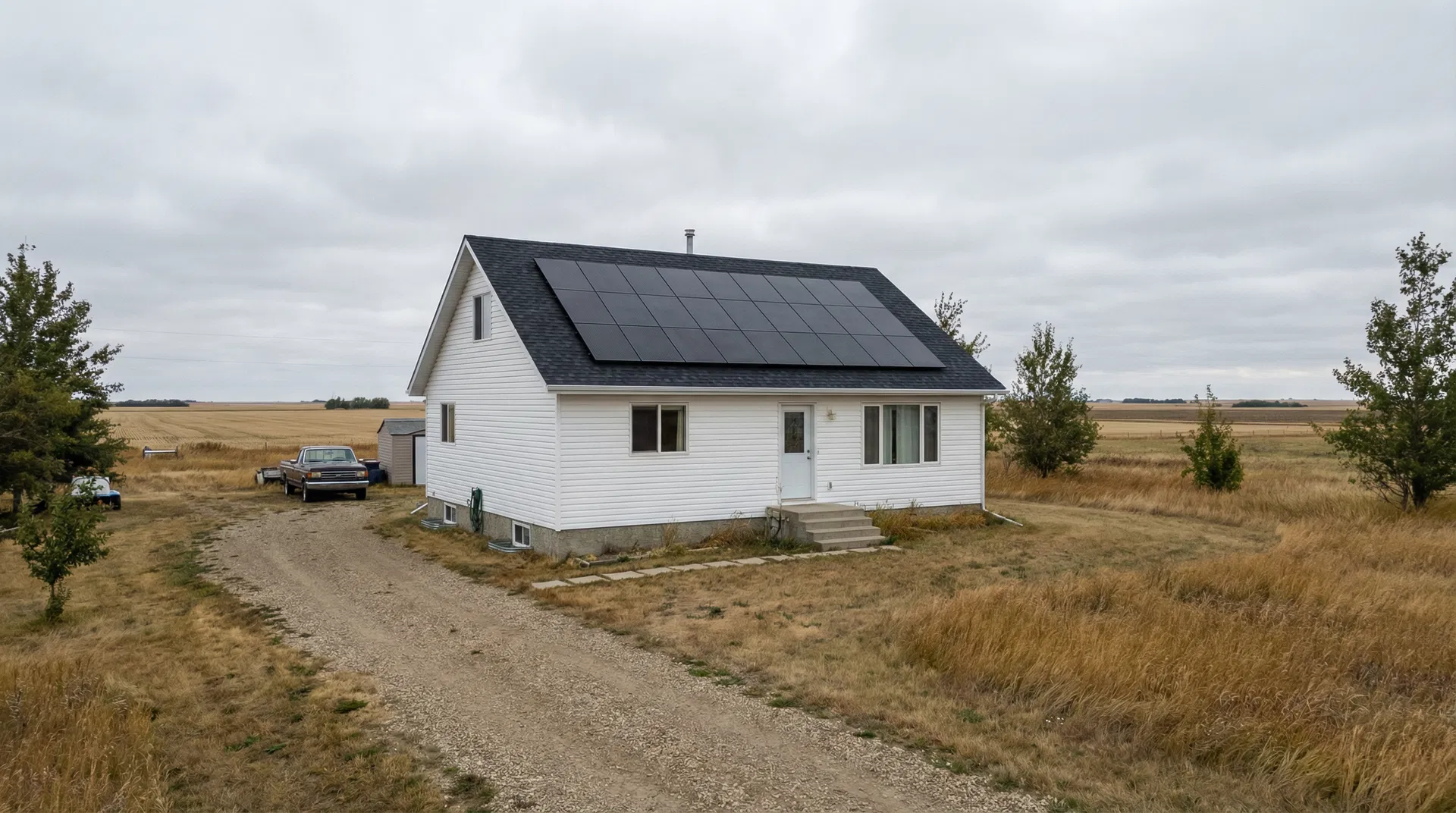
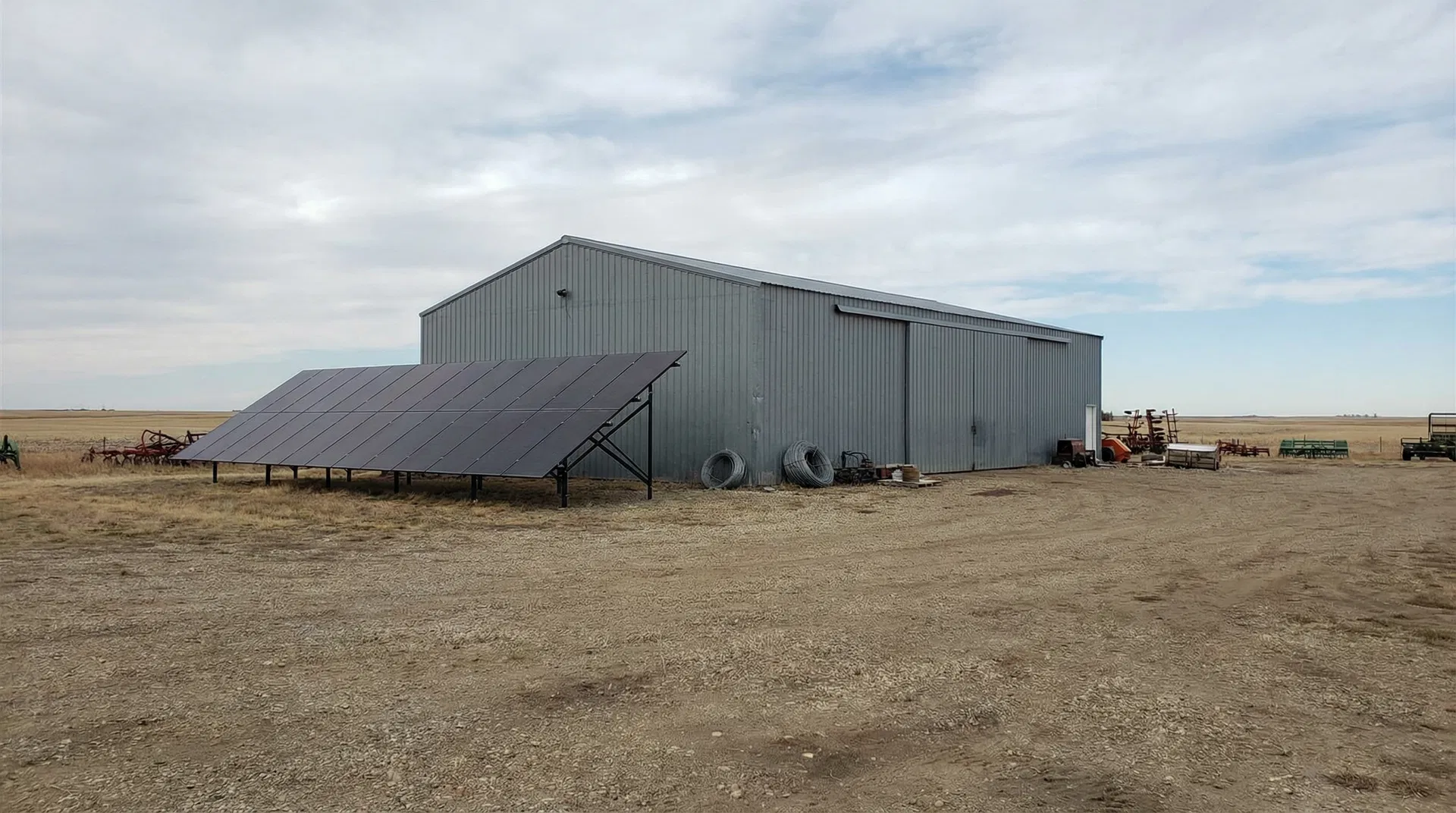
Solar cost in Drumheller, Alberta comes down to three line items: equipment, labor, and interconnection paperwork, and the equipment stays consistent no matter the property. Every install uses LONGi panels, paired with APsystems microinverters instead of a single string inverter. On a property with partial shading from a shelterbelt or an outbuilding, that per-panel approach means one shaded panel doesn't drag down the output of the whole array, which matters on acreages where trees and sheds break up a roofline. System size for this service typically runs 8 to 15 kW, with most homes landing around 10 kW once we've accounted for the loads on the property, whether that's just a house or a house plus a heated shop. Labor costs scale with roof complexity and, on some properties, whether we're doing a roof mount or a ground mount. A ground mount makes sense when a roof has poor south-facing exposure, or when there's open yard space and a roof with too many penetrations already. Interconnection paperwork is the piece homeowners underestimate: ATCO Electric requires a formal micro-generation application, and we prepare and submit that package as part of the install, not as an add-on. None of these numbers get finalized on a phone call. We price the job after a site visit and a look at your most recent power bill, because a shaded roof with three-phase service and a shop attached costs differently than an open field with a single-phase panel.
Solar Planning for Drumheller Properties
Drumheller, Alberta sits on ATCO Electric's distribution grid, and that single fact shapes almost every solar decision we make here. With a population of 7,909, this is a compact community built around a mix of acreages, in-town homes, and properties tied to the tourism economy that draws people to the Royal Tyrrell Museum of Palaeontology and the World's Largest Dinosaur. Some properties run on single-phase service, others on three-phase, and that difference changes which inverter and system size make sense. We don't start with a rule of thumb. We start with a site visit: roof pitch, shading from trees or outbuildings, panel age, and the service entrance itself. A property near the Atlas Coal Mine National Historic Site with a detached shop and irrigation pump draws power differently than a smaller in-town lot, and the design has to reflect that. Range Road Solar confirms every design outcome through an actual site review and your most recent power bill, not a canned calculator. That's the only way to land on a system size that matches what the property really uses, rather than what a generic template assumes about rural Alberta homes.
Electrical Site Review for Drumheller Properties
Voltage Rise
Voltage rise happens when the distance and wiring between a transformer and a property cause voltage to climb as an inverter pushes power back onto the line. On rural distribution circuits, where properties can sit further from the nearest transformer, that rise can be more pronounced than on a tight subdivision circuit. We factor voltage rise into inverter selection and system sizing so the inverter doesn't clip output or trip offline on a sunny afternoon.
Single-Phase vs Three-Phase
Properties in this area can have single-phase or three-phase electrical service, and that distinction isn't visual, it's in the service entrance itself. Three-phase service, common on some farm and shop setups, opens up different inverter and system capacity options than a single-phase residential service. We confirm which service type a property has before finalizing equipment, since the wrong assumption changes the whole design.
Panel Infrastructure
Rural Alberta properties often run electrical panels that are decades old, and both breaker capacity and panel age affect whether a panel can safely support a new solar system. We check the panel's rated capacity, its condition, and how much room is left for the breakers a solar system requires. If the existing panel can't support the addition, an upgrade means a new panel sized for both the home's existing loads and the solar system before installation moves forward.
Service Entrance Review
The service entrance and meter base are what ATCO Electric looks at closely when reviewing a micro-generation application, so we check the condition of both before submitting anything. A worn or outdated meter base can hold up an application even when the rest of the system design is sound. If the service entrance needs an upgrade to meet current requirements, we handle that as part of the project scope rather than leaving it as a surprise partway through.
Right-Sizing Solar for Drumheller Properties
Rural properties in this area typically need a bigger system than a comparable house in a city subdivision, and that's because there's usually more than one load to cover. A house alone is one thing, but add a heated shop, a well pump, or grain-handling equipment, and the total draw on the property climbs fast. That's a big part of why this service covers an 8 to 15 kW range instead of a single fixed size. Roof versus ground mount is the next decision, and it comes down to the property itself. If the roof faces the wrong direction, has heavy shading from trees or a nearby building, or is broken up by vents and multiple pitches, a ground mount on open yard space is often the better call, especially on acreages where land isn't the constraint it is on a smaller in-town lot. Either way, we don't size a system off a rule of thumb like watts per square foot of house. We pull the 12-month usage graph off your most recent power bill and design around what the property has actually used across a full year of seasons, plus whatever new loads you're planning, like a shop build or an EV. That bill, combined with a site visit, is what turns into a final system size, not a generic online calculator.
Typical Load Profiles We Design For Near Drumheller
Home Plus Heated Shop
This profile covers a house with an attached or detached heated shop, which is one of the most common setups we see outside town. The shop's heater, block heaters, and shop tools add a load that runs independent of the house schedule. We size the system using the combined draw shown on your most recent power bill, not just the home's typical usage.
Acreage with Well Pump and Outbuildings
Properties with a well pump, a barn, or multiple outbuildings often show usage patterns that a simple household estimate misses entirely. A well pump alone can be a meaningful chunk of a property's draw, especially with irrigation involved. We look at the full 12-month usage graph on your most recent power bill to catch these patterns before finalizing system size.
In-Town Home, Single-Family Load
A standard in-town home without a shop or major outbuildings has a more predictable load profile, closer to what you'd see in a city subdivision. These properties often land toward the lower end of the 8 to 15 kW range for this service. Even here, we confirm sizing against your most recent power bill rather than assuming a fixed number for every house on the block.
ATCO Electric Interconnection in Drumheller
Every solar install in Drumheller, Alberta connects through ATCO Electric, the wire service for this area. Before a system goes live, ATCO Electric has to review a micro-generation interconnection application specific to the property: its service size, its panel configuration, and the system design itself. Range Road Solar prepares that full package, from the electrical drawings to the equipment specifications, and submits it directly to ATCO Electric on your behalf. We don't guess at what the utility wants to see. We build the application around ATCO Electric's current requirements at the time of your project, because a submission built from outdated forms just bounces back and adds delay. Whether the property has single-phase or three-phase service, an older panel, or a newer service entrance, we account for that in the design before anything goes to ATCO Electric. Getting this paperwork right the first time is part of the install, not a separate step you manage yourself.
Project Economics and Design Review
| System Size | Annual Production | Year 1 Savings | Payback Period |
|---|---|---|---|
| 8-15 kW range, 10 kW typical |
Production, savings, and payback figures are calculated during a property-specific design review using your most recent power bill, not estimated in advance.
How We Work in Drumheller
Bill and Load Review
We review your power bill to understand your energy use in Drumheller and size the system to your actual consumption, not a generic estimate.
Site Assessment
We assess your roof or ground area, south-facing exposure, electrical service, and utility interconnection requirements specific to your property.
Design and Utility Application
We produce a system layout, production estimate, and cost summary, then submit your micro-generation application to your utility on your behalf.
Installation and Commissioning
Our crew installs racking, panels, inverter, and electrical connections. All work is performed by licensed electricians. We commission and test before handoff.
Current Program and Interconnection Review
Utility connection review
ATCO Electric reviews every micro-generation interconnection application before a system can be connected to the grid, and that review looks at the property's service, panel, and system design together. Range Road Solar prepares the full design package, including the electrical drawings and equipment specs ATCO Electric requires, and submits it on your behalf.
Current program review
Eligibility for any current commercial, farm, or residential program is reviewed against the rules in place at the time of your design, since requirements can shift year to year. We check what applies to your specific property and project scope rather than assuming a blanket answer for every install in the area.
Frequently Asked Questions
Get a Solar Assessment for Drumheller
Submit a recent power bill and we will review your consumption and provide an honest assessment for your Drumheller property. No obligation.
(587) 330-7502 Book a CallRelated Resources
More Solar Services in Drumheller