Local Solar Guides · April 2, 2026 · 7 min read
Solar in Airdrie: Your Power Company Hopes You Never Read This
Airdrie homeowners and acreage owners are paying some of the highest power bills in Canada. Here's how solar changes that math.
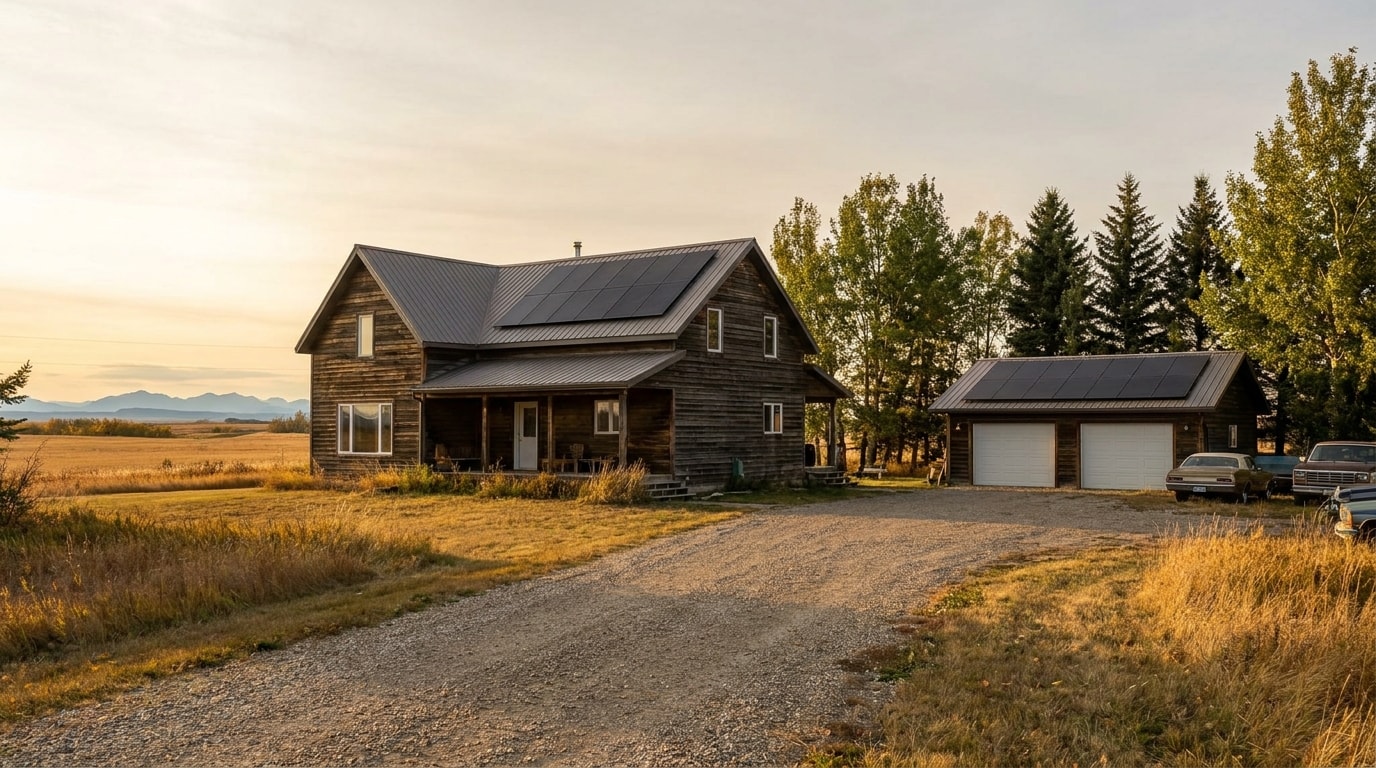
Airdrie gets over 300 days of sunshine a year. You are paying for every single one of them. Just not in the way you should be.
Your power bill is funding somebody else's retirement. That money leaves your property every month and it does not come back. Solar fixes that.
Airdrie Was Built for Solar
Southern Alberta is one of the best places in Canada to put panels on a roof. Or a shop. Or a field. Cold weather does not hurt solar. It helps. Panels run more efficiently when it is cold. Heat is the problem. Alberta winters are not.
Airdrie averages 2,396 hours of bright sunshine a year at the nearest Environment Canada reference station, and Natural Resources Canada's own solar resource maps put the specific yield for a well-oriented system in this area at roughly 1,292 kWh per kW installed, every year. That is not a marketing number. That is the federal government's data.
The city has also grown fast enough that the housing stock favours solar. Airdrie's population climbed from 61,581 people to 74,100 between the last two census counts, a jump of better than 20 percent in five years. Drive from the older grid near the Airdrie Water Tower out toward the newer subdivisions ringing Iron Horse Park and the difference is obvious: bigger lots, simpler truss rooflines, fewer dormers and chimneys to design panels around. A clean roof plane takes less labour to rack than a cut-up one, and that shows up directly in your installed cost per watt.
If you are sitting on a property in Airdrie and you are not generating your own power, you are leaving money on the table. Every month. For no reason.
How It Actually Works
Panels go on your roof or your land. They make electricity. You use what you need. The rest goes back to the grid, and FortisAlberta, the company that owns the distribution wires serving Airdrie, credits your account for it.
That is microgeneration in Alberta. It is not some experimental program. It is provincial regulation under Alberta's Micro-Generation Regulation. Your power company works for you now.
The interconnection paperwork runs through FortisAlberta specifically, not whatever retailer's name is printed on your monthly bill. We prepare and submit that micro-generation application for you, and FortisAlberta's review typically takes two to six weeks depending on current application volume. Most Airdrie homes carry a 100 A or 200 A electrical service, with 200 A common in newer builds, and either size is generally enough to connect a full residential system without a service upgrade.
In summer your system cranks out more than you use. Credits stack up at your retail electricity rate. In winter you pull those credits back down. End of the year, your power bill is close to zero. Some of our customers hit exactly zero.
That is not a sales pitch. That is math.
What It Costs
Every property is different, and the honest answer is a range, not one flat number. Roof-mount installs in the Airdrie area typically run $2.25 to $2.85 per watt installed. Ground-mount systems, which need posts, trenching, and more structure, run $2.50 to $3.50 per watt. Applied to real system sizes:
- —Small home, 6 to 8 kW roof mount: roughly $13,500 to $22,800 installed
- —Acreage home, 10 to 15 kW roof mount: roughly $22,500 to $43,000 installed
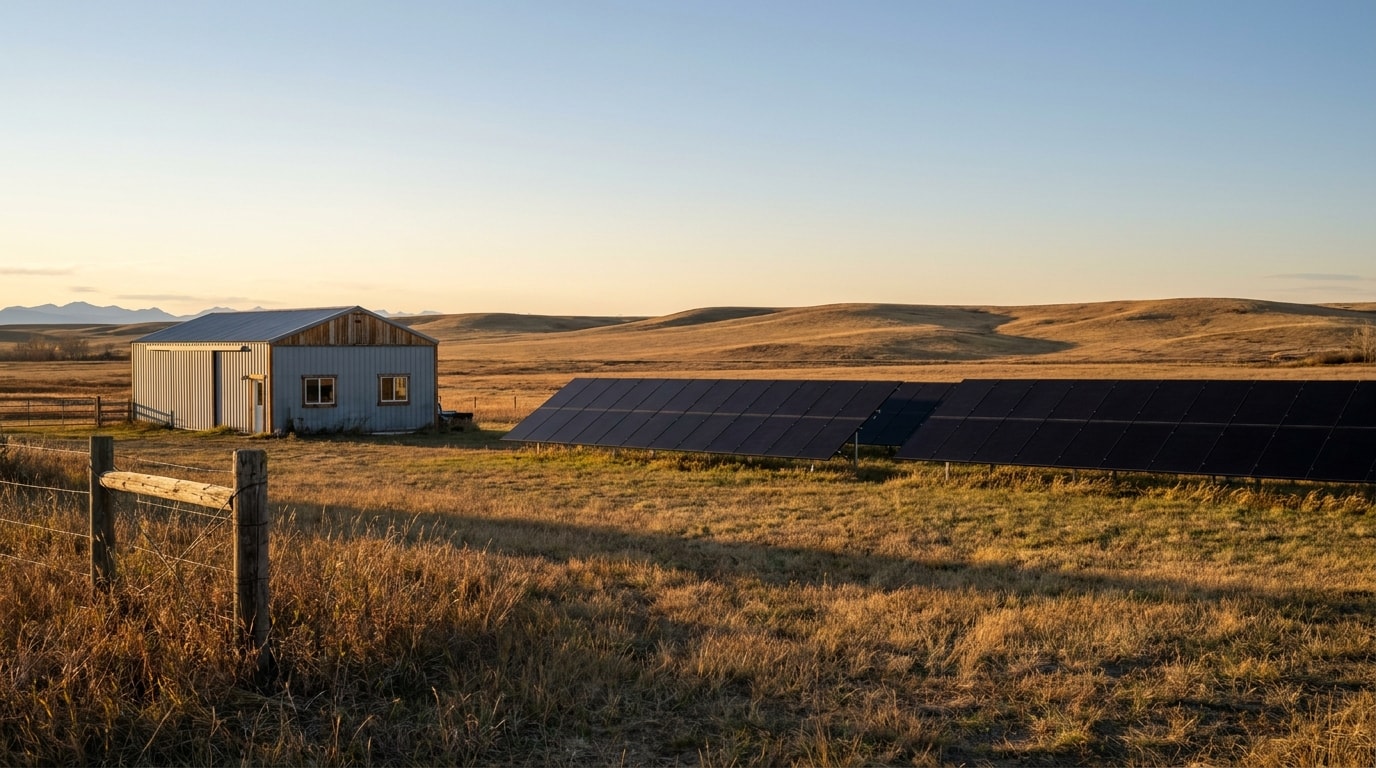
- —Shop or barn, 15 to 30 kW ground mount: roughly $37,500 to $105,000 installed, depending on size and site prep
Where your project lands inside those ranges comes down to roof complexity, panel count, inverter choice, and how much trenching a ground mount needs. We give you a real number after walking your property, not a figure pulled from a brochure.
If your farm or business is incorporated, the federal Investment Tax Credit gives you 30 percent back in year one. Your accountant will love you. Your power company will not.
Most residential systems pay for themselves in about 8 to 10 years at current Alberta electricity rates. Farm corporations with the ITC? Closer to 5 to 7. Panels carry warranties out to 25 years, so that is 15 to 20 years of essentially free power after payback. Do that math.
We break all of this down on our solar cost page. Real numbers. Not marketing numbers.
Winter in Airdrie Does Not Scare Us
Airdrie falls within a ground snow load zone of roughly 0.9 kPa, plus a 0.2 kPa rain-on-snow supplement, under the National Building Code of Canada. Standard residential panels carry mechanical load ratings of 1.6 to 2.4 kPa. The panels themselves are not the weak point in an Alberta winter.
Ground mounts are a different question, because design frost depth in the Airdrie area runs to about 1.8 metres. We typically drive helical piles to 2.0 metres or deeper, below that frost line, so posts resist both downward load and frost heave uplift over a 25-year system life. No excavation, no concrete cure time, just a pile driven to depth in an afternoon.
Airdrie also sits in the chinook belt. Warm winds move through most winters, clear the sky, and strip accumulated snow off panels faster than anyone could get a roof rake up there. Between chinooks, snow tends to slide off a smooth, dark panel surface on its own once the sun comes back out. A correctly sized system is designed around the full year, credits included, not around any single snowy week in January.
Airdrie or Rocky View County?
A lot of people say they are in Airdrie but actually live on an acreage in Rocky View County. If that is you — even better. More roof space. More open land for ground mounts. Higher power bills. Solar makes more sense on a quarter section than it does on a city lot.
We have done installs all across Rocky View. East of Airdrie, south toward Okotoks, out through the Foothills. Rural properties are not a side project for us. They are the whole point.
Why Us and Not the Other Guys
There are a lot of solar companies in Alberta right now. Most of them are from Ontario. Or they are lead generation websites that take your info and sell it to three different installers before lunch.
We are from here. Alberta-owned. Alberta-operated. 200+ installs and counting.
We install all major inverter brands, but after testing everything on the market we keep coming back to APsystems microinverters for most residential jobs. Their failure rate is the lowest we have seen. Each microinverter handles two panels, and each pair operates independently. One pair gets shaded, the rest of your system keeps producing. No single point of failure.
We show up. Give you a straight number. And go home. You call us when you are ready. That is the whole sales process.
Frequently Asked Questions
Which utility actually handles my Airdrie interconnection application?
FortisAlberta. It owns the distribution wires for Airdrie and the surrounding Rocky View County fringe, and every micro-generation application for an Airdrie address goes to them specifically. We confirm the wire owner for your exact address during the site visit rather than assuming based on a mailing address, because the paperwork has to go to the company that actually owns the lines running to your property.
What does a system actually produce here in a real winter month?
Based on local production data, a 10 kW system in the Airdrie area typically produces 400 to 650 kWh across a December or January, climbing back toward 1,000-plus kWh a month by spring. Over a full year that same system lands in roughly the 11,000 to 13,000 kWh range depending on roof orientation and shading. Winter is the slow season, not a reason to skip solar, because the credit system is built around the whole year, not any one month.
Does installing solar change my property taxes in Airdrie?
Under current City of Airdrie assessment practice, residential solar equipment is not added as a separately assessed improvement, so most homeowners see no change to their annual property tax bill after installation. If you want that confirmed in writing for your specific property, the city assessor's office will tell you directly.
How long from a signed agreement to a working system?
Usually two to six weeks. The main variable is the FortisAlberta micro-generation application, which typically takes two to six weeks to review on its own. We schedule the install crew around that approval window so there is minimal dead time once FortisAlberta signs off.
Get a Real Number for Your Property
Free site assessment. No pressure. We come out, look at your roof or your yard, check your electrical panel, and give you an honest quote within 48 hours.
No sitting at your kitchen table for two hours hoping you will sign something. That is not how we work.
If you are in Airdrie or anywhere nearby, book an assessment and find out what solar actually costs for your place. Not a guess. Not a range from a website. Your number.
Ready to get a real number for your property?
Send us your most recent power bill. We will review your consumption and give you an honest design and cost estimate. No obligation.
Range Road Solar Team
Rural Alberta Solar Installers
Our team has been installing solar across rural and central Alberta since 2019. Over 218 installs on farms, acreages, shops, and homes. We write about what we have actually seen in the field — not what the brochures say.
Serving Airdrie & Area