
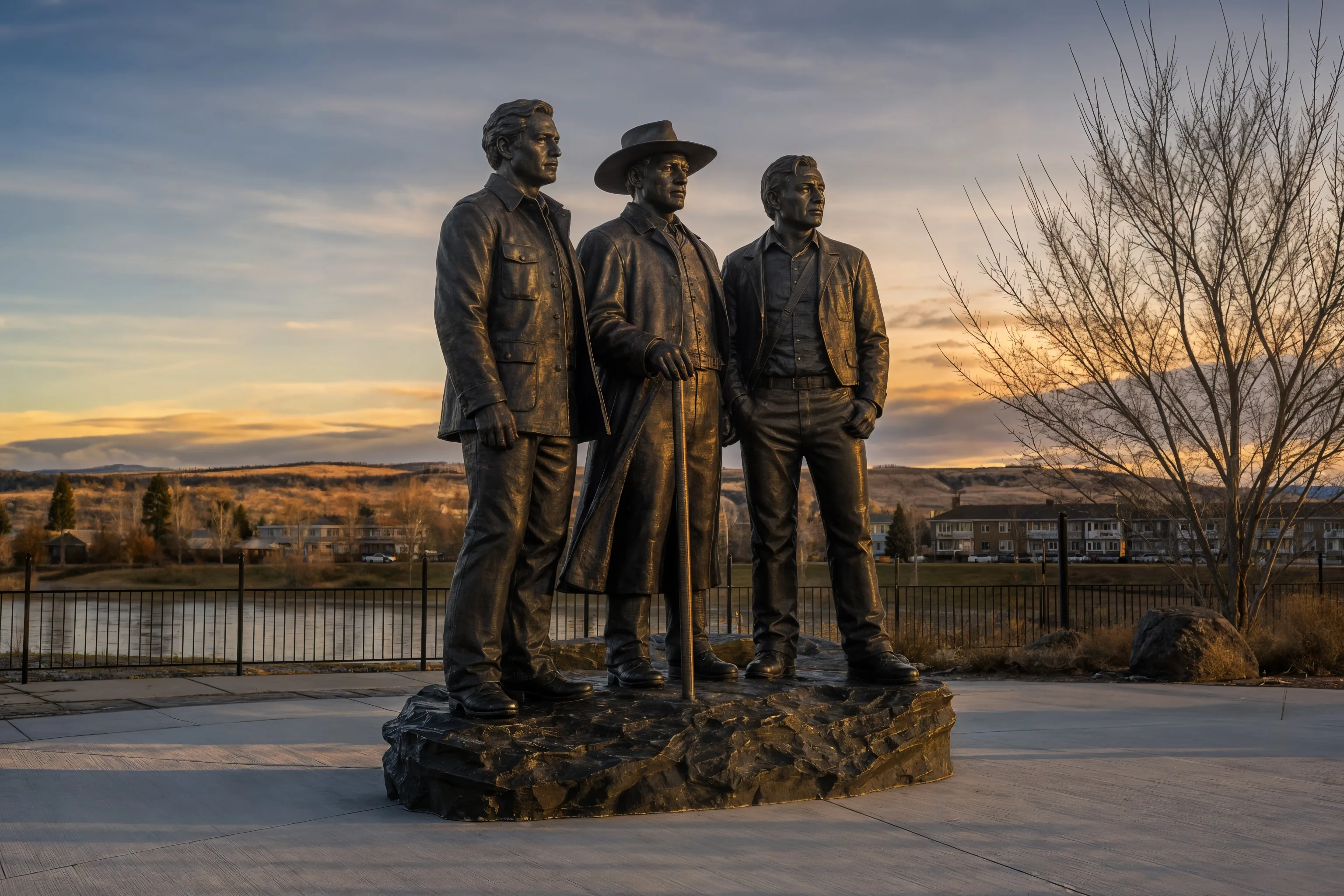
Cochrane by the Numbers
Cochrane sits at 51.19 degrees north in Rocky View County, on the Bow Valley corridor between Calgary and the front ranges. It counted 32,199 residents in the 2021 census and sits around 37,000 today, making it one of the fastest-growing towns in Alberta. Founded in 1881 around the Cochrane Ranche and the Canadian Pacific line, it still has its historic downtown, but the growth is in new subdivisions on the benchlands and in acreage development pushing out along Highway 22, the Cowboy Trail.
For solar buyers, the numbers that matter are the ones below. Every one of them feeds directly into how we size, price, and engineer a system here, and none of them are regional averages borrowed from somewhere else.
51.19 N
Latitude, same solar band as Calgary
2,396 hrs
Annual bright sunshine, Environment Canada normals (Calgary Int'l A station)
1,292 kWh/kWp
NRCan PV potential specific yield for this area
FortisAlberta
Wire service for Cochrane and the surrounding county
S2 / R3
Snow load zone and wind load zone used for racking design
55 min
Drive from our Airdrie office, about 65 km door to door
Chinook Country Is a Solar Advantage
People assume foothills weather works against solar. In Cochrane it mostly works for it. Chinook winds roll down the eastern slopes, push winter temperatures above freezing for days at a stretch, and strip snow off rooftops in hours. A panel that would be buried for weeks in Saskatchewan gets a clear glass surface again by lunchtime. Bright sunshine totals near 2,400 hours a year at the nearest long-term Environment Canada station, and the cold, clear air behind a chinook actually improves panel efficiency, since panels produce more power the colder they run.
The trade-off is mechanical, not electrical. Cochrane is wind zone R3 and snow zone S2, and exposed benchland lots on the west side catch more of both than sheltered in-town streets. That is why racking hardware and attachment spacing here are specified for this county's load tables, not Calgary's. It is a real engineering difference, and it costs nothing extra to get right if it is designed in from the start.
Your Wire Service Is FortisAlberta
Every Cochrane address, in town and in the surrounding county, is wired by FortisAlberta. You choose your energy retailer, but FortisAlberta owns the poles, the lines, and the meter. Under Alberta's Micro-Generation Regulation, your solar application goes to FortisAlberta, and once approved, your meter runs both directions: you draw power when you need it and bank a credit when your panels outproduce the house.
We handle the FortisAlberta paperwork as part of every project. Standard residential systems under your service capacity are typically approved without any distribution upgrades. The credit you earn for exported power rides on your retailer rate, which is one reason we review your actual bills before sizing anything: the right system size depends on how you use power, not on a salesperson's target.
Three Cochrane-Area Load Profiles We Size For
Cochrane is really two markets. There is the town itself, full of newer subdivisions and heritage homes near downtown, and there is the acreage belt along Highway 22 and the surrounding Rocky View County range roads, where properties run wells, shops, and barns. The bills look nothing alike, so the systems should not either. These are honest ranges from the bills we see, not promises.
| Property | What drives the load | Typical monthly bill | System that usually fits |
|---|---|---|---|
| Town bungalow, in-town Cochrane | Natural gas heat, standard appliances, no pool or hot tub | $90 to $170 per month | 6 to 8 kW roof system usually covers most of the year |
| Acreage home off Highway 22 (Cowboy Trail) | Well pump, septic lift, detached shop, often baseboard or electric backup heat | $240 to $450 per month | 9 to 12 kW roof or ground system |
| Horse or ranch property in the county fringe | Heated shop, barn lighting, water trough heaters, arena equipment | $400 to $750 per month | 12 kW and up, often ground mount on open pasture |
If your property blends two of these, that is normal. Acreage owners in this corridor frequently add a shop after the house system goes in, so we design electrical capacity with room to grow.
What Solar Costs in Cochrane
Roof-mount systems run $2.25 to $2.85 per watt installed, and ground-mount systems run $2.50 to $3.50 per watt. Worked honestly across that range: a 6 to 8 kW roof system on a town bungalow runs roughly $13,500 to $22,800 installed depending on the roof and equipment. A 10 kW ground mount on an acreage runs roughly $25,000 to $35,000.
What moves a quote inside that range is concrete: roof pitch and material, how much shading the surrounding terrain throws, the distance from panels to panel box, whether your service needs anything, and the equipment tier you pick. We quote LONGi panels with APsystems DS3 microinverters or Solis string inverters as standard, and we put a NRCan-based production estimate in writing before you commit to anything.
Here is how payback typically pencils out for this area, using the NRCan yield above, your FortisAlberta-delivered power, and a typical all-in residential rate of roughly 12 to 15 cents per kWh. Treat these as estimates to be refined against your own bills, not guarantees.
| System size | Mount type | Annual output (NRCan) | Installed cost | Typical annual offset | Payback, today's rates |
|---|---|---|---|---|---|
| 6.5 kW | Roof mount | ~8,400 kWh/yr | $14,600 to $18,500 | $1,050 to $1,260/yr | Roughly 13 to 16 years |
| 7.6 kW | Roof mount | ~9,870 kWh/yr | $17,100 to $21,700 | $1,230 to $1,480/yr | Roughly 13 to 16 years |
| 10 kW | Ground mount | ~12,900 kWh/yr | $25,000 to $35,000 | $1,610 to $1,940/yr | Roughly 14 to 21 years |
Every year power rates climb, those payback windows pull in. Panels carry 25-year linear output warranties, so a system that pays for itself in the mid-teens has a decade or more of net savings ahead of it. That is the economics case, plain.
Built for Foothills Weather: Snow, Wind, and Frost
Rocky View County maps to snow zone S2, and Cochrane's exposed benchland catches real wind in wind zone R3. We specify racking and attachment patterns to those load tables as a baseline, then adjust for your specific roof and lot exposure. Panels themselves are certified well beyond S2 snow loads, so the structure, not the glass, is what engineering is for.
Frost is the other local factor, mostly for acreage ground mounts. Design frost depth in this part of Alberta runs about 1.8 metres, so ground-mount posts go in at 2 metres or deeper to stay below the heave line. Rocky View County soils can be full of cobbles and till, which is exactly why we favour helical piles on acreages: they screw to depth without excavating a single hole, and they handle the wind loads of an open field.
On the roof side, chinooks do most of the snow clearing for you. Steeper pitches shed faster, so on new builds and reroofs around Cochrane we will typically pitch panels at or above 30 degrees where the roof allows. On shallow roofs the production math still works; you just carry a slightly larger winter snow-loss factor in the estimate.
55 Minutes From Our Airdrie Office
Our office is in Airdrie, about 65 kilometres and a 55-minute drive from Cochrane via Highway 22 or the Trans-Canada, depending on which side of the valley you are on. That is close enough that your site assessment is done by the people who will actually design and install your system, not a subcontractor reading a satellite photo.
It also means scheduling stays tight. We batch Cochrane and Rocky View County site visits together, so assessments and follow-ups book quickly. From design approval, expect two to six weeks to a commissioned system: most of that window is the FortisAlberta micro-generation application and permitting, and the physical install on a town lot is usually one to three days.
We have done hundreds of installs across Alberta, and the Bow Valley corridor towns are among our most frequent drives. If you have got a bill handy, we can usually tell you on the first call whether your roof, your load, and your rate make solar worth pursuing.
How a Cochrane Install Runs
Bill Review and Site Assessment
We read the 12-month usage graph on your FortisAlberta-delivered bill, then walk the property. Roof condition, shading from the valley walls, service capacity, and ground-mount options if you have the land.
Design, Quote, and FortisAlberta Filing
You get a written production estimate based on NRCan data for the Cochrane area, a fixed price, and an honest payback range. We file the micro-generation application with FortisAlberta on your behalf.
Permits and Equipment
Town of Cochrane or Rocky View County permits, equipment ordering, and scheduling. This is where the two to six week window is usually spent.
Install and Commission
Licensed electricians install racking, panels, inverter, and connections. Inspection, meter coordination, and then your system goes live and starts banking credits.
Frequently Asked Questions
Straight answers for Cochrane and the surrounding Rocky View County acreage belt.
Get a Solar Design for Your Cochrane Property
Send us a recent power bill and we will come walk your roof or your acreage, then give you a written production estimate and a fixed price. If the numbers do not work for your property, we will tell you that too.
Want rough numbers first? Run your estimated payback through our solar ROI calculator.
More Solar Services in Cochrane
Also Serving Nearby Communities