
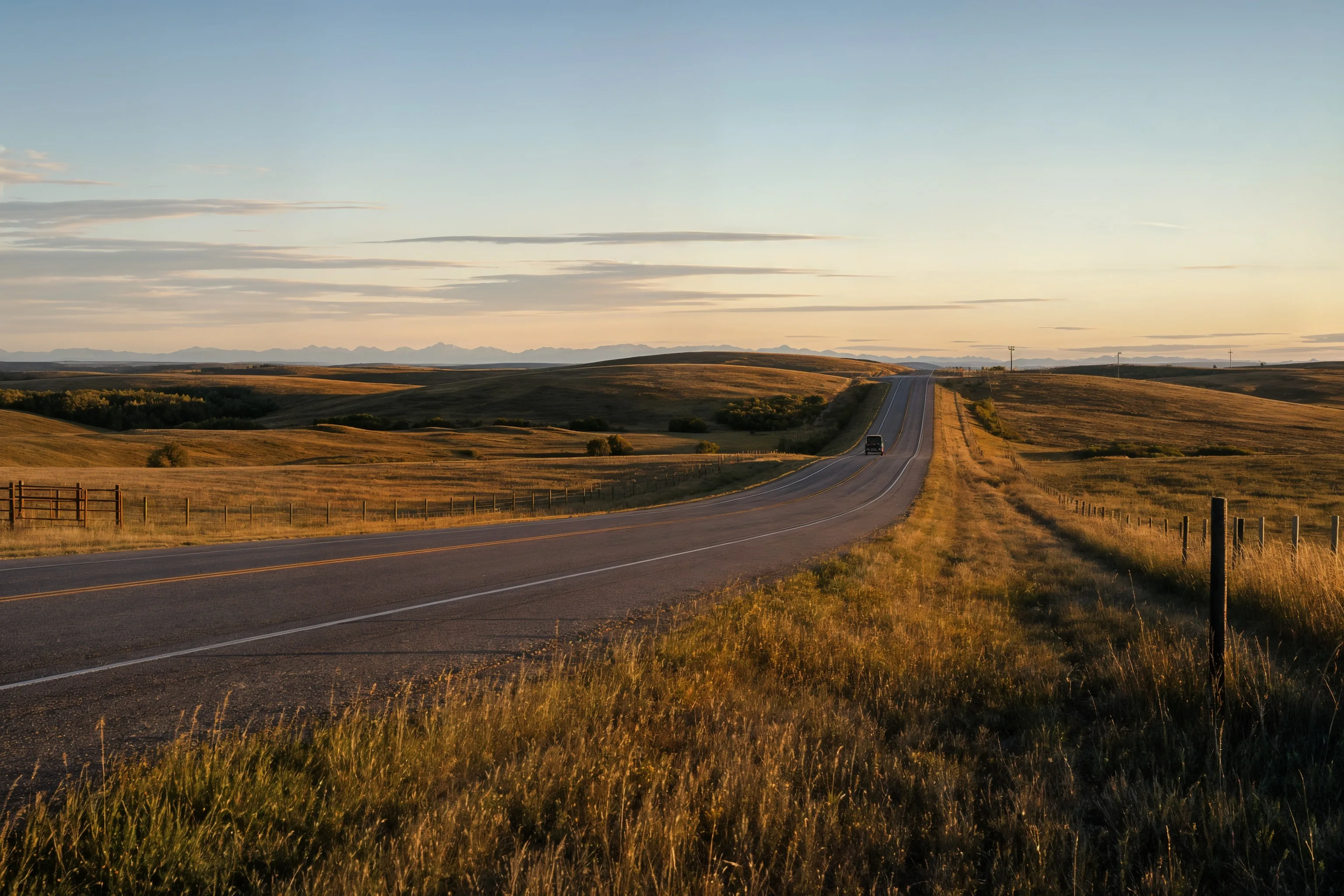
The Numbers Behind Foothills County Solar
Foothills County is a rural municipal district of about 23,000 people wrapped around the High River area, stretching from Heritage Pointe in the north down through Black Diamond, Turner Valley, and Millarville to Longview in the south. It sits near latitude 50.60 N, squarely in Alberta's best solar band. Environment Canada climate normals put bright sunshine here at roughly 2,385 hours a year, and the chinook belt does the rest: long clear winter days after a wind event more than make up for the short ones around solstice.
Natural Resources Canada's PV potential maps back that up with hard yield data. A 7.6 kW system at a typical Foothills County site produces roughly 9,850 kWh a year. That is enough to cover the full annual consumption of an efficient acreage home with room to spare, or a serious dent in a heated barn's winter draw. We use NRCan yield figures for your specific location in every production estimate we hand you, not a province-wide average.
Structural design is set by two code inputs that matter here: snow zone S2, a moderate ground snow load across the county, and wind zone R4, which reflects how hard chinooks hit exposed ridge-top and open-range sites. Racking is engineered to both. Footings go below the roughly 1.2 metre frost depth typical of the region, so frost heave never works a post loose over the 25 to 30 year life of the array.
~50.60 N
Latitude, prime Alberta solar band
2,385 hrs
Annual bright sunshine, Environment Canada normals
9,850 kWh/yr
From a 7.6 kW system, NRCan PV potential
S2 / R4
Snow zone and wind zone for racking design
Who Owns the Wires on Your Foothills County Property
Most rural properties in Foothills County are wired by FortisAlberta. That covers the bulk of the acreages and farmsteads along Highway 2 toward High River and down the Cowboy Trail corridor through Black Diamond, Turner Valley, and Longview. But county service areas are not perfectly uniform, and some properties sit near boundaries where the wire service provider changes. We confirm the provider against your legal address during the site assessment before anything is designed, so the interconnection paperwork goes to the right utility the first time.
Under Alberta's micro-generation regulation, a grid-tied system exports surplus power and earns a credit on your bill. The application, metering changes, and permission-to-operate all run through your wire service provider. We file that paperwork for you as part of the project, alongside the electrical permit and inspection booking. You sign where indicated and we handle the rest.
Rural service brings design details urban crews rarely see: long service runs, single-phase and three-phase entrances, older fuse panels, and meter bases that predate modern load centers. Every one of those affects how a solar system ties in and whether a service upgrade comes first. Checking the service entrance is a standard part of our Foothills County assessment, not a surprise line item after contract.
Chinook Country: What It Means for Your Array
Ask anyone who keeps horses in Millarville or cattle near Longview about the weather and you will hear about chinooks. Warm downslope winds off the mountains can swing temperatures 20 degrees in an afternoon, and they strip snow off exposed ground fast. For solar, that is genuinely useful: a tilted ground-mount array or a standing-seam metal barn roof sheds its snow sheet within hours of a chinook, where a shallow shingle roof in a colder corner of the province might hold cover for weeks. Snow cover days are already baked into our production estimates for the county.
The same wind that clears your panels tests the racking. R4 wind exposure plus open, treeless range means we specify heavier post schedules and tighter engineering on exposed sites than we would in a sheltered Calgary suburb. Hardware is rated and torqued for vibration cycles, and every ground mount we set goes in below the frost line so spring thaw never shifts a footing.
If your yard sits in a wind-sheltered spot, a coulee floor near Turner Valley or behind a treeline outside Black Diamond, the design can be lighter and cheaper. That is why we walk the site instead of quoting from a satellite photo. Two properties five kilometres apart can justify different racking, and the honest quote reflects the one you actually have.
Three Properties We See All Over This County
Foothills County is horse ranch and acreage country, and its load profiles cluster into three shapes. These bill figures are honest typical ranges from FortisAlberta rural accounts we see, not promises. Your bill decides the design.
The horse ranch with a heated barn
Think Millarville, the Heritage Pointe corridor, or the acreages northwest of High River. Arena lighting, heated waterers, barn fans, and a heated shop push winter bills into the $400 to $900 a month range, with annual consumption often 12,000 to 25,000 kWh. These properties usually fit a 12 to 25 kW system, frequently a ground mount beside the arena where orientation is perfect.
The acreage home with a shop
The classic two-acre place off Highway 2 or down a range road near Cayley or Blackie: house, detached or pole-barn shop, maybe a welder and a compressor. Bills typically run $250 to $500 a month, annual use 8,000 to 14,000 kWh. An 8 to 12 kW system covers most of that. If the shop has a newer metal roof, racking goes on cheap and easy.
The cottage or small hobby farm
Weekend places and small holdings around Turner Valley, Black Diamond, and the Longview fringe, often with well pumps and freezers running year-round. Bills of $150 to $350 a month, 4,000 to 8,000 kWh a year, fit a compact 5 to 8 kW system. Solar pairs well here because even modest offset compounds over decades of ownership.
Every one of these profiles has a different sweet spot for system size, and oversizing past your usage stops paying back the day the array is commissioned. That is why our first step is always the 12-month usage graph on your bill, matched against NRCan yield for your exact site.
What It Costs and What Comes Back
Our pricing is the same honest range on every page of this site. Rooftop systems run $2.25 to $2.85 per watt installed. Ground mounts run $2.50 to $3.50 per watt, reflecting the racking, trenching, and footings a proper rural ground mount needs. Worked through, a 7.6 kW rooftop system runs roughly $17,100 to $21,660 installed depending on the roof and equipment, and a comparable ground mount runs higher still.
The table below uses a 7.6 kW system producing roughly 9,850 kWh a year at a Foothills County site (NRCan PV potential) and typical all-in rural Alberta residential rates of roughly 25 to 32 cents per kWh in recent years, including distribution, transmission, riders, and energy. These are estimates: your rate class and usage decide the real number, and we model yours from the bill before you sign anything.
| Profile | Typical monthly bill | 7.6 kW covers | Rough annual savings |
|---|---|---|---|
| Heated-barn ranch | $400 to $900 | 35 to 70% of use | roughly $2,460 to $3,150 |
| Acreage home with shop | $250 to $500 | 70 to 100% of use | roughly $2,460 to $3,150 |
| Cottage or hobby farm | $150 to $350 | 100%+ of use | capped near your bill, roughly $1,500 to $3,150 |
On those numbers, a rooftop system in Foothills County typically pays back in roughly 8 to 12 years, with panels warranted for 25 to 30 years of output. Every year after payback is money the array was not spending. Panels carry 25-year linear output warranties; inverters run 10 to 15 years and get priced into long-term planning, not hidden from it.
Our standard install timeline runs two to six weeks from permit approval to energization, and the FortisAlberta interconnection filing runs in parallel. We schedule Foothills County work in county batches so you are not paying for a truck that drove down empty.
From Our Airdrie Shop to Your Foothills County Gate
Range Road Solar is based in Airdrie. From the shop to a property near High River it is about 75 km and 65 minutes down Highway 2; to Longview it is a longer run west on Highway 22. We batch site assessments into same-day county runs, usually pairing an assessment with an install or two in the area, which keeps your wait measured in days rather than weeks.
Bill Review by Phone
Send a photo of your FortisAlberta bill. We read the 12-month usage graph and tell you straight whether solar pencils out for your property, and roughly what size would fit.
On-Site Assessment
We walk the roof or yard site, check shading, confirm your wire service provider, and inspect the service entrance, meter base, and panel on the same visit.
Design and Quote
You get a layout, an NRCan-based production estimate for your coordinates, and a fixed price using the $2.25 to $2.85 per watt roof range or $2.50 to $3.50 per watt ground range.
Permits and Interconnection
We file the electrical permit, book the inspection, and submit the FortisAlberta micro-generation application in your name. Standard install timeline is two to six weeks.
Install Day
Crew and materials arrive staged together. Racking, panels, inverter, and tie-in are done by licensed electricians, with the ground disturbed only where footings and trenching require it.
Inspection, Metering, Commissioning
The authority having jurisdiction inspects, your utility sets bi-directional metering, and the system is commissioned. Monitoring is live from day one and we handle warranty paperwork.
Where We Work in Foothills County
We serve the full county: acreages around the High River area, the Highway 2 corridor through Heritage Pointe and down toward Cayley and Blackie, and the Cowboy Trail (Highway 22) communities of Black Diamond, Turner Valley, and Longview, plus Millarville and the ranch country west of it. Highway access in both directions is exactly why batching county work keeps response times short.
Most of our work is on acreages, horse properties, and farmsteads, so our crews are used to dogs that greet the truck, gates that need latching, and biosecurity requests around livestock. Tell us what your operation needs on the assessment visit and the plan will respect it. If you are just over a boundary in an adjacent municipality, call anyway and we will confirm whether the drive makes sense.
Foothills County Solar Questions, Answered Straight
See Your Foothills County Numbers
Send your latest FortisAlberta bill and we will model production for your exact site using NRCan yield data, quote the real installed price, and tell you honestly if solar does not pencil out for your property. No obligation either way.
Also Serving Nearby Communities