
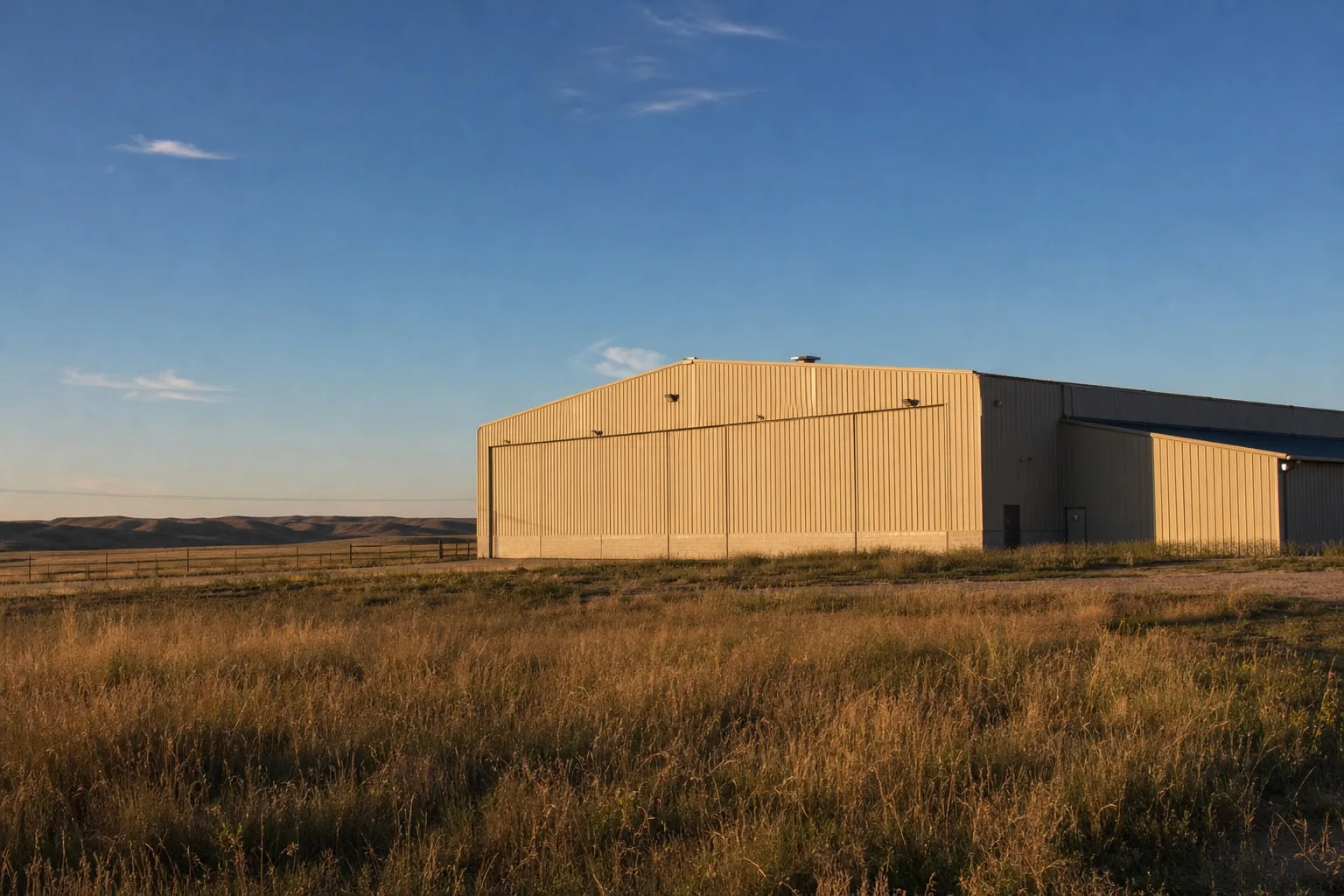
A Ranching Town With a Famous Bomber
Nanton was incorporated as a village in 1903 and became a town in 1907. Its population sat at 2,167 in the 2021 census, down slightly from 2,181 in 2016. The town's best-known landmark is the Bomber Command Museum of Canada, home to Avro Lancaster FM159, one of only 17 surviving Lancasters in the world and one of just four with fully operational engines able to taxi under their own power. Nanton's own heraldic emblem is a Wyvern, and the town also has the Canadian Grain Elevator Discovery Centre, a rare surviving example of the wooden elevators that once lined every prairie rail line.
Nanton sits inside the Municipal District of Willow Creek No. 26, the same municipality as Claresholm, Stavely, and Granum, with the Porcupine Hills rising to the west. That terrain matters for solar siting: properties closer to the hills can pick up more tree and hill shading than the open ranchland and grain country to the east, which is something we check at the site visit with a solar pathfinder rather than assume.
FortisAlberta is the distribution utility across the whole MD, town and ranch alike, so the wire owner does not change as you drive out past the edge of town. What changes is the load, from an ordinary town bungalow to a cattle operation running stock waterers, a heated shop, and calving-season equipment through a Porcupine Hills winter.
The nearest Environment Canada bright-sunshine normal, Calgary International Airport, logs 2,396.3 annual hours. NRCan's own location-specific yield figure for Nanton is about 1,330 kWh per installed kilowatt a year.
Three Load Profiles We See Around Nanton
Town bungalow near the main street: a three-bedroom home on a standard lot, typical bills in the $150 to $220 a month range through winter. A 6 to 7.6 kW rooftop system usually offsets most of that across the year.
Cattle operation toward the Porcupine Hills: stock waterers, a heated calving barn, and shop equipment push bills into the $350 to $800 a month range depending on herd size and season. These properties usually land a 12 to 25 kW ground-mount system, sized from the ranch's own consumption.
Grain operation on the open ground east of town: augers, aeration fans, and grain dryers at harvest create seasonal spikes on top of a steady base load, often $300 to $700 a month averaged across the year. A 15 to 25 kW ground mount is typical here.
What the Numbers Look Like at 50.35° North
Nanton sits at roughly 50.35 degrees north, 113.78 degrees west. NRCan's location-specific yield figure of about 1,330 kWh per installed kilowatt a year puts a well-oriented 7.6 kW system at roughly 10,100 kWh annually, and a 10 kW array at about 13,300 kWh. The smaller system comfortably covers a town bungalow; the larger starts to make a real dent in a ranch or grain operation's bill.
In hardware terms, a 7.6 kW system is roughly 17 to 19 panels at today's 400 to 450 W ratings, and a 10 kW array is closer to 22 to 25 panels. A typical town roof carries the smaller array comfortably; the ranches and farms around Nanton generally have the roof or ground area for the larger one. These are starting points; your real yield depends on orientation, tilt, shading from the Porcupine Hills terrain, and actual consumption.
Nanton falls in Alberta's snow-load zone S2 and wind-load zone R4. We engineer racking, flush rooftop rails in town or driven piles on a ranch ground mount, to those figures, which matters given how exposed open ranchland near the hills is to wind.
The Gear We Put on Nanton Roofs and Ranches
We build with LONGi panels, hail-tested to 35 mm stones at 97 km/h and backed by a 25-year product warranty. Residential and acreage systems pair them with APsystems microinverters, so a shaded chimney or a snow drift on one corner of the array does not drag the whole system down. Larger ranch and farm strings run on Solis inverters, with battery storage available where a calving operation wants backup through an outage.
Every install is done by licensed Alberta electricians and engineered for the same Porcupine Hills winter whether it sits on a town bungalow or a shop roof out on a ranch.
What You Can Actually Claim Around Nanton
Town homeowners are on their own here. Alberta scrapped its residential rebate program, so a system on a Nanton house earns its keep purely through lower bills over the warranty period, already factored into the figures elsewhere on this page. Incorporated operations have a better deal: the federal investment tax credit refunds 30 percent of installed cost, a meaningful dent in the bill for any ranch or farm business structured as a corporation. Exactly which programs a given operation can stack is something we work out together at the assessment, property by property.
Federal Investment Tax Credit (30%)
For incorporated ranches, farms, and businesses. Cuts net installed cost by close to a third in the first year.
Agricultural Sector Funding
Federal-provincial programs that can support equipment investment on qualifying Willow Creek No. 26 operations, depending on the intake window.
How a Nanton Project Runs, Start to Grid
Bill Review
Send us a recent power bill. We read your consumption and pin down the right system size for your roof or ranch.
Site Visit
We assess roof condition, ground for piles, shading from the Porcupine Hills terrain, and electrical service.
Design and Fixed Quote
A layout, a production estimate, and one price, with roof and ground-mount options compared side by side on ranch properties.
Permits and FortisAlberta Filing
We pull building and electrical permits and submit the FortisAlberta micro-generation application ourselves.
Installation
Rails and panels on a town roof, or piles, racking, and array in the yard, all by licensed Alberta electricians.
Commissioned and Connected
Inspected, commissioned, and switched onto the FortisAlberta grid. The meter starts earning credit.
Nanton Solar: Questions We Hear Most
See what our clients say
Real reviews from Alberta homeowners and ranchers.
Free Solar Assessment for Nanton
Town lot, ranch, or farm; tell us which and we will size it. No obligation.
Also Serving Nearby Areas
Town Roof or Ranch Ground Mount: Let's Run the Numbers
Grab a recent power bill and give us a call. We will turn that into a real system size and a fixed number for your Nanton property, no padded estimate, no hard sell.
Also Serving Nearby Communities