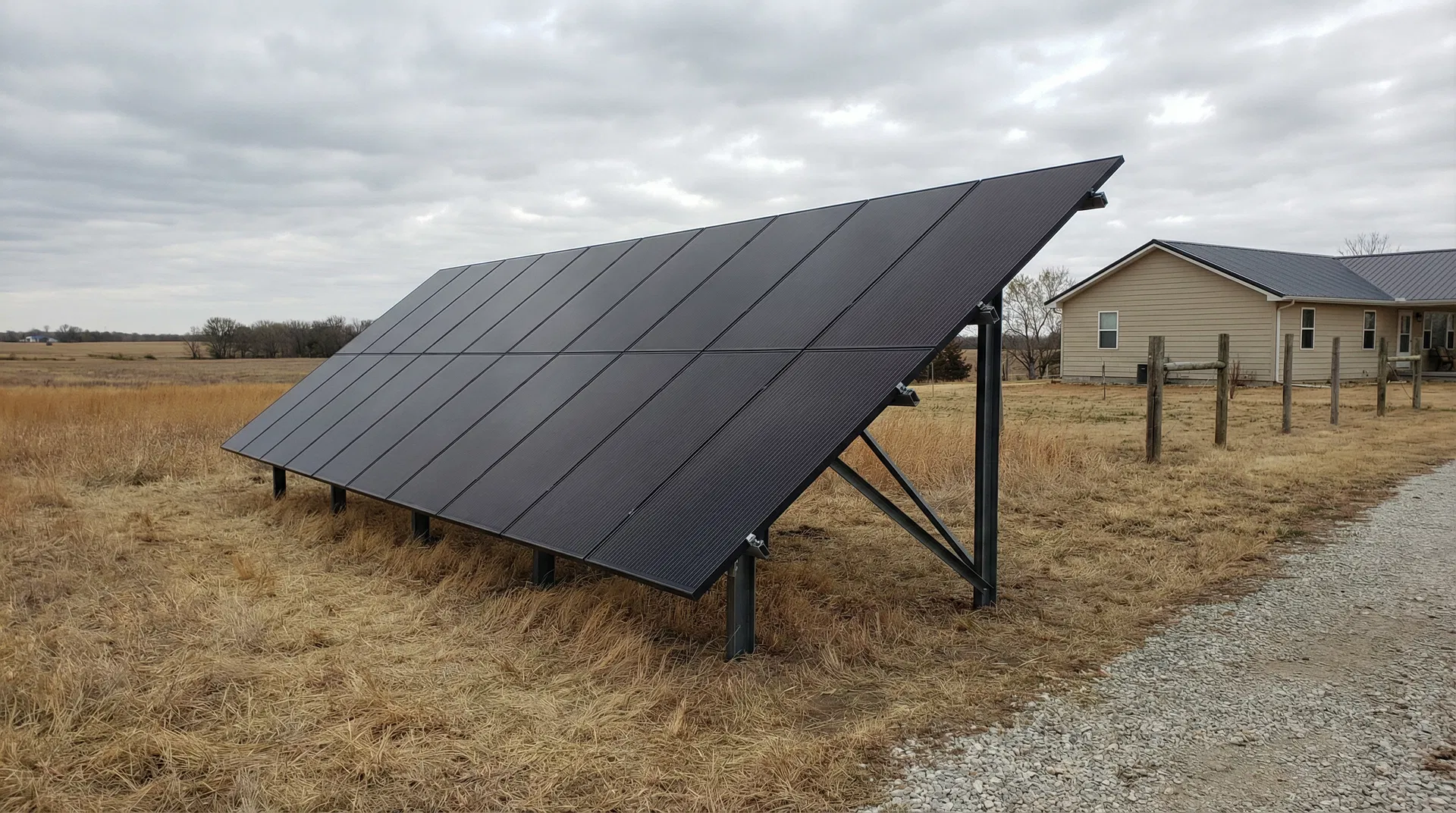
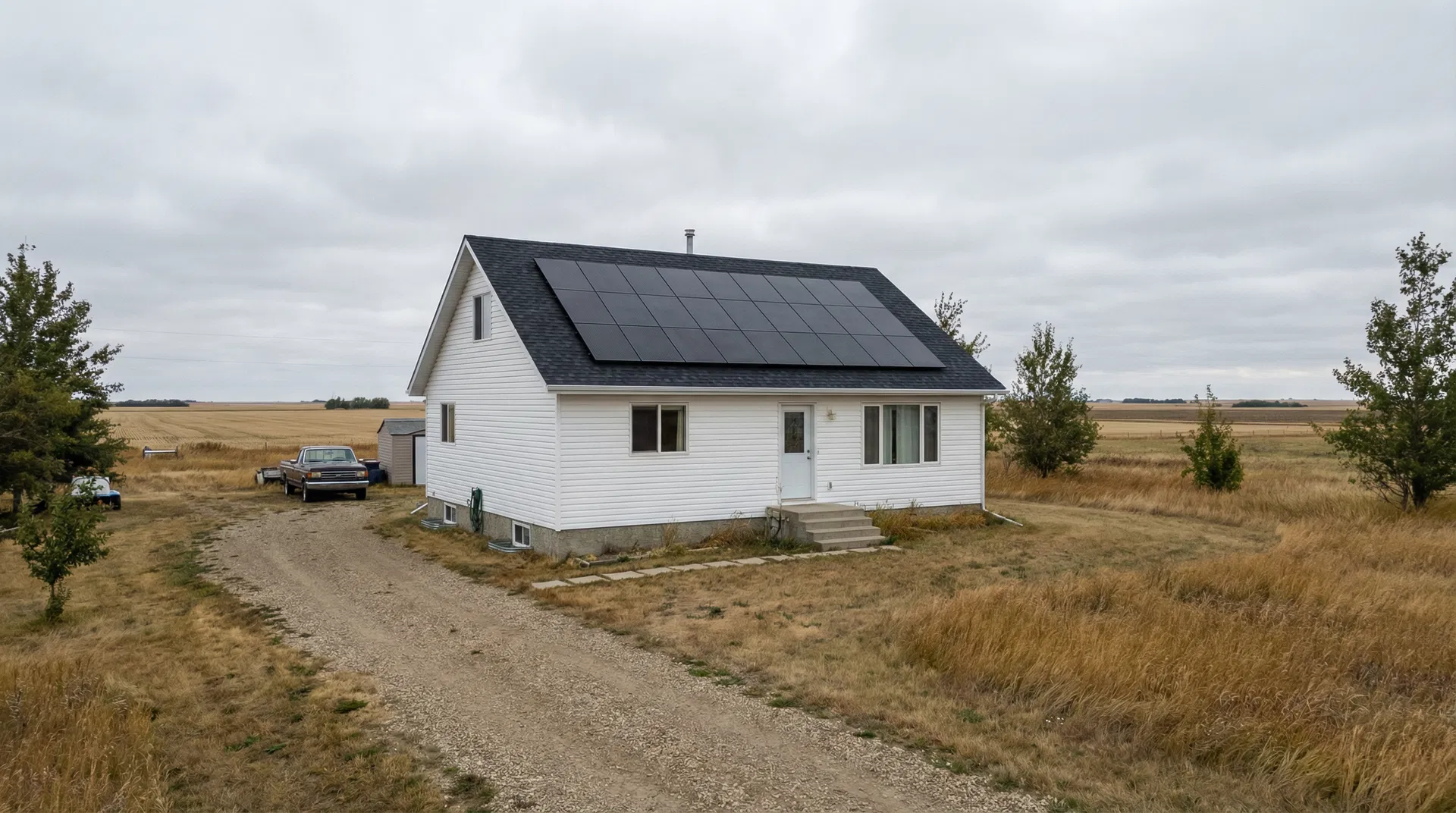
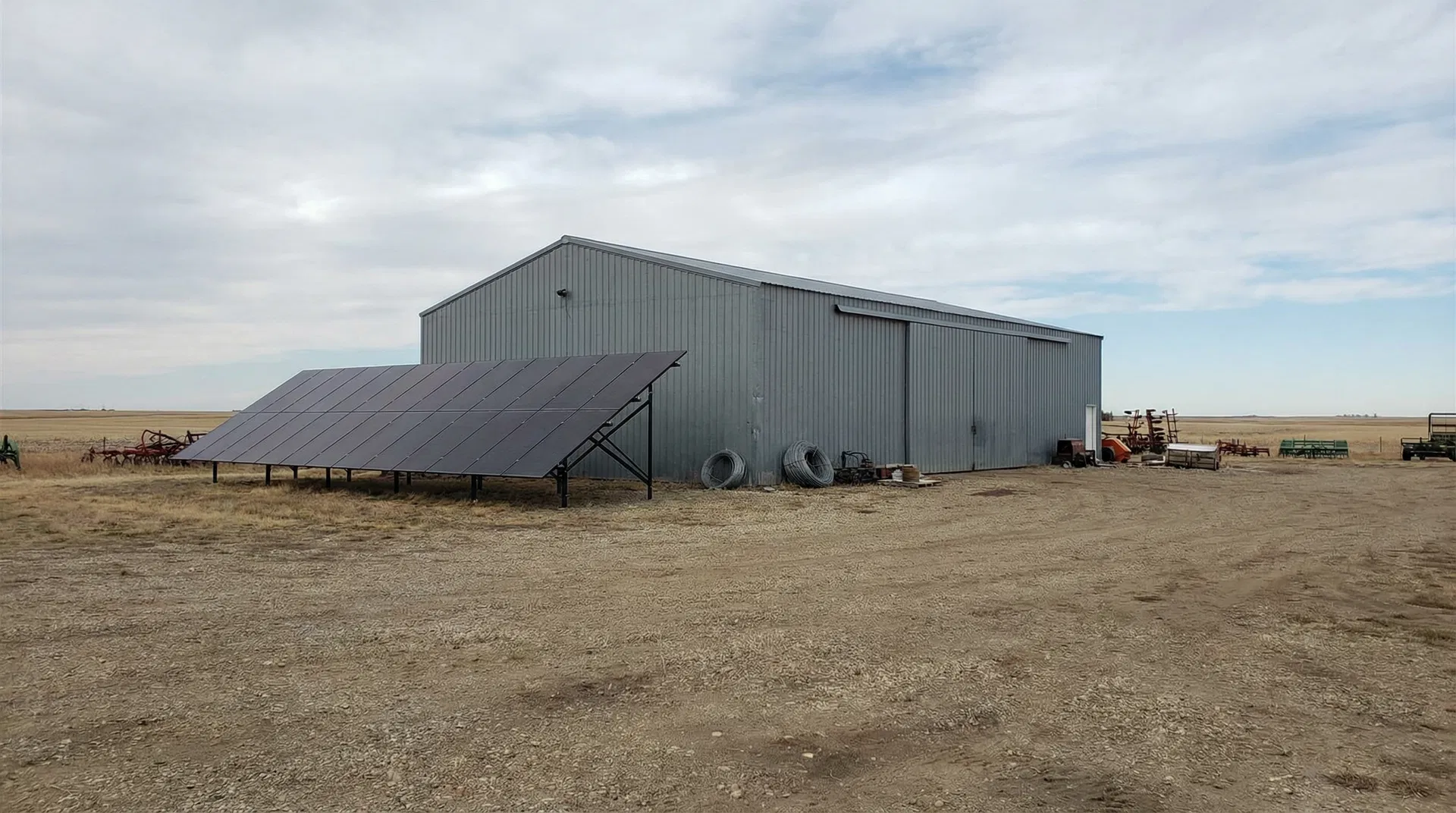
Farm solar Nanton starts with an honest look at your site before any equipment gets specified. That means walking the yard, checking roof condition and pitch on the shop or barn, identifying shading from grain bins or trees, and confirming whether a ground-mount array makes more sense than a rooftop install. For most farm operations in this area, we're working in the 20 to 50 kW range, with 25 kW being a common starting point for a property running a home, heated shop, and light grain handling. Larger operations with additional outbuildings or irrigation infrastructure often land in the upper half of that range or beyond it. The right size comes from your 12-month usage graph on your most recent power bill, not from a generic formula. We use LONGi solar panels on every farm install. They're well-proven on agricultural properties and carry a solid product warranty. For rooftop sections of a system, we pair them with APsystems microinverters, which handle partial shading better than a single string inverter and make monitoring individual panel output straightforward. For larger ground-mount arrays, we confirm the right inverter configuration during the design phase. Ground-mount is usually the preferred layout for properties with the land available. It lets us orient the array precisely, avoid roof shading complications from nearby structures, and keep maintenance simple. If your yard has open south-facing space away from bins and equipment, a ground-mount array is worth considering alongside or instead of a rooftop install. We'll tell you which approach fits your site.
Solar Planning for Nanton Properties
Farm operations around Nanton carry electrical loads that look nothing like a suburban house. You've got the home draw, a heated shop, grain handling equipment, possible irrigation, and outbuildings pulling from the same service. When those loads stack, your power bill reflects it. A solar system sized against that full picture can offset a meaningful portion of what the meter sees each month, but the design has to start with your actual numbers, not a rule of thumb. FortisAlberta is the wire service for Nanton, and any micro-generation system on this grid needs to go through their interconnection process. We know that process and we handle the application package for you. What makes farm solar work here isn't a simple kilowatt estimate. It's understanding which loads run during the day, what's on a timer, what runs seasonally, and whether the site is better served by rooftop panels, a ground-mount array, or a combination of both. We pull all of that together from your most recent power bill and a proper site assessment before we give you a design or a number.
Electrical Site Review for Nanton Properties
Voltage Rise
Voltage rise happens when a solar system exports power back through the distribution line and causes the voltage at the meter to climb above acceptable limits. On rural distribution lines that serve properties spread across distance, the line impedance can be higher than in urban areas, which makes voltage rise more likely to be a constraint. If voltage rise limits aren't addressed in the design phase, the inverters will clip output to stay within allowable voltage thresholds, reducing the system's effective capacity.
Single-Phase vs Three-Phase
Rural properties in Alberta are served by either single-phase or three-phase electrical service, and the distinction matters when sizing a solar system. Three-phase service supports larger loads and higher system capacities, while single-phase service imposes limits on how much generation FortisAlberta will approve without additional review. We confirm which service type your property has during the site assessment, because inverter selection and system capacity planning depend on it.
Panel Infrastructure
Older electrical panels on farm properties often have breaker capacity that was sized for the loads present when the panel was installed, which may not leave room for a solar system's generation breaker. We review the panel age, available breaker space, and bus bar rating during the site assessment to confirm whether the existing panel can support the system. If an upgrade is needed, we identify what's required and factor it into the project scope before the design is finalized.
Service Entrance Review
The meter base and service entrance condition affect whether FortisAlberta's micro-generation application can proceed without requiring upgrades. We check the meter base type, its condition, and whether it meets the utility's requirements for bi-directional metering before submitting the interconnection package. If the meter base needs to be replaced or upgraded, that work is coordinated as part of the project so it doesn't create a delay in the application process.
Right-Sizing Solar for Nanton Properties
Farm properties carry layered electrical loads that require a different sizing approach than a residential install. You might have the house drawing power continuously, a heated shop running through the winter, grain augers and aeration fans cycling seasonally, and outbuildings with lighting and equipment on separate feeds. When you add those loads together, the combined usage profile is what the solar system needs to be sized against, not any single one of those loads in isolation. Once we have that full picture, the roof-versus-ground-mount question comes next. Rooftop installs on a shop or barn make sense when the roof pitch, orientation, and condition are right and there's no shading from bins or taller structures nearby. But on most farm yards, there's also open land available that's better oriented than any existing roofline. When that's the case, a ground-mount array gives us the flexibility to face the panels exactly where we want them and sidestep whatever shading complications the yard layout creates. Sizing starts from the 12-month usage graph on your most recent power bill. That graph shows seasonal variation in your consumption, which is critical for a farm where summer and winter loads can look very different. We don't back-calculate from a generic square footage estimate or a per-acre rule of thumb. Your actual usage pattern drives the design. If your bill shows high summer demand from irrigation or grain handling, that informs the system size just as much as the heating load does in January. That's how we arrive at a number that actually fits your operation.
Typical Load Profiles We Design For Near Nanton
Home + Heated Shop + Grain Handling
This is one of the most common farm load combinations we see: a residence drawing year-round power, a heated shop running electric or gas-assisted heat with compressors and welders, and grain handling equipment that cycles hard during harvest. The combined load often supports a system in the 30 to 50 kW range depending on shop size and grain volume. We size from the 12-month usage graph on your most recent power bill to confirm whether those seasonal peaks push the system toward the upper end of that range.
Livestock Operation with Multiple Outbuildings
Livestock properties typically run waterers, ventilation fans, heat lamps, and lighting across several buildings simultaneously, often 24 hours a day through winter. That continuous baseline load is well-suited to solar offset during daylight hours, and the spread of buildings sometimes makes a ground-mount array more practical than trying to match multiple rooflines. A 20 to 30 kW system is a reasonable starting point for smaller livestock operations, though the actual size depends on how many head you're running and how your infrastructure is configured.
Acreage with Large Heated Shop Only
Some properties near Nanton are working acreages with a residence and a single large heated shop but no grain or livestock operation. The shop load, especially if it includes in-floor heat, a large compressor, or welding equipment, can still justify a 20 to 25 kW system on its own. We'll look at how often the heavy equipment runs and what portion of that load falls during daylight hours, because a shop that runs primarily during the day is a strong candidate for solar offset.
FortisAlberta Interconnection in Nanton
FortisAlberta is the wire service for Nanton, and every grid-connected solar system here needs to go through their micro-generation interconnection process before the system can run. That involves a formal application, a design package that meets their technical requirements, and coordination through their review process. We handle the FortisAlberta application on your behalf. You don't need to manage the utility correspondence. We prepare the design package, submit it to FortisAlberta, and follow up through their process. Once the system is commissioned and the meter work is confirmed, you're on the micro-generation program. For farm systems in the 20 to 50 kW range, the application involves more detail than a small residential install. Load documentation, single-line drawings, and equipment specifications all go into the package. Getting it right the first time avoids back-and-forth with the utility and keeps the project on schedule. That's the part of farm solar we've done enough times to get right consistently.
Project Economics and Design Review
| System Size | Annual Production | Year 1 Savings | Payback Period |
|---|---|---|---|
| 20-50 kW range, 25 kW typical |
Production, savings, and payback figures require a property-specific design and your most recent power bill before any estimates can be confirmed.
How We Work in Nanton
Bill and Load Review
We review your power bill to understand your energy use in Nanton and size the system to your actual consumption, not a generic estimate.
Site Assessment
We assess your roof or ground area, south-facing exposure, electrical service, and utility interconnection requirements specific to your property.
Design and Utility Application
We produce a system layout, production estimate, and cost summary, then submit your micro-generation application to your utility on your behalf.
Installation and Commissioning
Our crew installs racking, panels, inverter, and electrical connections. All work is performed by licensed electricians. We commission and test before handoff.
Current Program and Interconnection Review
Utility connection review
FortisAlberta reviews grid connection applications for all micro-generation systems in their service territory, including Nanton. Range Road Solar prepares the full design and documentation package and submits it to FortisAlberta on your behalf. We handle the utility correspondence so you're not managing that process while also running a farm operation.
Current program review
Commercial and agricultural solar installations may be eligible for provincial or federal programs depending on the operation type and current rules. We review eligibility against the programs in effect at the time of your design, because rules and program availability change. We don't assume eligibility before reviewing your situation.
Frequently Asked Questions
Get a Solar Assessment for Nanton
Submit a recent power bill and we will review your consumption and provide an honest assessment for your Nanton property. No obligation.
(587) 330-7502 Book a CallRelated Resources