Local Solar Guides · April 2, 2026 · 7 min read
Solar in Rocky View County: The Acreage Owner's Unfair Advantage
Rocky View County acreage owners have more roof, more land, and higher power bills than anyone in the city. That is exactly why solar works better out here.
Why Acreage Owners Win at Solar
City homeowners deal with small roofs, shading from neighbours, and power bills that are already modest because they're heating 1,400 square feet. Rocky View County acreage owners have none of those problems. You have a large south-facing roof, open sky in every direction, and a power bill that reflects what it actually costs to run a home, a shop, a pump, and a heated garage through an Alberta winter.
That combination of high consumption, no shading, and large available surface is exactly what makes solar work well. The system is bigger, the savings are bigger, and the payback math is straightforward.
What Power Bills Look Like Out Here
A typical Rocky View County acreage with a house, detached shop, and well pump is running $300 to $500 per month in power costs, sometimes more in January and February. That is not unusual. It is the cost of running a property that actually does something.
A properly sized solar system offsets the majority of that consumption from April through October, and a meaningful portion in the shoulder months. You are still connected to the grid. You still have power on cloudy days and through the winter. But the months where the sun is working, you are producing more than you use and banking credits with your utility.
Typical Rocky View County acreage solar numbers
| System size | 14 – 20 kW | Larger than typical residential |
| Installed cost | $42,000 – $58,000 | Before any tax credit |
| Federal Investment Tax Credit | 30% (incorporated only) | For farm or business operations |
| Annual savings | $2,800 – $4,500 | Based on current rates |
| Simple payback | 12 – 15 years residential | Shorter with rate escalation or the farm ITC |
Ground-Mount vs. Roof-Mount on an Acreage
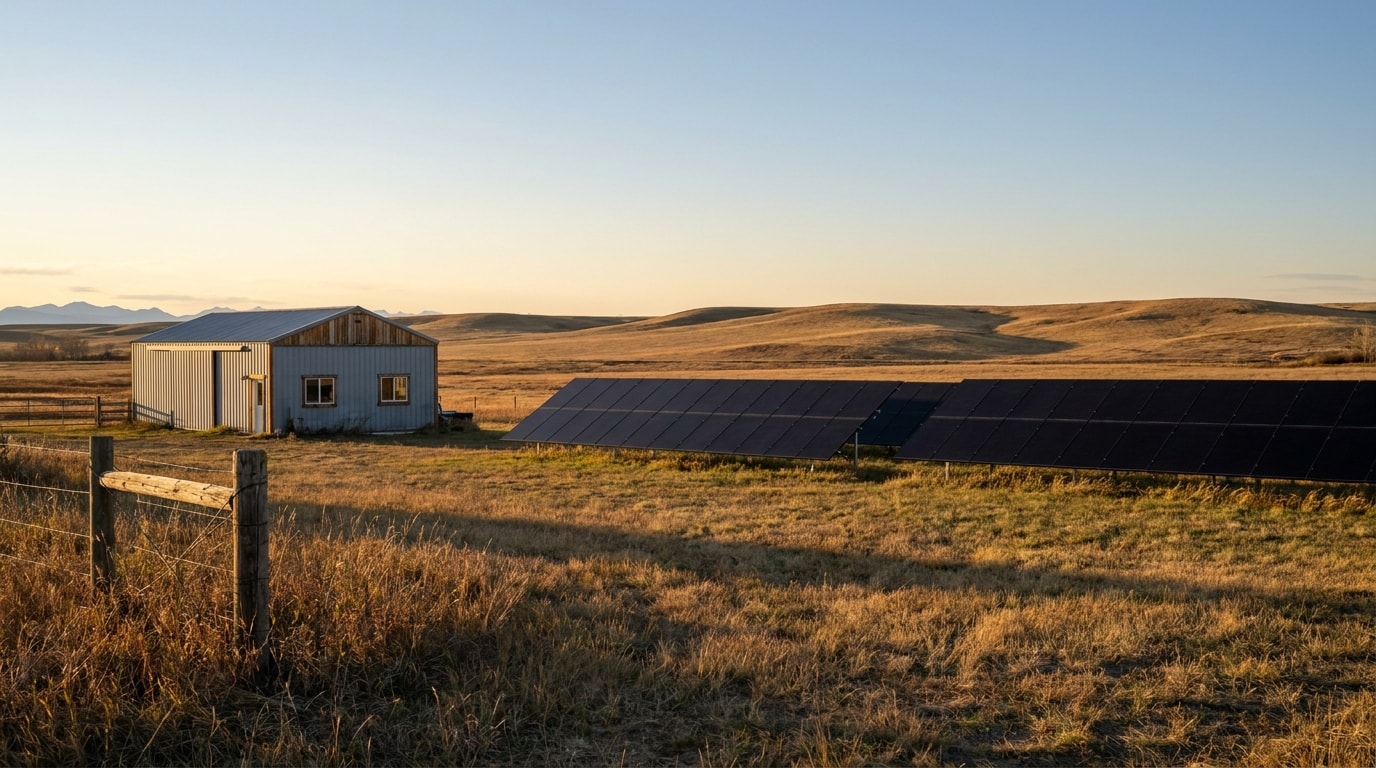
Most acreage owners have a choice that city homeowners do not: you can put panels on the roof, or you can put them on the ground. Both work. The right answer depends on your property.
Roof-mount
Simpler installation, lower cost, no additional land use. Works well on large south-facing roofs with a pitch between 15 and 40 degrees. The main limitation is that you are locked into whatever angle and orientation the roof gives you.
Ground-mount
More expensive to install but gives you full control over angle and orientation. On a flat acreage with no shading, a properly angled ground-mount array will outperform a roof-mount system of the same size by 5 to 15 percent annually. It is also easier to clear snow in winter, which matters in Rocky View County.
Alberta Microgeneration: How the Credits Work
Most Rocky View County acreages connect to the grid through FortisAlberta as the wire service provider. All Alberta wire service providers participate in the provincial microgeneration program. When your system produces more power than you are using, the excess flows back to the grid and you receive a credit on your bill at the same rate you pay for power.
This is called net metering. It means a sunny day in July is not wasted production. You are banking credits that offset your bill in December. The system does not pay you cash, but it does reduce what you owe, month after month.
For more detail on how microgeneration works in Alberta, see our Alberta microgeneration guide.
What a Real Rocky View County Install Looks Like
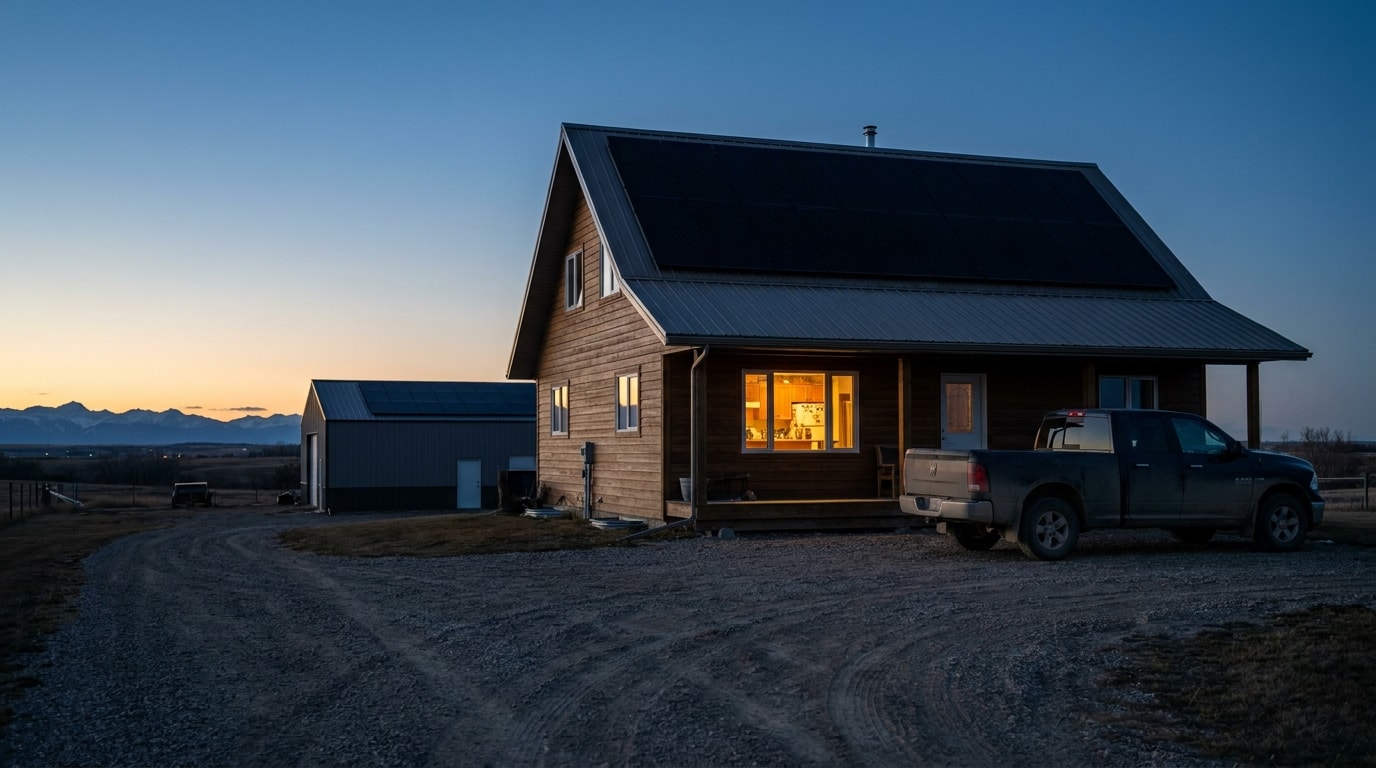
A 16 kW system on a Rocky View County acreage typically covers 60 to 80 percent of annual consumption. The system runs quietly with no moving parts. Maintenance is minimal: a visual inspection once a year and clearing heavy snow off the panels in winter if you want to maximize winter production.
The inverter converts DC power from the panels to AC power for your home. Modern inverters include monitoring apps so you can see exactly how much your system is producing in real time. Most of our clients check it more often than they expected to.
- —16 kW system: approximately 36 panels at 450W each
- —Annual production: 18,000 – 22,000 kWh in Rocky View County
- —Average Rocky View County acreage consumption: 24,000 – 32,000 kWh per year
- —Net metering credits bank from spring through fall, offset winter bills
- —System warranty: 25 years on panels, 10 years on inverter
The Honest Payback Conversation
Solar is not a get-rich-quick investment. It is a long-term infrastructure decision, the same way a new well pump or a metal roof is a long-term decision. You are spending money now to reduce a recurring cost for the next 25 to 30 years.
At current Alberta power rates, most Rocky View County acreage systems pay back in 12 to 15 years, and faster when rate escalation or the farm tax credit enters the picture. After that, the power is effectively free. A system installed today will still be producing at 85 percent capacity in 2051.
For a detailed breakdown of costs and payback in Alberta, see our solar cost guide.
A Worked Dollar Example for Rocky View County
Numbers make this concrete, so here is a baseline at a common residential size. A 10 kW rooftop system on an acreage home near Airdrie, Balzac, or Springbank costs about $36,000 installed. In Rocky View County sun, that system produces roughly 11,000 kWh per year. At a blended rate of about 24 cents per kilowatt-hour on a rural FortisAlberta account, counting energy, distribution, and riders, that production is worth approximately $2,600 per year in avoided charges and microgeneration credits.
Simple payback is $36,000 divided by $2,600, which works out just under 14 years. That figure assumes power rates never move again, which has not been Alberta's experience. Apply even three percent annual rate escalation and the effective payback tightens toward 12 years, with every year after that delivering power you no longer buy.
Most acreages here run larger than 10 kW because the loads are larger, and scaling up improves the cost per watt. The structure of the math does not change: production offsets your blended rate, credits bank through the summer, and the system keeps producing for well over a decade past its payback point.
Common Questions from Rocky View County Homeowners
What about hail? Rocky View County gets hammered.
It does, and panels are engineered for it. Quality modules are tested against 25 millimetre hail at terminal velocity, which covers the large majority of storms that cross the county. For the outliers, home insurance treats panels as part of the structure once your insurer is notified, and premium changes are usually small. Make that call before install day so there are no surprises.
Can I put the panels on my shop instead of the house?
Often you should. Alberta microgeneration ties to a single meter point, so what matters is which roof has the best pitch, orientation, and shading on the service you want to offset. Shops and outbuildings frequently win because they are newer, steel-roofed, and unshaded. If the house and shop sit on separate meters, that changes the design, and it is one of the first things we check on a site visit.
Which utility handles my interconnection?
Rocky View County is FortisAlberta territory. FortisAlberta reviews the interconnection application, approves the connection, and installs the bi-directional meter that tracks power flowing in both directions. Your retailer then applies microgeneration credits to your bill. We handle the application paperwork as part of every install.
How long does the whole process take?
Design starts as soon as we have your bills and a site visit. County permits and the FortisAlberta application typically take a few weeks to clear. Installation happens two to six weeks after permits, with the crew on site for one to three days on most acreage systems. The meter swap follows shortly after, and that is the day you start banking credits.
Will the system work during a power outage?
A standard grid-tied system shuts down during an outage. That is a safety requirement, not a design flaw, because line crews working on the wires cannot have your panels feeding power back at them. If outage protection matters on your property, a battery-backed design can keep essentials running. Most acreage owners skip the battery on the first build and leave room to add one later.
Getting a Quote for Your Property
Every acreage is different. Roof pitch, orientation, shading from trees or outbuildings, your utility, your consumption pattern. All of it affects what the right system looks like and what it will cost. The only way to get a real number is to look at your actual property and your actual bills.
We work exclusively in rural Alberta. We know what Rocky View County properties look like, what FortisAlberta requires, and what the installation conditions are out here. Send us your most recent power bill and we will give you an honest assessment with no obligation. Book a free assessment or call us at 587-330-7502 to get started.
Jonathan
Ready to get a real number for your property?
Send us your most recent power bill. We'll review your consumption and give you an honest design and cost estimate. No obligation.
Our Rocky View County solar installer team does acreages and farms from the Airdrie solar corridor west through solar in Cochrane and the surrounding range roads.
Range Road Solar Team
Rural Alberta Solar Installers
Our team has been installing solar across rural and central Alberta since 2019. Over 218 installs on farms, acreages, shops, and homes. We write about what we have actually seen in the field — not what the brochures say.
Serving Rocky View County & Area