
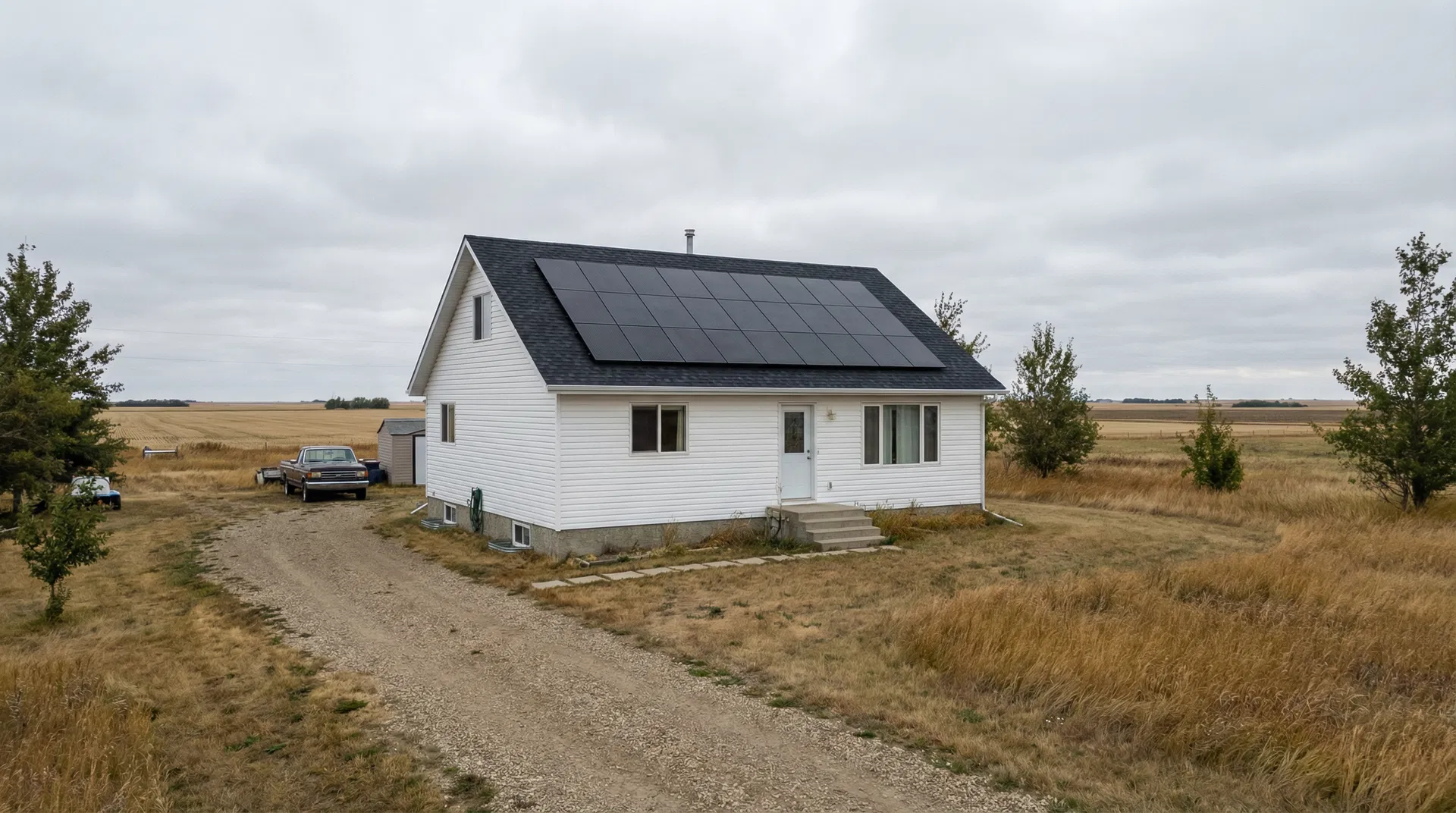
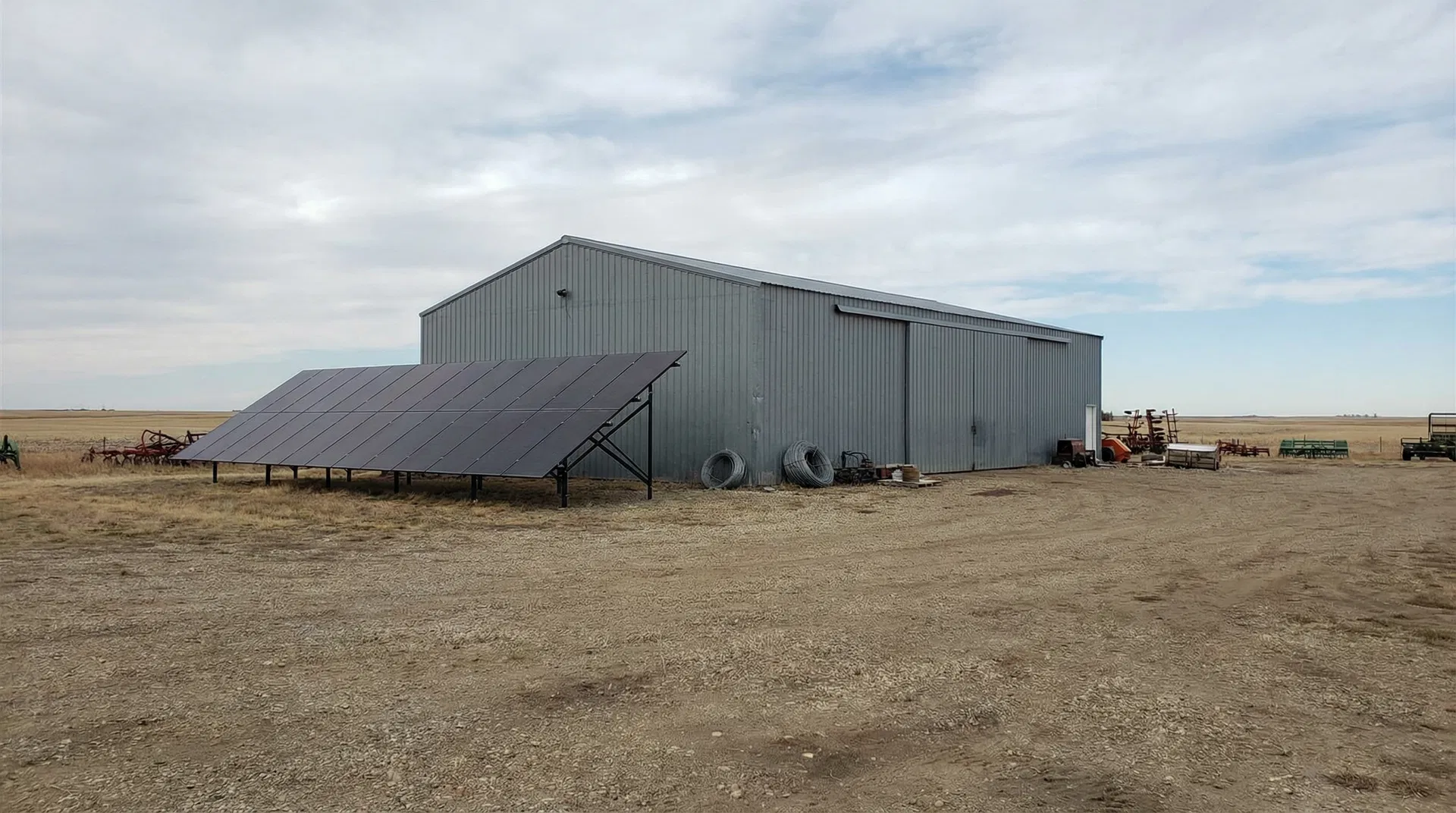
When people search for solar panels Strathmore, AB, they're usually looking at an acreage with a house, a shop, and maybe irrigation or grain-handling equipment, not a standard in-town bungalow. We install both rooftop and ground-mount systems here, and the right call depends on your roof condition, how much of your yard gets clear sun, and what else is drawing power on the property. Most of the acreage systems we design for this area fall in the 12-18 kW range, with 15 kW being typical once you add up a house and a shop. Every system we install uses LONGi panels paired with APsystems microinverters. Microinverters are a practical fit for acreage layouts because they let us mix panel orientations across a roofline or split an array between a house roof and a shop roof without one shaded section dragging down the whole string. That matters on properties with tree lines, outbuildings, or roof angles that don't all face the same direction. For ground-mount installs, common where the house roof is shaded, poorly pitched, or too small for a 12-18 kW array, we build the racking to the site: soil conditions, snow drift patterns from nearby structures, and access for maintenance all factor into the layout. Whether it's roof or ground-mount, we start from your most recent power bill and a walk-through of the property, not a standard package, because a house-only load and a house-plus-shop-plus-irrigation load call for genuinely different system sizes.
Solar Planning for Strathmore Properties
Strathmore was incorporated as a town in 1911, and it's grown into a community of roughly 14,339 people built around agriculture, rail, and the annual Strathmore Stampede. That mix shows up in the properties we design for: acreages with a home plus a shop, or a farmstead running irrigation pumps and grain-handling equipment alongside the house. FortisAlberta is the wire service across the area, and any acreage solar system here has to be designed against that distribution network, not a generic template. Environment Canada's climate normals list 2,396 hours of bright sunshine a year for the Calgary Int'l A station, the nearest long-term reporting station to this area. We don't turn that number into a production promise. Actual output on your property depends on roof pitch, tree lines, shop orientation, and how the panels get mounted, so we confirm real numbers with a site visit and your most recent power bill rather than a regional average. What we can speak to directly is how acreage properties here load their electrical service: a house circuit is one thing, a shop with a welder or a well pump is another, and grain-handling equipment adds a third. We size the system, whether roof-mount or ground-mount, around all of it, not just the house meter.
Electrical Site Review for Strathmore Properties
Voltage Rise
Voltage rise happens when the voltage at your property's connection point sits higher than standard because of the length and load on the distribution line feeding it, which is common on rural runs. If voltage rise pushes conditions outside normal range, some inverters respond by clipping output to protect themselves, cutting into the power the system actually delivers. We check the voltage at your service entrance during the site review so the system gets sized and configured for the conditions on your line, not a textbook assumption.
Single-Phase vs Three-Phase
Acreage properties in this area can have either single-phase or three-phase electrical service, depending on when the property was built and what it was originally set up to run. That distinction matters for inverter selection and system capacity, since three-phase service typically opens up higher system capacity and different equipment options than a single-phase connection supports. We confirm which service type your property has before finalizing equipment, not after.
Panel Infrastructure
A lot of acreage properties around here are running electrical panels installed decades before anyone planned for a 12-18 kW solar system, so breaker capacity and panel age are one of the first things we check. We look at the panel's rated capacity, its condition, and whether there's room for the breakers a solar system adds. If the existing panel can't support the system, an upgrade means installing a panel with enough capacity and headroom, which we fold into the project scope rather than treating as a surprise change order.
Service Entrance Review
We review the service entrance and meter base as part of every site visit, checking its condition and rated capacity against what a 12-18 kW system requires. The meter base condition matters directly for the micro-generation application to FortisAlberta, since an outdated or undersized meter base can hold up approval. If an upgrade is required, we identify it during the design phase and build it into the project plan up front instead of after the application is already in.
Right-Sizing Solar for Strathmore Properties
Acreage systems here tend to run bigger than a standard in-town rooftop system, and that's mostly about how many things are drawing power. A house is one load. Add a heated shop, an irrigation pump, or grain-handling equipment, and you've got two or three more loads stacked on the same service, which is why we design acreage systems in the 12-18 kW range instead of a smaller in-town package. Roof versus ground-mount is a property-by-property call. If the house roof has good southern or western exposure and enough clear area, roof-mount usually makes sense. But plenty of acreages have roofs shaded by shelterbelts or outbuildings, pitched at an angle that doesn't work well, or just too small to carry a 12-18 kW array. On properties like that, and especially where there's open yard space away from tree lines, ground-mount is often the better call, and it gives us more flexibility on orientation and tilt. Either way, we size the system from the 12-month usage graph on your most recent power bill, not a rule-of-thumb number based on square footage or occupant count. That graph shows us how your usage moves through the year, including seasonal loads like irrigation or heating, and it's a far more accurate starting point than a generic per-person or per-square-foot estimate.
Typical Load Profiles We Design For Near Strathmore
Home + Heated Shop
This is one of the most common setups we see on acreages here: a house plus a detached shop with heat, lighting, and often a welder or air compressor. We size the system using the combined draw from both structures as it shows up on your most recent power bill, splitting the array or the microinverter groupings between roof or ground-mount sections as needed. A shop with occasional high-draw tools like a welder behaves differently than one used mainly for storage, which is exactly the kind of detail the usage graph on your bill reveals.
Irrigation Pump + Grain Handling
Properties running irrigation pumps, augers, or grain dryers see seasonal spikes that a flat annual average would completely miss. We look at the usage graph on your most recent power bill to see when those spikes happen and how large they are, then size the system so it's built for peak load periods, not just an average month. These loads often push the system toward the higher end of the 12-18 kW range.
Multi-Building Acreage (House + Shop + Secondary Structure)
Some properties run a house, a shop, and a third structure such as a barn, guest suite, or workshop, each with its own draw. We treat the property as a single connected system for design purposes even when the buildings are physically separate, sizing the array and inverter configuration around total combined usage from your most recent power bill rather than designing each building in isolation.
FortisAlberta Interconnection in Strathmore
FortisAlberta is the wire service across this area, which means every acreage solar system we install here connects through FortisAlberta's distribution network rather than a municipally owned utility. Before we finalize a system design, we prepare and submit the micro-generation interconnection application on your behalf, including the technical details FortisAlberta requires for a system in the 12-18 kW range. Rural acreages often have distribution conditions in-town properties simply don't: longer runs from the nearest transformer, three-phase service on some properties and single-phase on others. We review your specific connection point as part of the design, not after the fact, and we handle the paperwork end of the FortisAlberta application process so you're not the one tracking down technical specs or filling out interconnection forms. Approval terms, credit handling, and program rules are set by FortisAlberta and can change, so we confirm current requirements with them directly as part of every design review rather than quoting rules that may be out of date.
Project Economics and Design Review
| System Size | Annual Production | Year 1 Savings | Payback Period |
|---|---|---|---|
| 12-18 kW range, 15 kW typical |
Production, savings, and payback figures are specific to your property and require a design review using your most recent power bill.
How We Work in Strathmore
Bill and Load Review
We review your power bill to understand your energy use in Strathmore and size the system to your actual consumption, not a generic estimate.
Site Assessment
We assess your roof or ground area, south-facing exposure, electrical service, and utility interconnection requirements specific to your property.
Design and Utility Application
We produce a system layout, production estimate, and cost summary, then submit your micro-generation application to your utility on your behalf.
Installation and Commissioning
Our crew installs racking, panels, inverter, and electrical connections. All work is performed by licensed electricians. We commission and test before handoff.
Current Program and Interconnection Review
Utility connection review
FortisAlberta reviews every micro-generation interconnection application for acreage systems in the 12-18 kW range, checking the technical details of your specific connection point. Range Road Solar prepares and submits that design package on your behalf as part of the project, handling the technical documentation FortisAlberta requires.
Current program review
Eligibility for residential, farm, and commercial solar programs is reviewed against current rules at the time of your design, since program details can change. We check what applies to your specific property type, whether it's a straightforward acreage or a working farm, as part of the design review rather than assuming a blanket answer.
Frequently Asked Questions
Get a Solar Assessment for Strathmore
Submit a recent power bill and we will review your consumption and provide an honest assessment for your Strathmore property. No obligation.
(587) 330-7502 Book a CallRelated Resources
More Solar Services in Strathmore