
About Vulcan
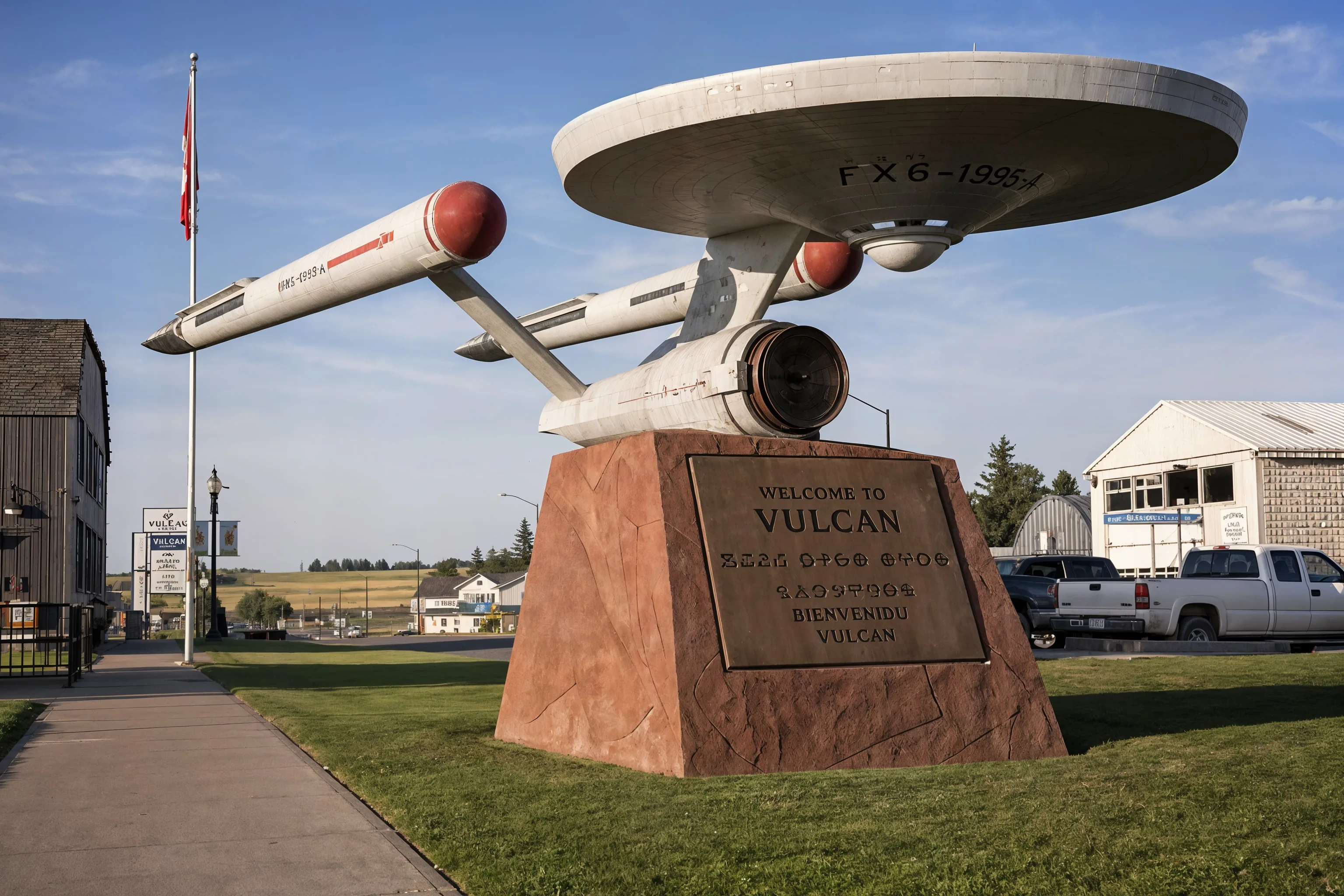
The Town of Vulcan, Alberta, population around 2,000, has spent decades leaning into the coincidence of its name. The Vulcan Tourism and Trek Station, built in the shape of a flying saucer, anchors the visitor economy downtown, with a full-size replica of the USS Enterprise mounted out front and a statue of Mr. Spock watching over Main Street. Every year the town hosts Spock Days, also promoted as Vul-Con, a festival built around the Star Trek tie-in that draws fans from across the country to a county whose working economy has nothing to do with science fiction.
That working economy is grain farming and cattle ranching across Vulcan County's open prairie. Wide, unshaded rooflines on shops and Quonsets, long sightlines across quarter sections, and farmyard loads that run all year make the county a strong fit for both rooftop and ground-mount solar. Range Road Solar sizes systems around the actual load, whether that is a farmhouse, a grain operation's bins and dryers, or a cattle operation's waterers and yard lights.
Solar Potential in Vulcan
Vulcan's latitude of 50.41 is the southernmost in this batch of towns, and it shows in the numbers: about 2,400 hours of bright sunshine a year, converting to roughly 1,304 kWh per installed kilowatt, among the strongest yields we quote anywhere in our service area. That puts a 7.6 kW system near 9,910 kWh a year, and a 10 kW array climbs to around 13,040 kWh.
| Property type | Typical system | Installed cost range | Est. annual production |
|---|---|---|---|
| In-town Vulcan home | 6-8 kW roof-mount | $13,500 - $22,800 | ~7,820 - 10,430 kWh |
| Grain operation shop or Quonset | 8-12 kW roof-mount | $18,000 - $34,200 | ~10,430 - 15,650 kWh |
| Cattle ranch or quarter-section farm | 10-15 kW ground-mount | $25,000 - $52,500 | ~13,040 - 19,560 kWh |
Pricing is a range because roof condition, panel count, and electrical work all move the final number. We confirm the exact figure at the site visit, not before.
Snow Load, Wind, and the Local Build
The National Building Code places Vulcan in snow load zone S2 but a higher wind load zone, R4, a direct consequence of open, unbroken prairie with nothing nearby to slow the wind. Every rack, rooftop or ground-mount, is built to that R4 spec rather than borrowed from a calmer region, and panel tilt is chosen so snow clears within a day or two of sun. The cold works in your favour too: panels are semiconductors, so a crisp winter day in Vulcan County squeezes more watts out of the same panel than a scorching July one would.
Most Vulcan homes and shops end up on LONGi panels with APsystems microinverters, while the bigger ground-mount arrays on ranches and grain operations across Vulcan County are better matched to Solis string inverters instead.
Grid Connection and Net Metering
FortisAlberta owns and operates the distribution lines serving Vulcan and the rest of Vulcan County. We prepare and submit the micro-generation interconnection application, coordinate the technical review, and schedule the bi-directional meter swap. Approval typically takes two to six weeks from a complete application. During that window your system is installed and inspected but not yet exporting power.
Once the meter is swapped, Alberta's net metering rules apply: your panels produce, your meter spins backward against your usage, and you draw from the grid when production is low. Long prairie summer days build up credits that carry forward into shorter winter days, so the annual bill, not any single month, is what matters.
Six Steps From Power Bill to Power Producer
Power Bill First
Your usage pattern over the year is what sizes the array correctly, so that is where we start.
Property Visit
Roof or ground, shop or Quonset, we assess the real site in Vulcan before drawing anything up, including shading and interconnection needs.
Firm Quote
A full layout, a production number, and a price that does not move once work starts.
Permits and FortisAlberta Paperwork
Building and electrical permits plus the micro-generation application, filed with FortisAlberta on your behalf.
Build Day
Racking, panels, inverters, wiring, all done by licensed electricians, typically in a day or two for a residential job.
Switched On
Inspection, meter swap, and FortisAlberta activates the connection. You are generating from that point forward.
Solar in Vulcan, Common Questions
Our clients speak for themselves
Read what Alberta homeowners and farmers say about Range Road Solar.
Free Solar Assessment for Vulcan
Rooftop or ground-mount. In town or on the ranch. We will tell you what works best.
Also Serving Nearby Areas
From Main Street to the Quarter Section, We Know Vulcan
Send a power bill over and we will put real, Vulcan-specific numbers in front of you, Star Trek statue or not.
Also Serving Nearby Communities