
The Sunniest Corner We Serve
Vulcan County is dryland farming and irrigation country. The rural municipality wraps around the Town of Vulcan and the villages of Champion, Carmangay, Arrowwood, Milo, and Lomond, with a county population of roughly 3,968 people spread across a lot of open prairie. That open prairie is the point. At about latitude 50.40, with no foothills to the west and nothing on the horizon in any direction, the county collects some of the best solar irradiance in Alberta.
Environment Canada 1991 to 2020 climate normals put annual bright sunshine here at roughly 2,426 hours. That is among the highest readings in this batch of Alberta locations, and it shows up directly in production numbers. Natural Resources Canada PV potential data for the Vulcan area shows a 7.6 kW system producing about 10,020 kWh per year, close to 1,320 kWh per installed kilowatt. For context, many central Alberta locations run closer to 1,150 to 1,250 kWh per kilowatt. Same panels, more power.
The county economy runs on agriculture, and the electrical load profiles match: irrigation pivots pulling hard through July and August, farm shops with welders and compressors, grain handling equipment, and century-old farmsteads with service entrances that were never designed for modern loads. Solar fits this county because the production curve and the farm load curve line up almost perfectly.
Built for Vulcan County Conditions
Every racking design we stamp for this county starts from two numbers: snow zone S2 and wind zone R4. S2 is a moderate snow-load zone, which keeps racking cost reasonable while still engineering for a genuine prairie winter. R4 reflects the open-terrain wind exposure you get on flat ground with no shelterbelts in the wrong places. We rate the structure for both, so the array handles chinook thaws and spring wind events without drama.
Snow is worth a straight answer. Panels here are mounted at a tilt steep enough that most snowfall slides off on its own, and the dark glass surface warms and sheds the rest faster than a steel roof does. Cold, sunny winter days are actually some of the best production days of the year, because panels generate more efficiently in the cold. Vulcan County winters cost you very little annual production.
Rural service is the other engineering reality. Long distribution runs, split-phase farm services, and older meter bases all shape how much solar a property can host and where the inverter connects. We assess your service entrance, panel capacity, and voltage rise before quoting anything, so the FortisAlberta interconnection application passes the first time.
Three Vulcan County Load Profiles We Size For
There is no typical Vulcan County customer, but there are three profiles that cover most of the county. Your 12-month FortisAlberta bill tells us which one you are, and we size from that, not from a brochure.
Irrigation pivot operation. Pivot pumps dominate the county's heavy loads, running flat out through the growing season. Seasonal bills of $1,200 to $2,800 per month are common on pivot-heavy farms, and the load peaks in July and August, exactly when a south-facing array peaks. These properties usually justify 30 kW or larger ground-mount systems with strong, honest paybacks.
Farmstead with shop. A farmstead with a heated shop, welder, air compressor, and grain handling equipment usually runs $400 to $900 per month across the year. A 12 to 20 kW system, roof or ground, offsets most of that. This is the most common install profile in the county.
Town of Vulcan bungalow. In town, a bungalow or two-storey home with normal electric service runs $120 to $260 per month. The Town of Vulcan, population 1,769 at the 2021 census and incorporated in 1921, is a FortisAlberta town just like the farms around it. A 6 to 8 kW rooftop system covers most of these homes' annual use.
What Solar Costs in Vulcan County
We price by the watt, and the ranges below are the honest spread. Roof mounts run $2.25 to $2.85 per watt installed. Ground mounts run $2.50 to $3.50 per watt installed, reflecting the racking, trenching, and engineered foundations a ground array needs. The per-kilometre drive from Airdrie does not add a travel surcharge, but it is one reason we batch county assessments and confirm your site visit window ahead of time.
Worked examples, using the high irradiance numbers this county actually delivers:
| System | Size | Approx. annual production | Installed cost range |
|---|---|---|---|
| Town rooftop (Vulcan bungalow) | 6 to 8 kW | 7,900 to 10,550 kWh | roughly $13,500 to $22,800 |
| Farmstead roof or ground | 12 to 16 kW | 15,800 to 21,100 kWh | roughly $30,000 to $45,600 roof, $36,000 to $56,000 ground |
| Irrigation operation ground mount | 30 to 40 kW | 39,500 to 52,800 kWh | roughly $75,000 to $140,000 ground |
Production figures use the NRCan PV potential value for the Vulcan area, about 1,320 kWh per kW per year on a south-facing array. Panels carry 25-year output warranties, and inverters typically last 10 to 15 years. Every quote we deliver shows the math on one page: your bills, the system size, the production, and the payback.
Honest Payback Math for This County
Payback depends on your FortisAlberta rate and how much of your production you use on site. We do not invent rates or promise numbers we cannot back. What we can tell you, using typical FortisAlberta residential energy charges as an honest labelled estimate: electricity in this service area has recently landed around 14 to 17 cents per kWh all-in for residential accounts, and farm accounts vary with their rate class and demand charges.
| Annual production | Estimated annual bill offset | Best fit |
|---|---|---|
| about 10,000 kWh (7.6 kW) | roughly $1,400 to $1,700 | Town home or small acreage |
| about 20,000 kWh (15 kW) | roughly $2,800 to $3,400 | Farmstead with shop |
| about 40,000 kWh (30 kW) | roughly $5,600 to $6,800 | Irrigation pivot operation |
Offset estimates assume roughly 15 to 17 cents per kWh, labelled as an estimate because your actual rate sits on your bill and we size from the real number, not a provincial average. Properties that use most of their power on site, like irrigation operations running pumps against midday production, see the strongest returns. Alberta's micro-generation rules credit exported power, but self-consumption is always worth more than export.
Getting to Vulcan County, and What It Means for Your Schedule
Range Road Solar is based in Airdrie. Vulcan County is about 140 km south, a 115 minute drive on Highway 2 and Highway 23. We make that drive regularly, and we plan it properly. Assessments in the county are scheduled in clusters, so your site visit is paired with other Vulcan County work rather than billed as a dedicated trip. Install days are booked in blocks for the same reason.
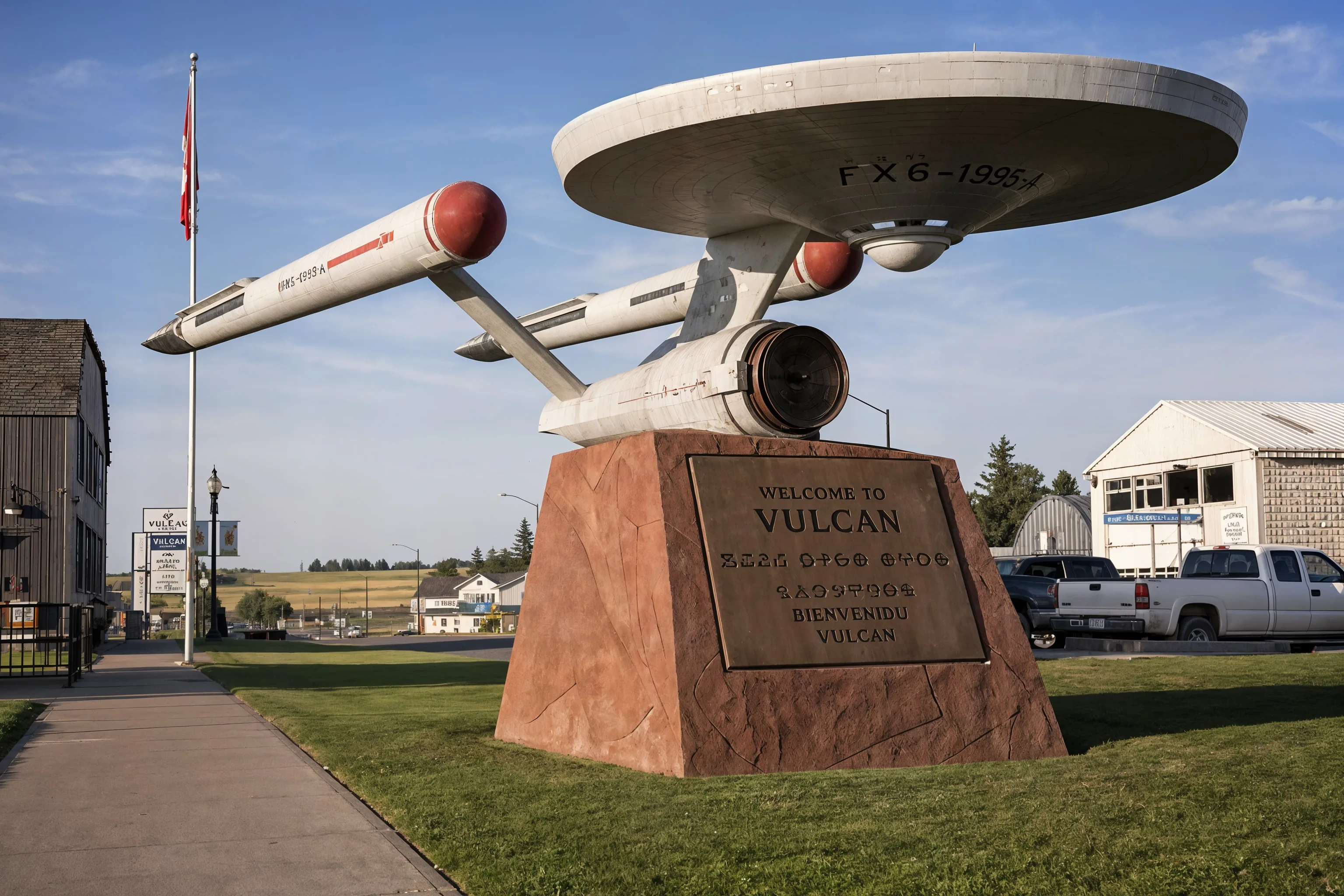
This is the part of Alberta where the Star Trek fans find us. The Town of Vulcan leaned into its name decades ago, and the Vulcan Tourism and Trek Centre, complete with the Starship statue and landing pad, is genuinely worth a stop while you are in town. The town even has a small Vulcan Solar Park. If your assessment day lands on a nice afternoon, give yourself ten minutes there. The county itself, though, is all business: pivot corners, feedlots, and some of the best irradiance numbers in the province.
One practical note for farm customers: if your yard is hard to find, a pin drop or a description of the approach from the nearest range road saves everyone an hour. We have been down enough grid roads to know the mailbox is not always at the driveway.
The Installation Process
Power Bill Review
We pull the 12-month usage history off your FortisAlberta bill. That graph, not a guess, sets the system size ceiling.
Site Assessment
We walk the yard: roof or ground options, shading from bins and shelterbelts, service capacity, and the best place for a ground mount if you want one.
System Design
You get a layout, a production estimate based on Vulcan County irradiance, and a single-page cost and payback summary.
Permits and Interconnection
We file the Vulcan County building permit and the FortisAlberta micro-generation application. This is usually the longest step in the two to six week window.
Installation
Our crew installs racking, panels, inverter, and electrical connections. Work is done by licensed electricians, on farmsteads and in town.
Commissioning and Inspection
The system is inspected, the bi-directional meter goes in, and you watch the first production numbers come in on your monitoring app.
Where We Work in the County
Range Road Solar serves farmsteads, acreages, and town properties across Vulcan County: the Town of Vulcan and the villages of Champion, Carmangay, Arrowwood, Milo, and Lomond, plus the farm country between them. We also work adjacent municipalities throughout central and southern Alberta. If you are on a rural route and unsure whether you are in the county, send us a pin and your bill and we will confirm in one reply.
We are a rural-focused contractor with hundreds of installs across Alberta. Most of our work is on acreages, farms, and agricultural properties, which is exactly the kind of electrical environment Vulcan County offers.
Frequently Asked Questions
Also Serving Nearby Areas
Ready for an Honest Vulcan County Number?
Send a recent FortisAlberta bill and we will review your consumption and give you a straight answer on what solar can do for your Vulcan County property, including payback math you can check yourself. No obligation.
Also Serving Nearby Communities