
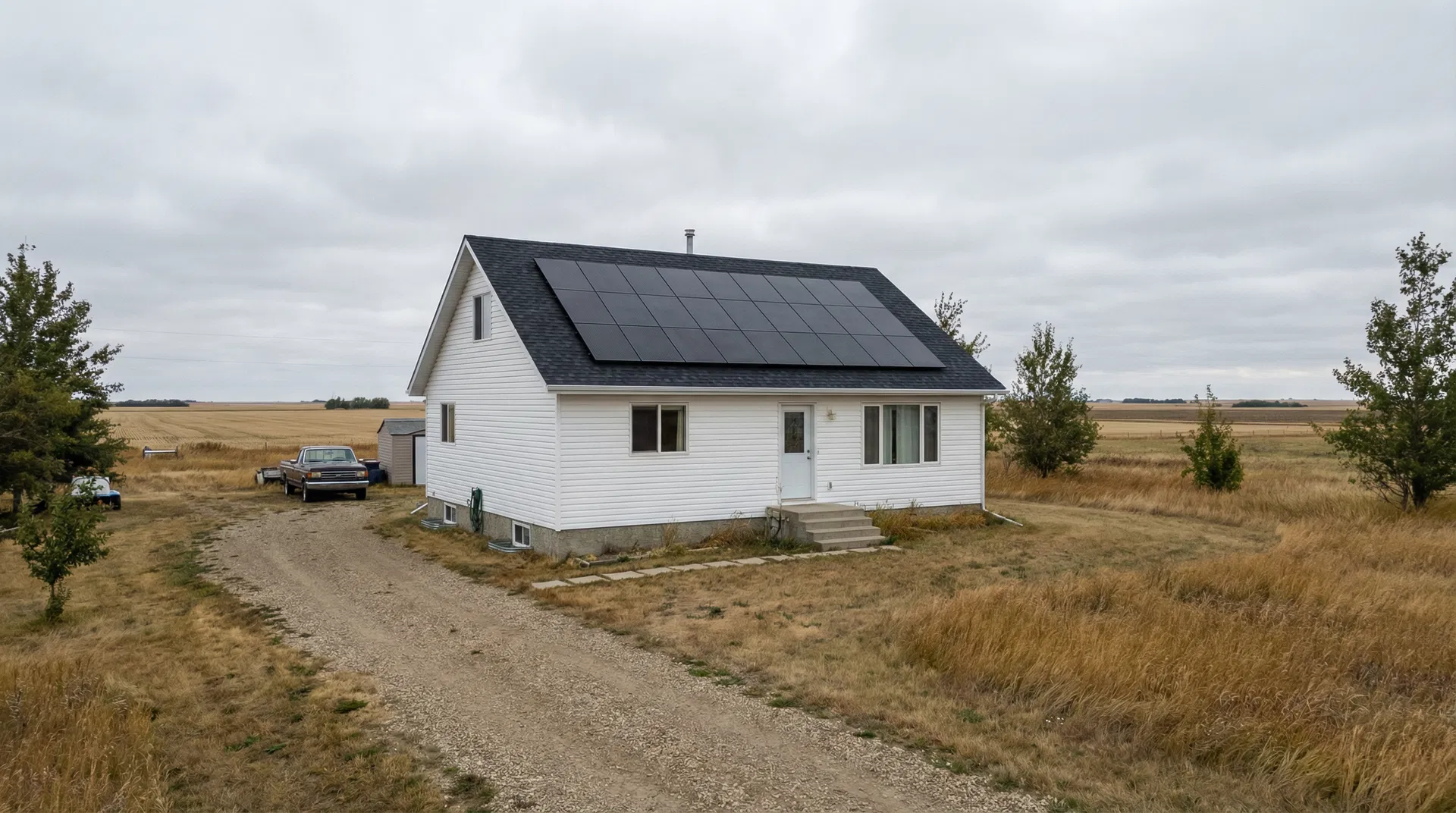
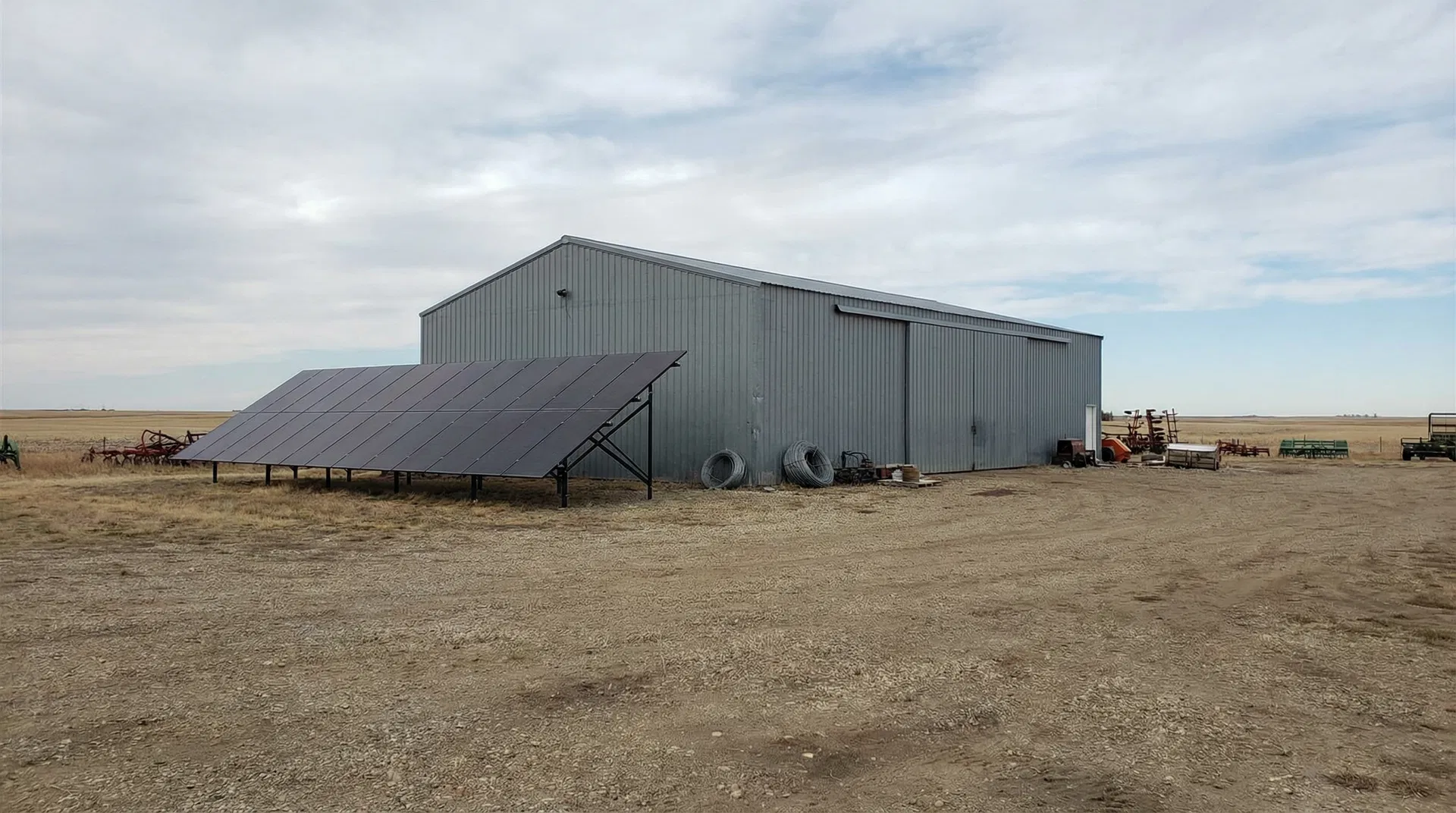
If you're searching "shop solar strathmore alberta," you're probably trying to figure out whether your barn, workshop, or outbuilding can carry its own solar array instead of running everything off the house panel. We install standalone and grid-tied systems in the 8 to 20 kW range, sized to the building and the loads inside it, whether that's a welder, an air compressor, livestock waterers, or shop heat. Every system uses LONGi panels paired with APsystems microinverters, which let us mix roof orientations and partial shading without dragging the whole array's output down to the weakest panel. On a metal-roofed machine shed, that usually means a straightforward rooftop mount along the south-facing slope. On an older barn with a steep pitch or heavy tree cover nearby, we'll often recommend a ground-mount array instead, set up on open ground where the angle and orientation are ours to choose rather than the building's. Some properties end up with both: a smaller rooftop array on the shop and a larger ground-mount system covering the rest of the load. We also build standalone systems for outbuildings that don't need a grid-tied setup at all, which comes up more on properties with a detached shop sitting well off the main electrical service. Whatever the layout, the starting point is the same: we walk the property, look at how the building is wired, and size the array around what it actually uses.
Solar Planning for Strathmore Properties
Strathmore, Alberta was incorporated as a town in 1911, and it's grown from 13,756 residents to 14,339 in the most recent census count. That growth means more shops, workshops, and outbuildings going up on properties that weren't built with a solar interconnection in mind. Environment Canada's climate normals for the nearby Calgary International Airport station put annual bright sunshine at 2,396 hours, which is the kind of baseline we factor into a design, not a sales pitch. What actually matters for your project is the property in front of us: how your shop or outbuilding is wired, what the roof pitch looks like, and whether a ground-mount array makes more sense given the yard layout. We don't guess at system size from a brochure number. We start with your most recent power bill and the 12-month usage graph printed on it, then walk the property to check service type, panel capacity, and shading. Whether the property sits near the Strathmore Golf Club or out toward Kinsmen Park, every job gets the same site-specific review before we talk numbers. That's how we keep the design honest instead of generic.
Electrical Site Review for Strathmore Properties
Voltage Rise
Voltage rise happens when a point on the distribution line sits far enough from the transformer that line resistance lets voltage climb as your solar system pushes power back onto the grid. Rural feeders tend to run longer than in-town lines, which can make this more of a factor on some properties than others. We check for it during the site review because it affects how hard an inverter can push output before it clips, which shapes how we size the array.
Single-Phase vs Three-Phase
Shops and outbuildings can be wired for single-phase or three-phase service, depending on when the building went up and what kind of equipment it was built to run. That distinction matters for inverter selection, since three-phase equipment like some welders or larger compressors needs a system designed around that service type. We confirm which service type a building has before we spec out the inverters, not after.
Panel Infrastructure
A lot of rural outbuildings are running panels that are decades old, with breaker capacity that was never meant to carry a solar interconnection on top of the building's existing loads. We check the panel's age, its rated capacity, and how much headroom is left before we finalize a system size. If the panel can't support the added breaker, the fix is a panel upgrade or a dedicated sub-panel, which we scope out as part of the design before any equipment goes in.
Service Entrance Review
We check the condition of the service entrance and the meter base as part of every site visit, since a worn or undersized meter base can hold up the FortisAlberta micro-generation application regardless of how the solar array itself is designed. If the meter base is outdated or doesn't meet current requirements, it needs an upgrade before FortisAlberta will approve the interconnection. We flag that early so it doesn't turn into a surprise partway through the project.
Right-Sizing Solar for Strathmore Properties
Rural properties almost always need a bigger system than a comparable house in town, simply because there's more going on behind the meter: a home, plus a shop, plus an outbuilding or two, maybe an irrigation pump or grain-handling equipment that only runs part of the year. All of that load adds up, which is why shop and outbuilding systems in the 8 to 20 kW range are common out here while a town house might land well under that. Roof versus ground mount comes down to what the property actually offers. If the shop roof faces south with a clean pitch and no shade, a rooftop array is usually the simpler, cheaper build. But if there are trees or a neighboring building casting shade, the roof pitch is wrong for solar, or the yard is spread out with open ground sitting unused, a ground-mount array often makes more sense. Ground mounts let us pick the angle and orientation ourselves instead of working around a roof that wasn't built with solar in mind. Either way, we size the system from the 12-month usage graph on your most recent power bill, not a rule-of-thumb number per square foot or per animal unit. That graph shows the actual pattern of what the property uses across a full year, including seasonal spikes from heating, pumping, or grain drying. Combined with a site walk, that's what drives the final system size.
Typical Load Profiles We Design For Near Strathmore
Home + Heated Shop
This is the most common setup we see: a house plus a heated detached shop used for vehicle storage, a workbench, or small equipment repair. The shop heater and any power tools add a steady baseline load on top of normal household use. We pull the 12-month usage graph from your most recent power bill to see how much that shop heat shifts winter usage before sizing the array.
Shop + Grain Handling
Properties running grain augers, aeration fans, or a grain dryer see sharp seasonal spikes that don't show up in a simple square-footage estimate. Those loads are often short bursts of high demand rather than steady draw, which changes how we size the array and inverter capacity. We look at the shape of those spikes on your power bill's usage graph, not just the annual total.
Multi-Building Yard
Some yards have a house, a workshop, and a separate outbuilding like a machine shed or barn, each drawing power on its own schedule. We'll sometimes split the array across buildings or route one larger system to cover the combined load, depending on how the service is wired. Either approach starts with the same usage graph and site walk before we commit to a system size.
FortisAlberta Interconnection in Strathmore
Properties in this area sit in FortisAlberta's distribution territory, so any shop or outbuilding solar system that ties into the grid goes through FortisAlberta's micro-generation application process. We prepare and submit that application as part of the installation, including the technical details FortisAlberta requires on inverter specs, system size, and the point of interconnection. For a shop or outbuilding system, that often means documenting a separate service point or a sub-panel feed from the main service, depending on how the building is wired. We handle the paperwork and the technical back-and-forth with FortisAlberta so you're not the one chasing down forms or decoding utility language. What the application process looks like in terms of timelines, credit handling, or rate structure is something FortisAlberta sets and updates on its own schedule, so we review current rules with you at the design stage rather than quoting numbers that could be out of date by install day. If a property has multiple structures on separate services, we sort out early which ones need their own application.
Project Economics and Design Review
| System Size | Annual Production | Year 1 Savings | Payback Period |
|---|---|---|---|
| 8-20 kW range, 12 kW typical |
Production, savings, and payback figures are only available after a property-specific design review that uses your most recent power bill.
How We Work in Strathmore
Bill and Load Review
We review your power bill to understand your energy use in Strathmore and size the system to your actual consumption, not a generic estimate.
Site Assessment
We assess your roof or ground area, south-facing exposure, electrical service, and utility interconnection requirements specific to your property.
Design and Utility Application
We produce a system layout, production estimate, and cost summary, then submit your micro-generation application to your utility on your behalf.
Installation and Commissioning
Our crew installs racking, panels, inverter, and electrical connections. All work is performed by licensed electricians. We commission and test before handoff.
Current Program and Interconnection Review
Utility connection review
FortisAlberta reviews every grid-tied micro-generation application before a system can connect, and that review covers the technical details of your inverter setup and point of interconnection. Range Road Solar prepares that application package as part of the installation, handling the forms and specs so you're not deciphering utility paperwork on your own.
Current program review
Eligibility for any commercial, farm, or residential program changes from year to year, so we check what currently applies to your property type at the time of your design review rather than assuming last year's rules still hold. That review covers how your shop or outbuilding is classified and used.
Frequently Asked Questions
Get a Solar Assessment for Strathmore
Submit a recent power bill and we will review your consumption and provide an honest assessment for your Strathmore property. No obligation.
(587) 330-7502 Book a CallRelated Resources
More Solar Services in Strathmore