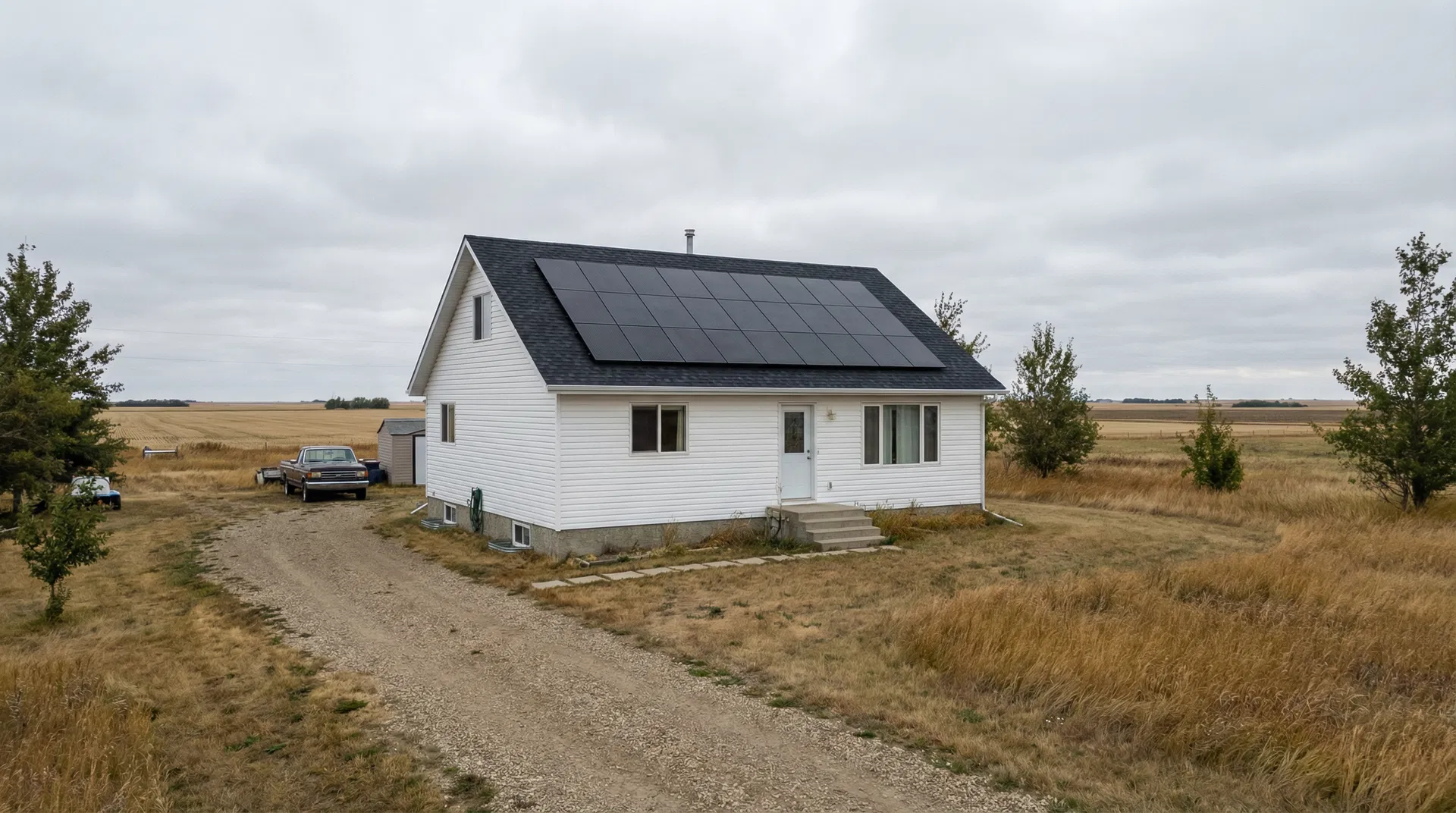
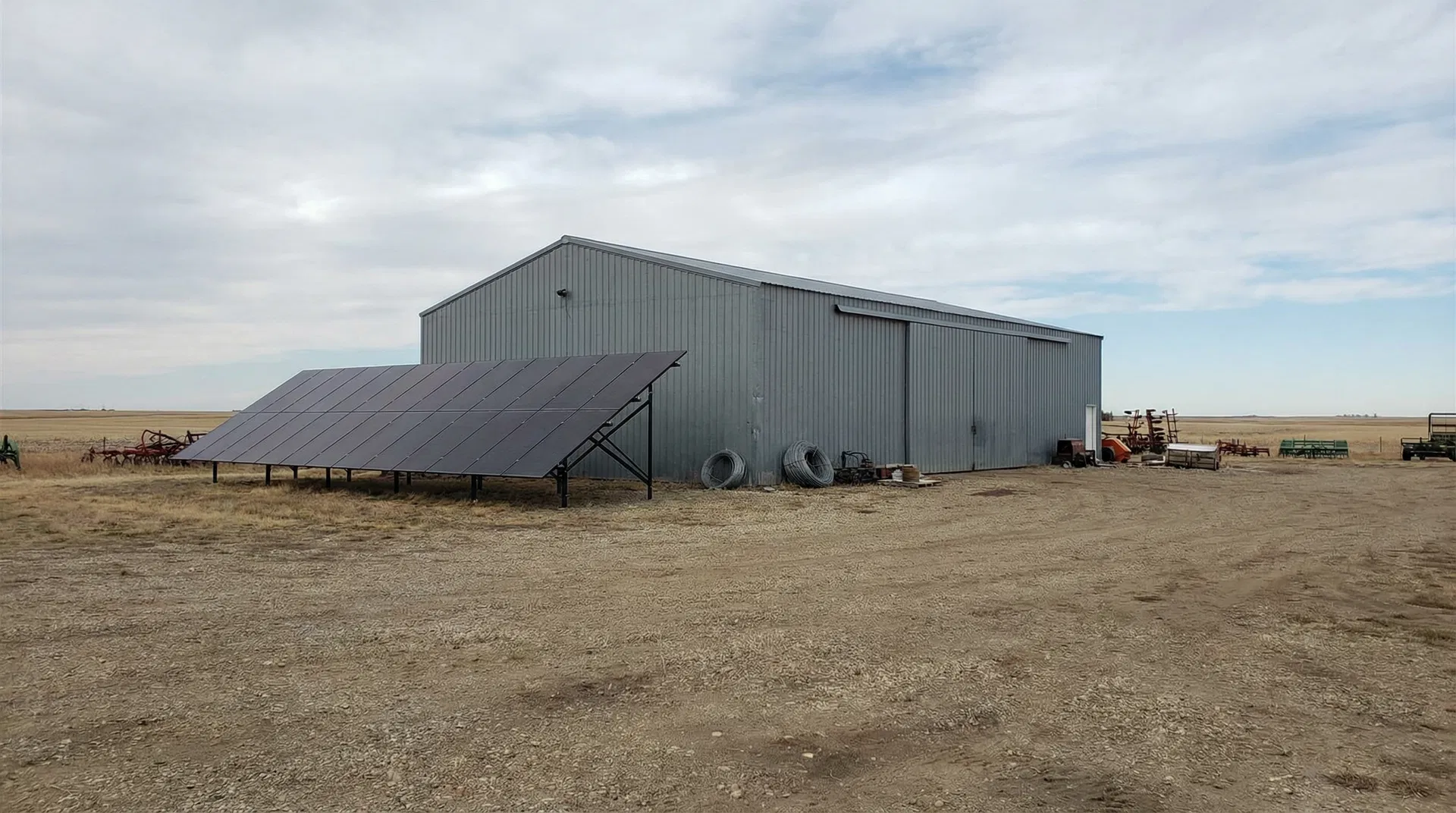
If you're researching commercial solar Mountain View County options for a shop, barn, or ag building, Range Road Solar sizes the system to the property, not a one-size package. Our commercial installs here run in the 15 to 100 kW range, with a 30 kW system typical for a mid-size shop or barn roof. We use LONGi panels on every job, and we pair them with APsystems microinverters on smaller commercial arrays or a string inverter setup once a system moves toward the top of that range, where string topology handles the higher DC voltage more efficiently. Ground mount comes up often on acreage and ag properties where the shop roof is shaded, undersized, or already carrying HVAC and vent equipment. We also look at the electrical service itself before finalizing a design: whether the property runs single-phase or three-phase, what the panel and breaker capacity can support, and whether the meter base needs upgrading before FortisAlberta will approve the interconnection application. None of that gets guessed. We pull the 12-month usage graph off your most recent power bill and build the system size around the load that graph actually shows, whether that's a welding shop running intermittent high draw or a grain operation with seasonal dryer loads.
Solar Planning for Mountain View County Properties
This area was incorporated January 1, 1961 as the County of Mountain View No. 17, and its economy still runs largely on prime agricultural land alongside a growing base of ag-service and light industrial operations. That mix means the properties we quote look different from a typical in-town commercial lot: working shops, grain handling buildings, irrigation pumps, and outbuildings spread across acreage rather than a single footprint on a paved lot. The Olds-Didsbury Regional Airport sits nearby too, and hangar and shop operations near it face the same wiring and load questions as a farm yard: single-phase or three-phase service, panel age, and how much roof or ground space is actually usable. FortisAlberta runs the wire service for properties here, and that shapes how we submit the interconnection application and how we size the inverter lineup. We don't hand out a flat per-acre number and call it a system design. Every quote starts with a site walk and your most recent power bill, because a welding shop with three-phase service draws differently than a grain operation running seasonal dryers, and the design has to match the load, not a template.
Electrical Site Review for Mountain View County Properties
Voltage Rise
Voltage rise happens when a solar inverter pushes power back through a long or thin distribution line, raising the voltage at the point of connection. Rural feeders often run longer distances between the transformer and the property than in-town service, so we check line length and conductor size before finalizing inverter output. If voltage rise is a concern, we may need to adjust inverter settings or system size so the inverter doesn't clip output trying to stay within voltage limits.
Single-Phase vs Three-Phase
Properties here can have single-phase or three-phase electrical service, and that distinction drives which inverter equipment fits the job. A three-phase shop or barn can usually support a larger, more efficient string inverter setup, while a single-phase property is often better matched to microinverters like the APsystems units we install. We confirm phase configuration during the site visit, since guessing wrong means resizing the whole system later.
Panel Infrastructure
Older electrical panels on rural properties don't always have the breaker capacity or busbar rating to add a solar backfeed breaker safely. We check the panel's age, amperage rating, and existing breaker load before finalizing a design, looking for signs like outdated fuse panels or panels already running close to capacity. If the panel can't support the addition, an upgrade to a larger panel or a supplemental load center happens before installation, not as a surprise after the fact.
Service Entrance Review
We inspect the service entrance and meter base as part of every site visit, checking for corrosion, outdated equipment, or a meter base that isn't rated for a solar interconnection. The meter base condition matters directly for the micro-generation application to FortisAlberta, since FortisAlberta reviews the service entrance as part of approving the connection. If an upgrade is required, we scope it as part of the project so the interconnection application isn't delayed by equipment that needed replacing anyway.
Right-Sizing Solar for Mountain View County Properties
Commercial and farm properties in the area typically need a bigger system than an in-town business, and it's rarely because of the shop alone. A single site might run a main building, a heated shop, grain handling equipment, and irrigation pumps, all on one service, and each of those loads adds up before we ever talk panel count. That's why we don't size off a rule of thumb like a flat number per square foot of roof. We pull the 12-month usage graph off your most recent power bill and size the system against what that graph actually shows across the year, not an assumption about what a shop should use. Roof mount makes sense when the shop or main building has clear south or west-facing roof space, a decent pitch, and no shading from nearby trees or grain bins. Ground mount becomes the better call when the roof is shaded, pitched wrong, already carrying HVAC or vent equipment, or when there's simply open yard space and it's more practical to build a ground array than to work around roof obstacles. Acreage and farm layouts often favor ground mount for exactly that reason: there's room, and it keeps the array clear of future shop or building expansion. Either way, the final call comes down to your site conditions and your bill, reviewed together, not a generic formula applied to every property the same way.
Typical Load Profiles We Design For Near Mountain View County
Shop + Main Building
This profile covers a property running a house or main office alongside a heated shop, where the shop's heating and equipment load often rivals or exceeds the main building's draw. We look at how the two loads stack through the year on the usage graph from your most recent power bill, since a shop that's heated hard in winter can shift the whole sizing conversation. The system gets sized to cover that combined load, not just the main building.
Grain Handling and Seasonal Dryer Load
Grain operations often carry a load that spikes hard for a few weeks a year when the dryer runs, then drops off the rest of the season. That kind of spiky, seasonal draw shows up clearly on the 12-month usage graph, and it changes how we think about system size versus a property with flat, steady usage. We size around the full-year picture rather than the peak dryer weeks alone, so the system pulls its weight the rest of the year too.
Multi-Building Ag Operation
Some properties run several structures off one service: a shop, a barn, a bunkhouse, or outbuildings with their own lighting and equipment loads. Each building adds to the total draw even when no single one looks large on its own, and that cumulative load is exactly what the usage graph on your power bill captures. We size the system against that combined picture rather than treating each building as a separate small project.
FortisAlberta Interconnection in Mountain View County
FortisAlberta is the wire service for properties in the area, and that's the utility Range Road Solar deals with directly on your interconnection application. We prepare the micro-generation application package, including the single-line diagram, equipment specifications for the LONGi panels and inverter setup, and the site details FortisAlberta needs to review the connection. For commercial systems in the 15 to 100 kW range, that package also documents how the system ties into your existing service, whether that's single-phase or three-phase, and what the meter base and service entrance look like on inspection. We don't quote a turnaround time for FortisAlberta's review, and we don't promise a specific credit or payout structure, because those depend on your rate plan and FortisAlberta's current process at the time you apply. What we do handle is the paperwork itself: preparing it correctly the first time so it doesn't bounce back for missing information. That's part of the design review, not a separate line item.
Project Economics and Design Review
| System Size | Annual Production | Year 1 Savings | Payback Period |
|---|---|---|---|
| 15-100 kW range, 30 kW typical |
Production, savings, and payback figures require a property-specific design and your most recent power bill, and we don't provide them before that review.
How We Work in Mountain View County
Bill and Load Review
We review your power bill to understand your energy use in Mountain View County and size the system to your actual consumption, not a generic estimate.
Site Assessment
We assess your roof or ground area, south-facing exposure, electrical service, and utility interconnection requirements specific to your property.
Design and Utility Application
We produce a system layout, production estimate, and cost summary, then submit your micro-generation application to your utility on your behalf.
Installation and Commissioning
Our crew installs racking, panels, inverter, and electrical connections. All work is performed by licensed electricians. We commission and test before handoff.
Current Program and Interconnection Review
Utility connection review
FortisAlberta reviews every grid connection application for a new solar system before it can be energized. Range Road Solar prepares the full design package, including equipment specs and the single-line diagram, and submits it on your behalf. We don't control FortisAlberta's review process, but we make sure the application is complete and accurate the first time it goes in.
Current program review
Commercial, farm, and residential solar projects can qualify for different incentive or tax treatment depending on rules in place at the time of installation. We review your project's eligibility against whatever rules are current when we build your design, rather than relying on outdated program information. That review happens as part of your design package, before you sign off on a system size.
Frequently Asked Questions
Get a Solar Assessment for Mountain View County
Submit a recent power bill and we will review your consumption and provide an honest assessment for your Mountain View County property. No obligation.
(587) 330-7502 Book a CallRelated Resources
More Solar Services in Mountain View County