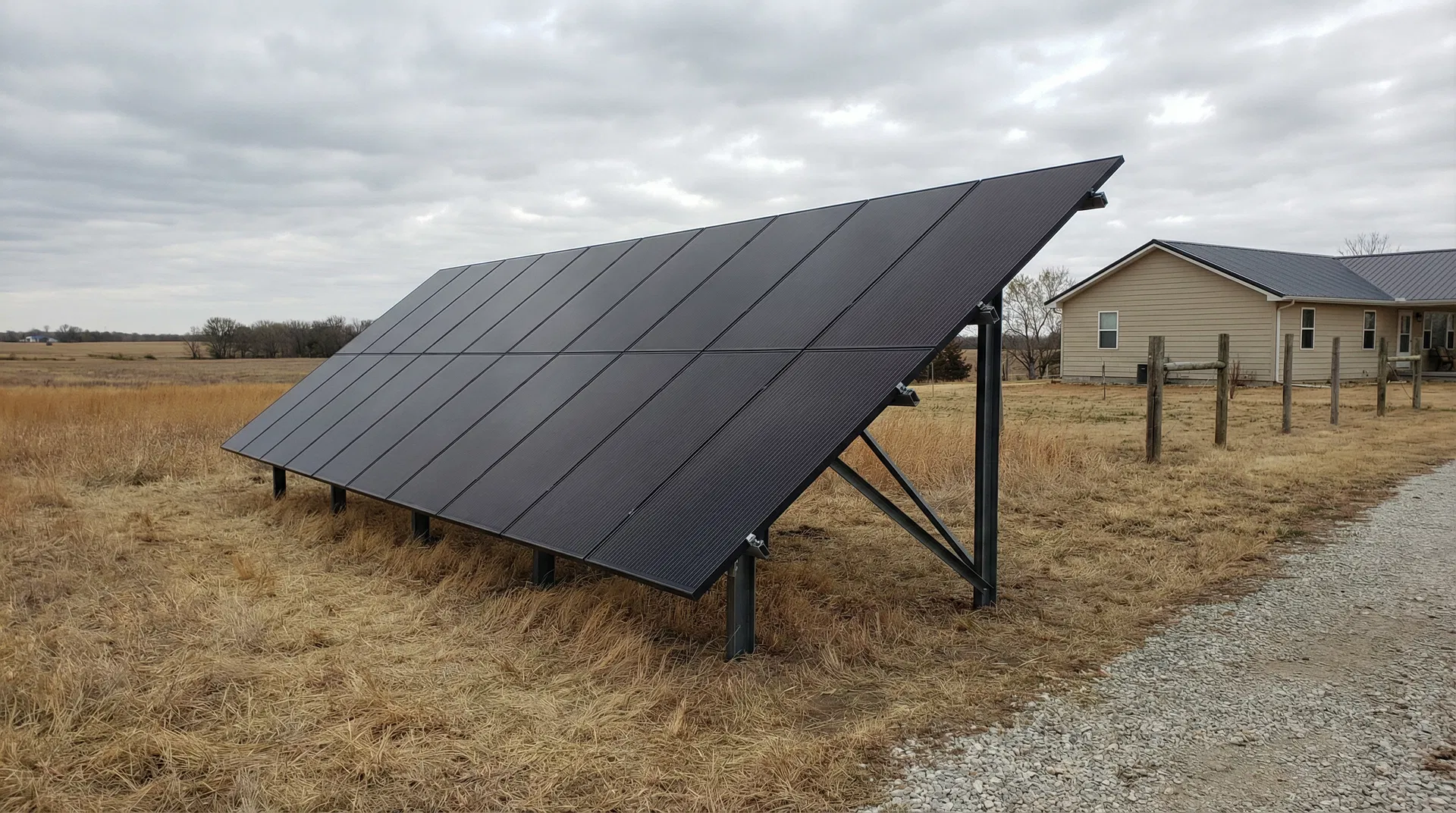
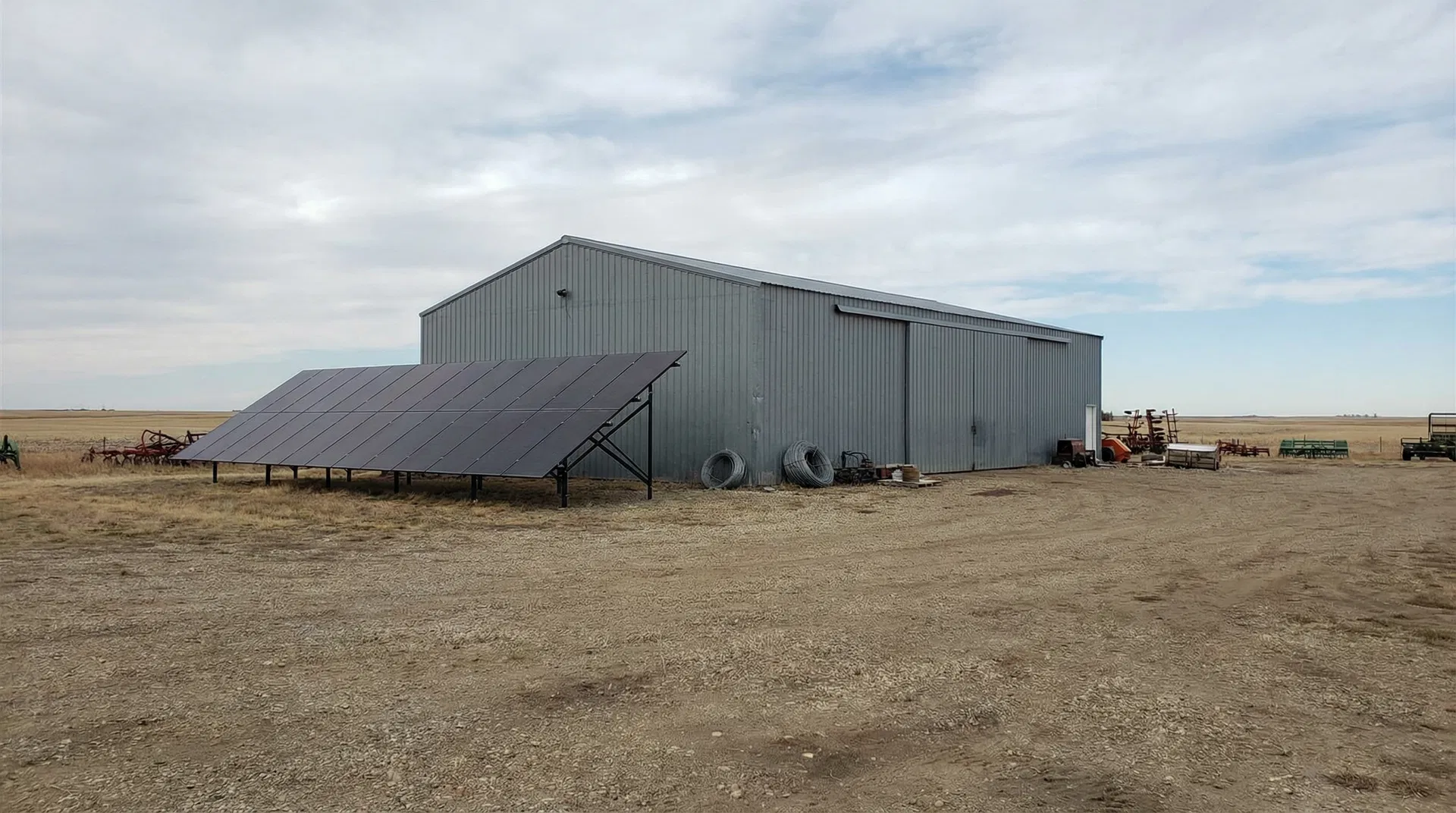
Commercial solar ponoka county projects typically fall in the 15 to 100 kW range, with a 30 kW system being a common starting point for mid-sized agricultural or light commercial operations. The right size depends entirely on your usage history, roof or ground-mount space, and the loads you're running. We install LONGi panels on every commercial project. They hold up well on metal and membrane commercial roofs, and they're rated for the kind of weather variability Alberta delivers. For systems under 30 kW with distributed roof sections, APsystems microinverters give you per-panel monitoring and avoid a single-point-of-failure. For larger commercial systems, string inverters are often the better fit, and we specify accordingly based on your site layout and phase configuration. Ground-mount systems are common on Ponoka County properties with flat or gently rolling yard space. When the roof isn't right, whether it's a poor pitch, too much equipment on the surface, or shading from adjacent grain bins or trees, a ground-mount array on a steel post structure keeps the project moving without compromising output. We review Canada's Investment Tax Credit for Clean Technology as part of every commercial design review. Eligibility and rates are confirmed against current federal rules at design time. If your operation qualifies, that credit materially changes the project economics. We build the review into the process, not as an afterthought. Every project includes a single-line electrical diagram, the FortisAlberta interconnection application, and a production model built from your actual site data.
Solar Planning for Ponoka County Properties
Commercial operations in Ponoka County run meaningful electrical loads. Grain handling, heated shops, cold storage, office buildings, and processing facilities all draw consistent power year-round. That kind of load profile is exactly what makes a grid-tied solar system worth designing properly. The county spans a wide range of property types, from small agri-business operations near Ponoka and Lacombe to larger industrial and mixed-use sites further out on rural roads. Each one has a different roof layout, service entrance configuration, and monthly load pattern. That's why we don't quote from a rate card. We size every system from the 12-month usage graph on your most recent power bill and a proper site review. FortisAlberta is the wire service here. Their micro-generation rules govern how your system connects to the grid, how excess generation is tracked, and what the application process looks like. We handle that paperwork. You don't need to coordinate directly with the utility. What you do need is a realistic picture of what a system can actually do for your specific load, on your specific site. That's what the design review delivers.
Electrical Site Review for Ponoka County Properties
Voltage Rise
Voltage rise happens when a solar system pushes power back toward the grid and the local distribution line isn't sized to absorb it without voltage climbing above acceptable limits. On longer rural distribution lines common in Ponoka County, that rise can be more pronounced than in a dense urban grid. If voltage rise exceeds FortisAlberta's threshold, the inverter will throttle output, which affects how we size the system and set export limits during design.
Single-Phase vs Three-Phase
Rural properties in this area may be served by single-phase or three-phase electrical service, and that distinction matters for how a commercial solar system is designed. Three-phase service supports larger inverter capacity and more flexible load balancing, while single-phase service caps how much power can be exported per leg. We confirm your service configuration during the site review so inverter selection and system capacity are matched to what's actually at the meter.
Panel Infrastructure
Older electrical panels on rural commercial and agricultural properties often weren't built with solar in mind, and breaker capacity can be a limiting factor. We assess panel age, available breaker slots, and the main breaker rating against the planned system size. If the existing panel can't safely support the solar connection, we'll include a panel upgrade in the project scope rather than design around a bottleneck.
Service Entrance Review
The service entrance and meter base are what FortisAlberta inspects as part of the micro-generation application, so their condition affects whether the interconnection can proceed without upgrades. We check the meter base housing, seals, and wiring condition during the site visit. If the meter base doesn't meet current FortisAlberta standards, an upgrade is required before the application moves forward, and we factor that into the project plan from the start.
Right-Sizing Solar for Ponoka County Properties
Commercial and agricultural properties in this area rarely have a single load to offset. A typical site might be running a heated shop, a main office or retail building, cold storage, yard lighting, and irrigation or grain handling equipment all under one account. That stacked load profile means systems here often need to be larger than what you'd see on a suburban commercial building of similar square footage. Roof mount works well when the commercial roof is in good condition, properly oriented, and free of shading from adjacent structures. A lot of properties in the county have exactly that: large south-facing metal roofs on shops and storage buildings with no obstructions. When they don't, we look at ground mount. If the roof pitch is wrong, if rooftop equipment takes up too much space, or if the yard has a clear open stretch with better solar access, a ground-mount array on steel posts is often the cleaner solution. We don't size systems from rule-of-thumb averages. The 12-month usage graph on your most recent power bill shows us your actual consumption pattern by month, including the seasonal peaks that matter most for system sizing. That graph, combined with a site visit to assess roof or land conditions, orientation, shading, and service infrastructure, is how we arrive at a system size that reflects your real load, not a generic estimate. We provide honest production estimates based on your actual power bills and site conditions, not inflated projections.
Typical Load Profiles We Design For Near Ponoka County
Agricultural Operation with Heated Shop and Grain Handling
Farms running grain augers, dryers, and heated equipment storage carry significant and variable electrical loads across the year, with heavy usage concentrated in harvest and planting seasons. A system sized for this kind of operation typically sits in the 40 to 75 kW range and often uses a combination of roof-mount on the shop and a ground-mount array to cover the full load. We size from the 12-month usage graph on the most recent power bill to capture both the base load and the seasonal spikes.
Light Commercial Building with Year-Round HVAC
Office buildings, retail operations, and service businesses with consistent HVAC, lighting, and equipment loads are strong candidates for a 15 to 30 kW rooftop system. These properties tend to have a more predictable monthly consumption pattern than agricultural sites, which makes production modeling straightforward. We confirm system size against the most recent power bill and roof conditions before finalizing any design.
Mixed-Use Property with Shop, Cold Storage, and Office
Properties combining a commercial shop, refrigerated storage, and an office building under one utility account often need a 30 to 60 kW system to make a meaningful dent in the combined load. Cold storage runs continuously, which creates a reliable base load that solar can offset well during daylight hours. We map each load category against the monthly usage graph to determine where solar generation lines up most effectively with actual consumption.
FortisAlberta Interconnection in Ponoka County
FortisAlberta is the wire service for Ponoka County. Any solar system connected to the grid here goes through their micro-generation application process, and the design package has to meet their technical standards before approval. We handle the full FortisAlberta application on your behalf. That includes the single-line diagram, system specifications, equipment documentation, and any follow-up correspondence the utility requires. You won't need to navigate their interconnection portal or figure out what they need. That's our job. For commercial systems in the 15 to 100 kW range, FortisAlberta's review process is more involved than a standard residential application. Larger systems may require additional technical documentation or load-flow analysis depending on the point of connection and service capacity at your site. We design with those requirements in mind from the start, so there are no surprises partway through the application. We don't make claims about approval timelines or how your exported generation will be settled. Those details depend on current utility rules and your specific service agreement, and we walk through them honestly during the design review.
Project Economics and Design Review
| System Size | Annual Production | Year 1 Savings | Payback Period |
|---|---|---|---|
| 15-100 kW range, 30 kW typical |
Production, savings, and payback figures require a property-specific design review and your most recent power bill before any estimates are prepared.
How We Work in Ponoka County
Bill and Load Review
We review your power bill to understand your energy use in Ponoka County and size the system to your actual consumption, not a generic estimate.
Site Assessment
We assess your roof or ground area, south-facing exposure, electrical service, and utility interconnection requirements specific to your property.
Design and Utility Application
We produce a system layout, production estimate, and cost summary, then submit your micro-generation application to your utility on your behalf.
Installation and Commissioning
Our crew installs racking, panels, inverter, and electrical connections. All work is performed by licensed electricians. We commission and test before handoff.
Current Program and Interconnection Review
Utility connection review
FortisAlberta reviews grid connection applications for all solar installations in Ponoka County. Range Road Solar prepares the full design package, including single-line diagrams and equipment documentation, and submits it directly to FortisAlberta on your behalf. You don't need to manage the utility relationship separately.
Current program review
Eligibility for commercial, agricultural, and farm-related solar programs is reviewed against current federal and provincial rules at the time of your design. We don't publish program details that may have changed since this page was written. What's available and what your operation qualifies for gets confirmed during the design review, not before.
Frequently Asked Questions
Get a Solar Assessment for Ponoka County
Submit a recent power bill and we will review your consumption and provide an honest assessment for your Ponoka County property. No obligation.
(587) 330-7502 Book a CallRelated Resources