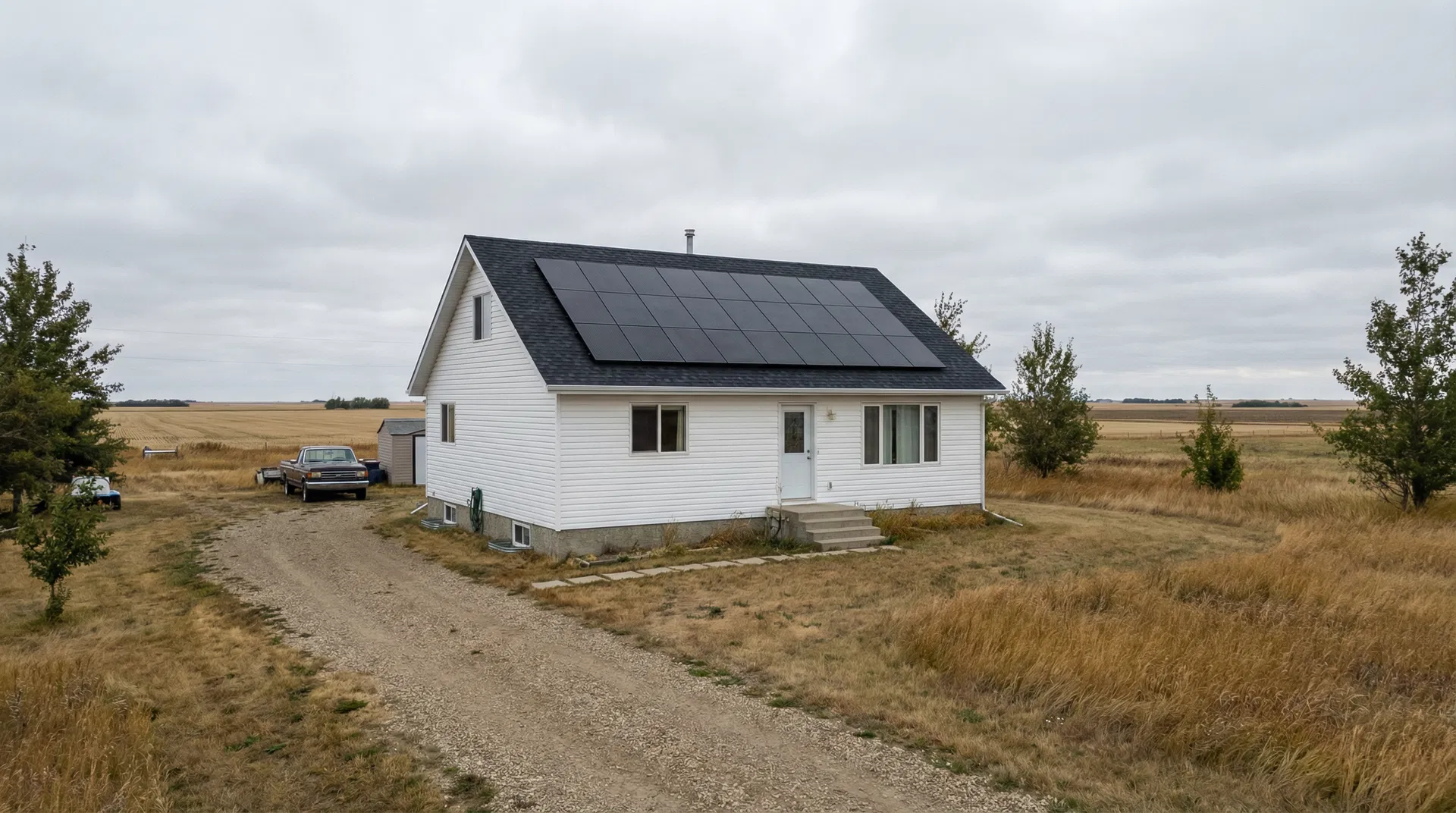
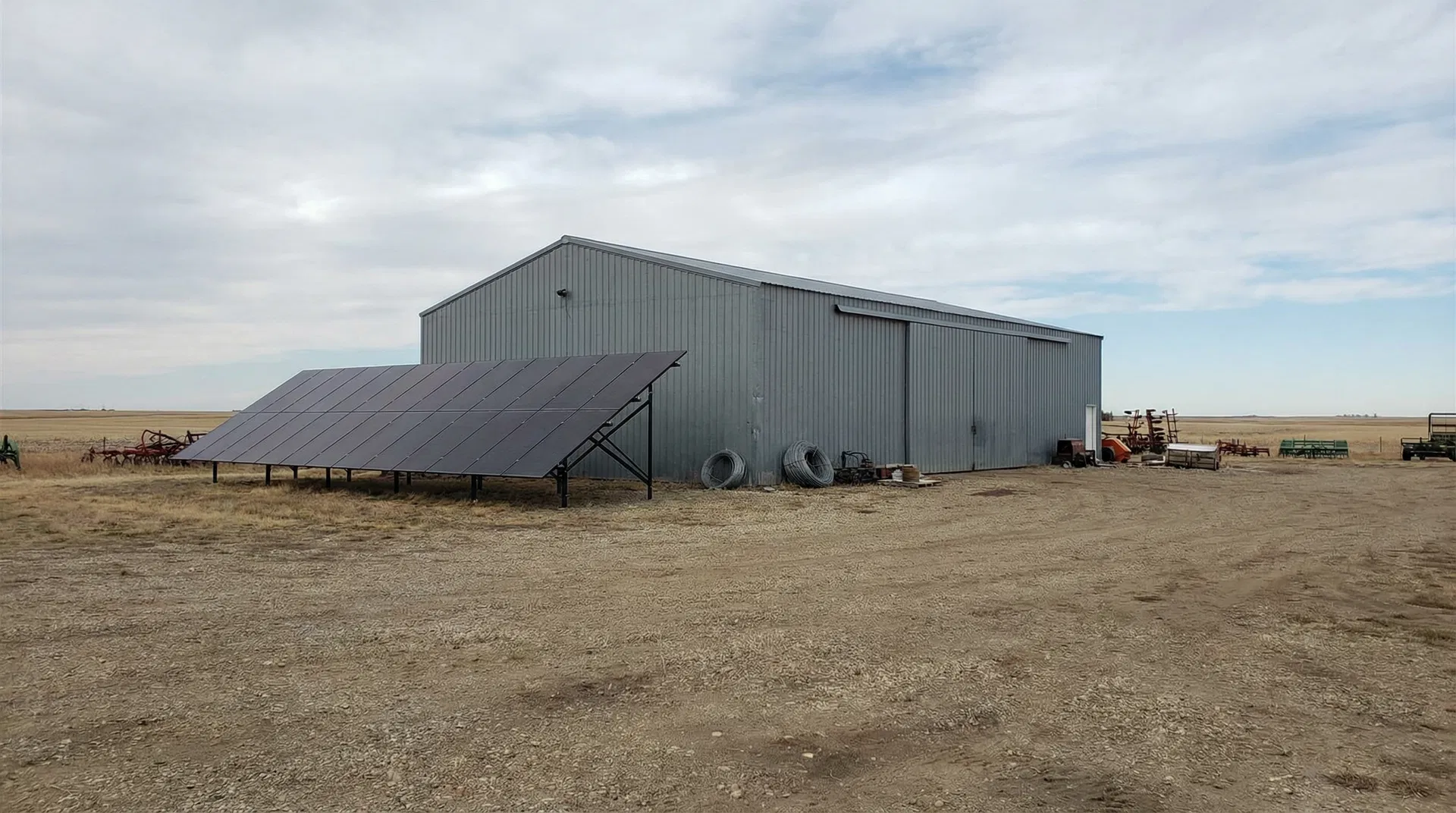
Commercial solar in Stettler County runs in the 15 to 100 kW range for most of the businesses, farms, and acreage operations we design for here. That range covers a lot of ground: a 15 kW system might cover a small shop or office, while a 100 kW array is sized for a grain facility, a multi-building yard, or an oilfield services operation running heavier equipment. Every system starts with LONGi panels, which we use across both residential and commercial projects for consistent performance and warranty support. For smaller commercial arrays, we typically pair them with APsystems microinverters, which let us monitor production at the panel level and keep a fault on one string from taking down the whole array. Once a system moves toward the top of that 15 to 100 kW range, or the property runs three-phase service, we look at string inverters instead. String inverters handle higher voltage and larger arrays more efficiently than a microinverter setup at that scale, and they simplify maintenance on a bigger roof or ground-mount field. Mounting depends on the building. Pole barns, quonsets, and flat commercial roofs each take a different racking approach, and some properties have enough open yard space that a ground-mount array makes more sense than fighting roof pitch or shading from a nearby structure. We walk the property, look at the roof or available land, and confirm the right mix of equipment before we write up a design.
Solar Planning for Stettler County Properties
Stettler County, Alberta has grown from 5,322 residents in 2016 to 5,666 today, and the regional economy still rests on two identified anchors: an Agricultural Hub and the Oil and Gas Sector. Commercial buildings reflect that mix. A grain handling facility, a welding shop, and an oilfield services yard all draw power differently, and all three sit on FortisAlberta's wire service. That variety is exactly why we don't start a commercial quote with a generic number. We start with your most recent power bill, which carries a 12-month usage graph showing how your load actually moves through the year, and we pair that with a site visit to check roof condition, available ground space, and your electrical service. Environment Canada's climate normals for the Red Deer A station, the nearest long-term record, list 2,125.0 hours of bright sunshine a year, and NRCan's solar resource maps put the PV-specific yield for this part of Alberta at 1,265 kWh/kWp. Those are regional reference figures, not a promise for your roof or field. What a system here actually produces depends on orientation, shading, and tilt, which is why we confirm real numbers through design, not averages.
Electrical Site Review for Stettler County Properties
Voltage Rise
Voltage rise happens when power runs a long distance along a rural distribution line before it reaches your service, and the voltage at your panel can sit higher than it would closer to a substation. That matters for solar because an inverter has to stay within a set voltage window to keep exporting, and in some cases it will throttle or clip output rather than push voltage even higher. We check line conditions and your service voltage as part of sizing, so the system we design doesn't run into clipping once it's installed.
Single-Phase vs Three-Phase
Commercial properties here run on either single-phase or three-phase electrical service, and which one you have changes what equipment fits. Three-phase service generally opens up a wider range of inverter options and supports larger system capacity, while single-phase service caps how much a given inverter setup can handle. We confirm your service type early, since it shapes which inverters and system size we design around.
Panel Infrastructure
Older commercial panels weren't built with a second power source in mind, so we check breaker capacity and panel age before finalizing a design. We look at the panel's rated capacity, the age and condition of the breakers, and whether there's room for a backfeed breaker sized to the new system. If the panel can't support it, an upgrade means a new panel or breaker sized to handle both the building's existing load and the solar system.
Service Entrance Review
We review the service entrance and meter base as part of every commercial site visit, checking the condition of the conductors, the meter base enclosure, and the connection point itself. The meter base has to be in good working condition because FortisAlberta's micro-generation application includes it as part of the interconnection review. If the meter base or service entrance needs an upgrade before it can support the application, we scope that out as part of the project plan.
Right-Sizing Solar for Stettler County Properties
Commercial and farm properties here often carry more than one load behind a single meter: a main building plus a shop, grain handling equipment, irrigation, or a yard full of oilfield service equipment. That's a different sizing problem than a single-family home, and it's part of why system sizes span such a wide range. Roof or ground mount comes down to the property itself. A tight commercial roof with HVAC units, vents, and limited clear space might not have enough usable area for the system a business needs, and shading from a taller building or windbreak can rule out sections of roof entirely. When that's the case, and there's open yard or field space available, a ground-mount array is often the better call. It also gives us more control over orientation and tilt than a fixed roof pitch does. We size every system from the 12-month usage graph on your most recent power bill, not a rule-of-thumb per-square-foot estimate. That graph shows how your load actually moves across the year: seasonal spikes from heating, grain drying, or seasonal equipment show up clearly, and we design around that real pattern. Combined with a site visit, that's what turns into a specific system size, not a guess.
Typical Load Profiles We Design For Near Stettler County
Shop and Main Building
This profile combines a main commercial building with an attached or separate heated shop, which often means two distinct load patterns under one account. We read both off the 12-month usage graph on your most recent power bill and design a system sized to the combined load, not just the office or storefront.
Grain Handling and Seasonal Equipment
Grain handling operations see sharp seasonal spikes when augers, dryers, and aeration fans run hard for a few weeks and sit mostly idle the rest of the year. Sizing a system around that pattern means looking at peak months on your power bill, not an average, so the array matches the load when it actually happens.
Oilfield Services Yard
A yard running oilfield service equipment, compressors, or welding bays tends to carry a steadier daytime draw than a seasonal operation does. We size these systems from your most recent power bill and a walk-through of the equipment actually running on site, so the array matches how the yard draws power day to day.
FortisAlberta Interconnection in Stettler County
FortisAlberta is the wire service for commercial and farm properties we work with in Stettler County, and that's the utility every interconnection application for a new solar system routes through. Before a system goes in, the design package has to include the right paperwork for FortisAlberta's micro-generation process: single-line electrical diagrams, equipment specifications for the panels and inverters, and site details specific to your service entrance. Range Road Solar prepares and submits that full package on your behalf. We don't ask you to track down the forms or interpret the application yourself. We handle the FortisAlberta submission the same way for a 15 kW shop system and a 100 kW facility: correct paperwork, matched to your actual electrical setup, submitted once. We don't quote approval timelines, credit terms, or payout rates here, because those depend on current FortisAlberta rules and your retailer at the time you apply. We confirm what applies to your project when we build your design package, not before.
Project Economics and Design Review
| System Size | Annual Production | Year 1 Savings | Payback Period |
|---|---|---|---|
| 15-100 kW range, 30 kW typical |
Production, savings, and payback figures are specific to your property and require a design review plus your most recent power bill.
How We Work in Stettler County
Bill and Load Review
We review your power bill to understand your energy use in Stettler County and size the system to your actual consumption, not a generic estimate.
Site Assessment
We assess your roof or ground area, south-facing exposure, electrical service, and utility interconnection requirements specific to your property.
Design and Utility Application
We produce a system layout, production estimate, and cost summary, then submit your micro-generation application to your utility on your behalf.
Installation and Commissioning
Our crew installs racking, panels, inverter, and electrical connections. All work is performed by licensed electricians. We commission and test before handoff.
Current Program and Interconnection Review
Utility connection review
FortisAlberta reviews every grid-connection application for a new solar system before it's approved to interconnect. Range Road Solar prepares the full design package, including the single-line diagrams and equipment specifications, and handles the submission on your behalf.
Current program review
Commercial, farm, and residential solar projects are each reviewed against whatever federal, provincial, and utility rules are in effect at the time of your design, since eligibility and requirements change. We check your project against current rules when we build your design package rather than relying on what applied last year.
Frequently Asked Questions
Get a Solar Assessment for Stettler County
Submit a recent power bill and we will review your consumption and provide an honest assessment for your Stettler County property. No obligation.
(587) 330-7502 Book a CallRelated Resources