
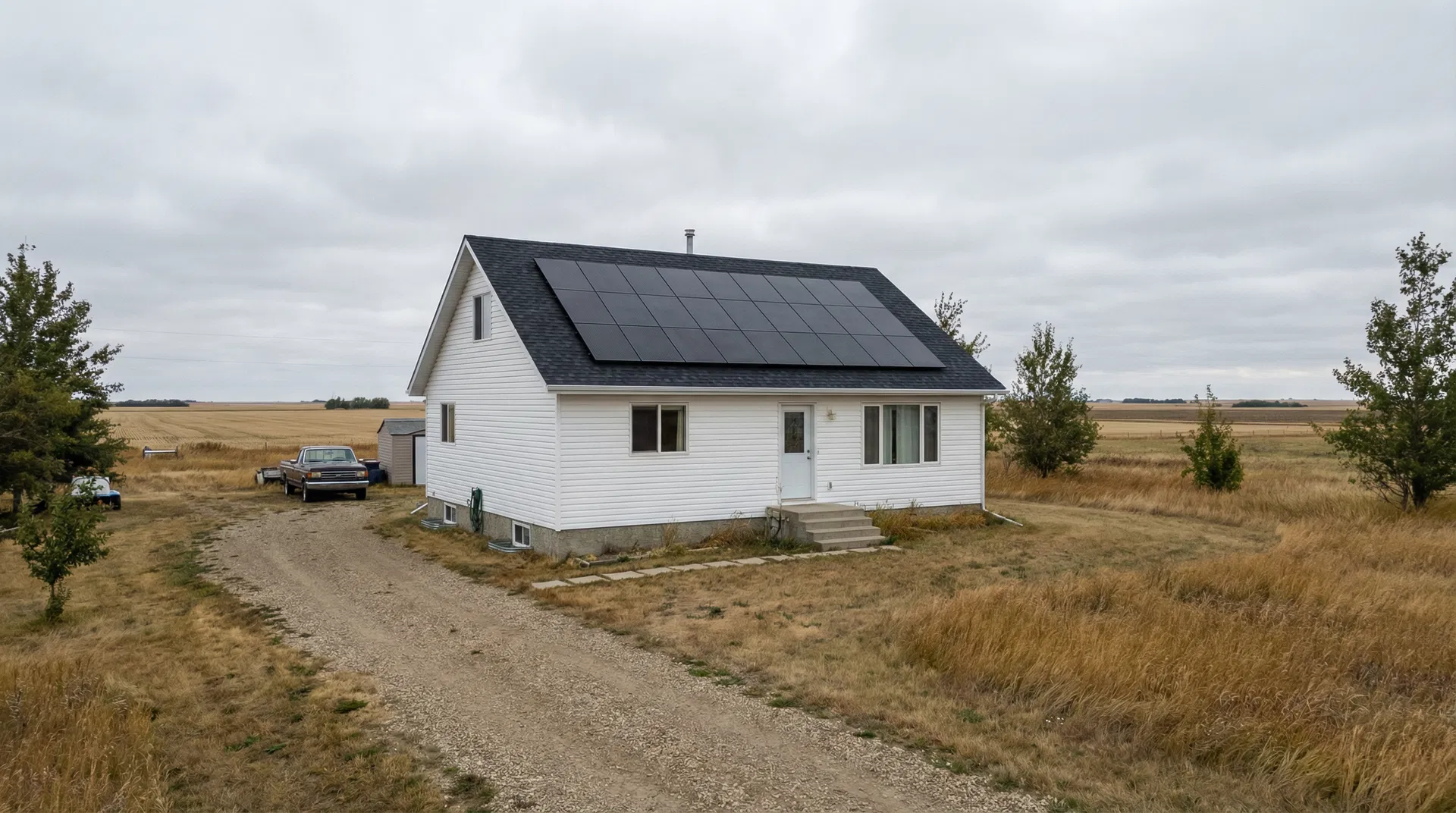
Solar Financing in Eckville, Alberta starts with the equipment, because financing a system means financing real hardware, not a concept. Range Road Solar installs LONGi panels paired with APsystems microinverters on properties here, and the financing plan we put together is sized against the system those components actually build, an 8 to 15 kW array for most residential and acreage properties, with 10 kW as the typical size we see. Microinverters from APsystems make sense on a lot of these properties because roof lines aren't always simple: a farmhouse roof with a couple of dormers, a shop roof with a different pitch than the house, or a layout where partial shade from a tree line hits part of the array but not all of it. Panel-level conversion means one shaded or underperforming panel doesn't drag the whole string down, which matters for financing because it protects the production the payment is based on. We don't finance a system before we've sized it. The process runs in order: site visit, review of your most recent power bill, a design that accounts for your roof or ground-mount conditions, then a financing plan with a monthly payment we size against the bill the system is replacing. That's true whether it's a house financing an 8 kW roof array or a property with a shop and grain handling equipment financing a larger 15 kW system. LONGi panels and APsystems microinverters are the default equipment on every quote we build, financed or not.
Solar Planning for Eckville Properties
Eckville is a small property base. The 2021 census put the population at 1,014, down from 1,125 the census before, and that scale is exactly why a generic solar financing quote doesn't work here. The town has a longer history than the population number suggests: it was incorporated as a Village on November 3, 1921, and became a Town on July 1, 1966. A lot of the homes and outbuildings on the surrounding properties predate solar as a normal add-on, which means every system has to be planned around the property that's actually there, not a subdivision template. Agricultural support industries are a real part of the local economy, and that shows up on site visits: a house, a shop, sometimes a second building, all drawing off the same service. That's the kind of load profile financing has to fit. Range Road Solar doesn't quote a size off a rule of thumb. We walk the property, look at the roof or ground-mount options, and pull the 12-month usage graph off your most recent power bill before we build a financing plan. The monthly payment gets sized against the bill it's replacing, not against a number that sounds good in an ad.
Electrical Site Review for Eckville Properties
Voltage Rise
Voltage rise happens when the distance and wiring between a property and the nearest transformer cause the voltage at the point of connection to run higher than at the source, and rural distribution lines in this area can have exactly that kind of run. That matters for solar because an inverter that sees voltage climb too high during peak production hours will clip output to protect itself. We check the distribution conditions at your service point as part of system sizing, so the inverter and array size we land on actually holds up under real conditions.
Single-Phase vs Three-Phase
Properties in this area can have either single-phase or three-phase electrical service, and which one you've got affects both inverter selection and how much system capacity we can put behind a single connection. A three-phase service, common on some farm and shop setups, opens up different inverter options than a single-phase residential service does. We confirm which type of service is on your property before we spec equipment, not after.
Panel Infrastructure
A lot of rural properties around here are running electrical panels that are older than the solar equipment we're installing, and breaker capacity is one of the first things we check. We look at panel age, available breaker space, and busbar rating to see whether it can take a solar breaker without exceeding code limits. If it can't, an upgrade means a new panel sized for both existing loads and the new system, done before the array goes in.
Service Entrance Review
The service entrance and meter base are part of what FortisAlberta reviews when we submit a micro-generation application, so we check the condition of both before we finalize a design. An older or damaged meter base can hold up that application even if the rest of the electrical system is fine. If an upgrade is needed, we fold it into the project scope so the interconnection application isn't the thing that stalls the timeline.
Right-Sizing Solar for Eckville Properties
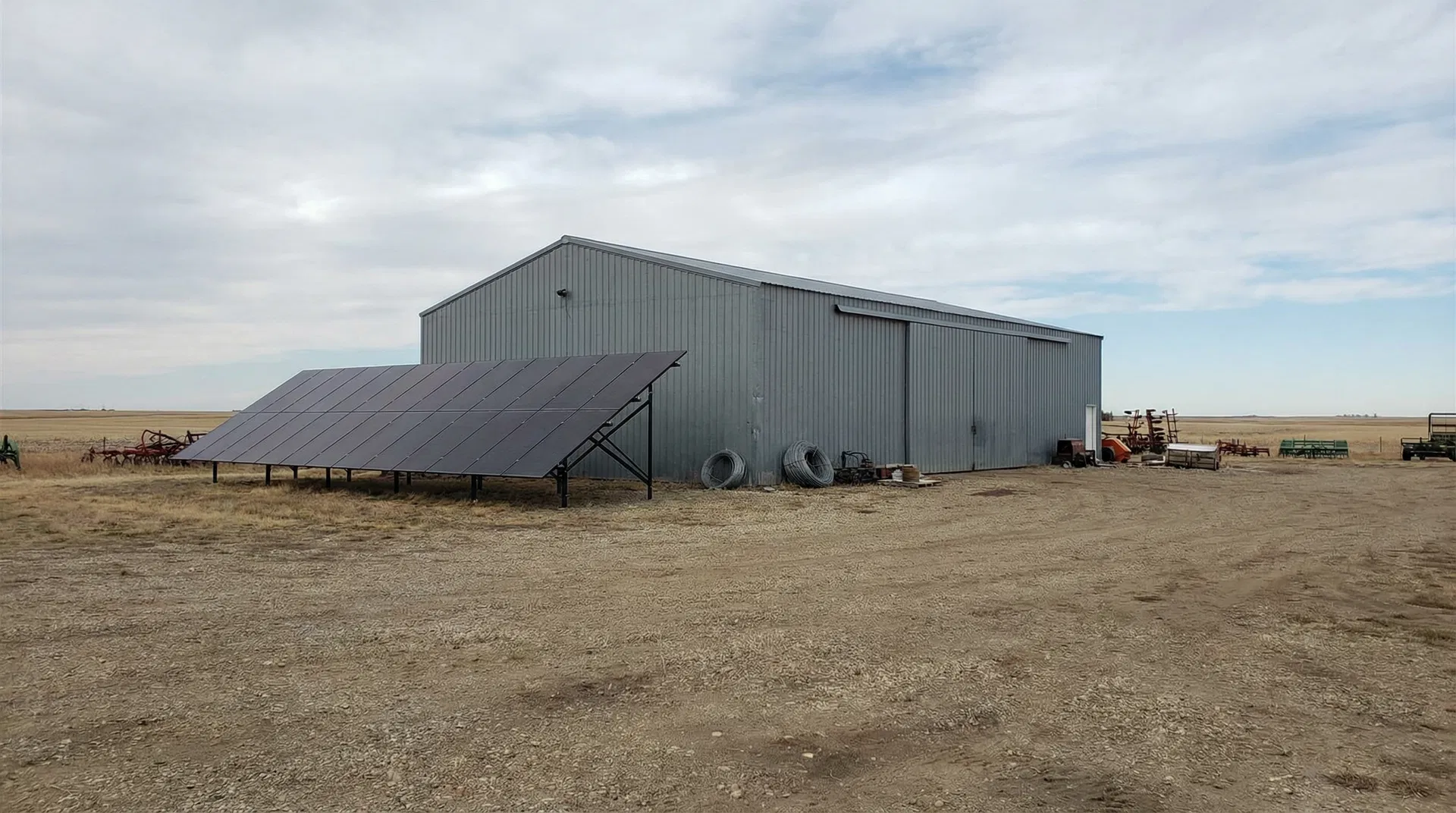
A system sized for a rural property in this area usually ends up bigger than a comparable system in a city subdivision, and that's because rural properties stack more than one load onto a single service: the house, sometimes a heated shop, an outbuilding or two, and on working properties, irrigation pumps or grain handling equipment. All of that draws off the same connection, and a system sized only for the house misses most of what's actually using power. Roof versus ground mount comes down to what's on the property. If the roof has good exposure and enough usable area, that's usually the simpler and less expensive option. But when trees or other buildings shade the roof, when the pitch or orientation isn't right, or when there's a spread-out yard with open land available, a ground-mounted array is often the better call and gives us more control over orientation. Either way, we don't size a system off a rule of thumb like watts-per-square-foot or a generic multiplier. We pull the 12-month usage graph off your most recent power bill, which shows the actual pattern of what the property uses across a full year, and we combine that with a site design that accounts for your roof or ground-mount conditions. That combination, current bill plus site design, is what determines the system size we recommend and the financing plan built around it.
Typical Load Profiles We Design For Near Eckville
Home + Heated Shop
This is one of the most common load profiles we see in this area: a house plus a heated shop drawing on the same service. The shop's heating and any tools or equipment inside add a load on top of the home, and that combination often points toward the upper end of the 8 to 15 kW range rather than the lower end. We size it off the 12-month usage graph on your most recent power bill, which shows both loads together.
Acreage with Irrigation or Well Pump
Properties with irrigation or a well pump running through the growing season have a load profile that spikes at certain times of year rather than staying flat. That seasonal pattern shows up clearly on the usage graph on your power bill, and it's part of why we design off that graph instead of a flat estimate. The system has to cover the peak months, not just an average.
Farm with Grain Handling Equipment
A working farm with grain handling equipment, augers, or dryers has a load profile that's different again: short bursts of heavy draw during harvest, with lighter use the rest of the year. We look at how that shows up on your most recent power bill and design a system, and a financing plan, that reflects when the property actually uses the most power, not just how much it uses on paper.
FortisAlberta Interconnection in Eckville
FortisAlberta is the wire service for properties in and around Eckville, and any grid-connected solar system here has to go through FortisAlberta's micro-generation interconnection process before it's turned on. Range Road Solar handles that application as part of every installation we finance, residential or farm. That includes the site-specific paperwork FortisAlberta requires to review a grid-tied system, whether it's an 8 kW roof array on a house or a 15 kW system split between a home and a shop. We don't leave that step to the homeowner to figure out on their own, and we don't treat it as an afterthought once the panels are up: it's part of the design package from the start, alongside the financing plan itself. If your property already has FortisAlberta service, as most properties in the area do, the interconnection application is a known process for us. We can't quote you an approval timeline or tell you how a specific credit or payout works, because those depend on current FortisAlberta rules and your specific setup. What we can do is confirm the details that apply to your property during the design review, before financing terms are finalized.
Project Economics and Design Review
| System Size | Annual Production | Year 1 Savings | Payback Period |
|---|---|---|---|
| 8-15 kW range, 10 kW typical |
Production, savings, and payback figures require a property-specific design review using your most recent power bill and current FortisAlberta rules, and we don't publish estimates without one.
How We Work in Eckville
Bill and Load Review
We review your power bill to understand your energy use in Eckville and size the system to your actual consumption, not a generic estimate.
Site Assessment
We assess your roof or ground area, south-facing exposure, electrical service, and utility interconnection requirements specific to your property.
Design and Utility Application
We produce a system layout, production estimate, and cost summary, then submit your micro-generation application to your utility on your behalf.
Installation and Commissioning
Our crew installs racking, panels, inverter, and electrical connections. All work is performed by licensed electricians. We commission and test before handoff.
Current Program and Interconnection Review
Utility connection review
FortisAlberta reviews every grid-connected micro-generation application before a system goes live, and Range Road Solar prepares and submits that application as part of the design package on every project we finance. We don't leave that step for you to navigate on your own.
Current program review
Residential, farm, and commercial properties can qualify for different financing terms and program rules, and those rules change. We check current eligibility against your property type, whether it's a house, an acreage, or a working farm, at the time we build your design and financing plan, not off an outdated list.
Frequently Asked Questions
Get a Solar Assessment for Eckville
Submit a recent power bill and we will review your consumption and provide an honest assessment for your Eckville property. No obligation.
(587) 330-7502 Book a CallMore Solar Services in Eckville