Solar financing in Ponoka, Alberta is built around one number: the payment your household or operation can actually carry each month, not a sales target. We size every system first, then structure the payment around it, not the other way around. For most properties here, that means an 8 to 15 kW system, with 10 kW being the typical install for a single-family home on a standard residential lot. Every system we finance uses LONGi panels paired with APsystems microinverters. We default to this combination because it holds up on the roof types we see most around here, from older asphalt-shingle homes to metal roofing on newer builds and acreage shops. Microinverters also let us finance in stages on larger properties: a homeowner can finance the house system now and add shop or barn capacity later without replacing existing equipment. We work with financing terms that spread the cost over a period matched to the system's expected service life, with a monthly payment sized against the bill it's meant to replace. Before we quote a payment, we need your most recent power bill. That bill carries the 12-month usage graph we use to size the system correctly, instead of guessing from square footage or roof size alone. Whether you're financing a straightforward rooftop system on a residential home or a larger ground-mount array on an acreage outside it, the process starts the same way: a site visit, a look at your panel and service entrance, and a design built from your actual numbers.
Solar Planning for Ponoka Properties
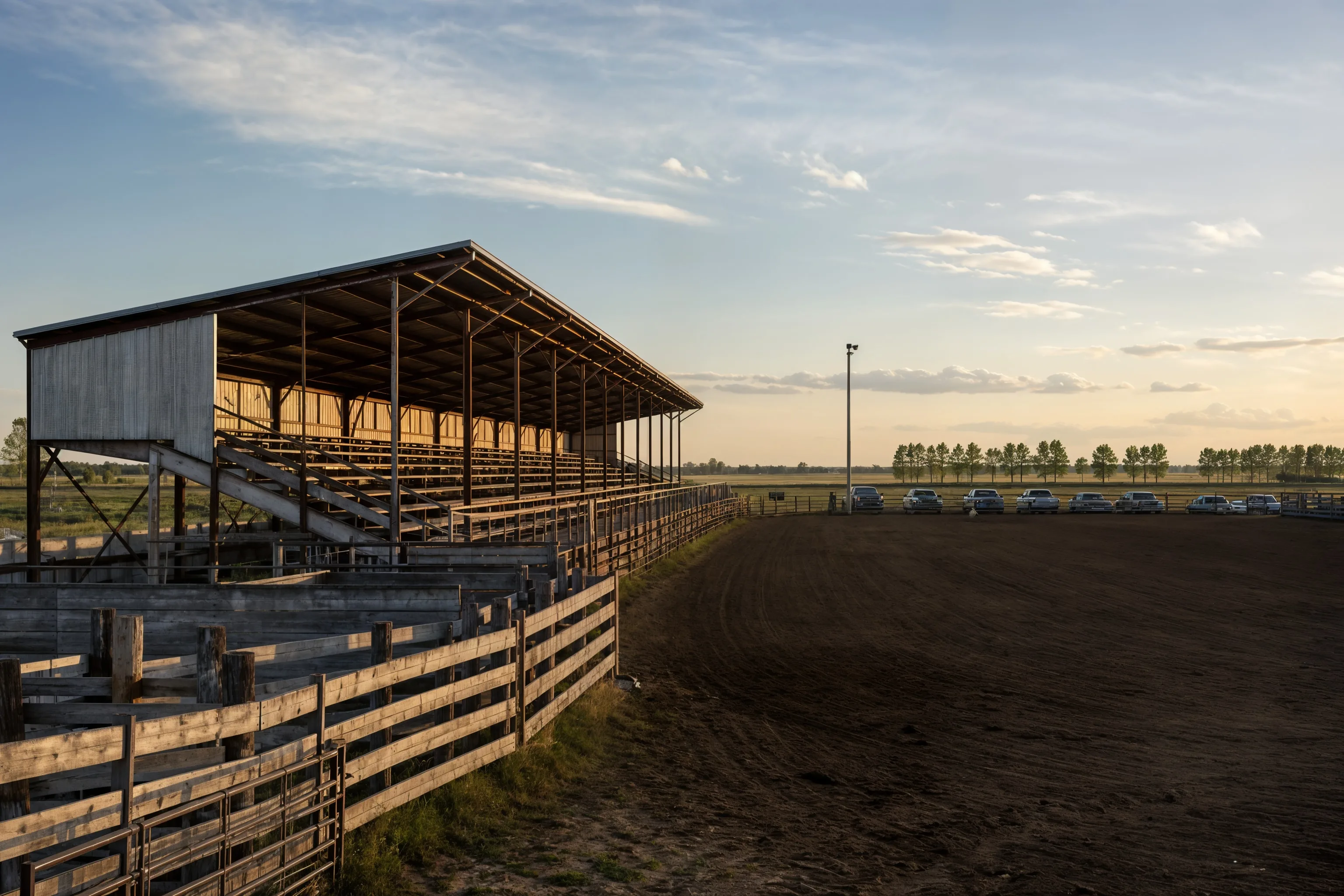
Ponoka sits on Highway 2A between Red Deer and Edmonton, and the properties we design for here run from lots close to the core to acreages further out. Ponoka was incorporated on October 19, 1904, and has grown into a community of 7,331 people, up from 7,229 at the prior census. That growth shows up in a real mix of housing stock: older homes with original electrical panels, newer builds, and acreages with shops, barns, or outbuildings that each add their own load to the picture. Solar planning starts with what's already on the property, not a generic template. A home near the Ponoka Stampede Grounds has different roof orientation and shading than a shop out past the Centennial Centre for Mental Health and Brain Injury. We walk the site, check the breaker panel, look at roof pitch or scope out ground-mount options, and we don't guess at system size. We confirm it against your most recent power bill and the usage graph printed on it. That's the same process whether you're financing a 9 kW rooftop array on a standard residential lot or a 14 kW ground-mount setup on an acreage further out.
Electrical Site Review for Rural Properties
Voltage Rise
Voltage rise happens when the line voltage at a property creeps higher than standard because of distance from the transformer or the condition of the local distribution line. On rural and small-town feeders, that rise can push the point of common coupling closer to an inverter's upper voltage limit, which affects how much the inverter can produce before it clips or trips offline. We measure voltage at the panel during the site visit so system sizing accounts for it instead of assuming a textbook number.
Single-Phase vs Three-Phase
Properties on the outskirts or further out on acreages may have single-phase service, while some larger operations and shops run three-phase. That distinction matters for financing because it narrows which inverter models and system capacities make sense. We confirm phase type during the site visit so the equipment we quote and finance actually matches what's at the panel.
Panel Infrastructure
Older homes and farm services around here sometimes carry original breaker panels and 100-amp or smaller main services, which weren't built with solar in mind. We check panel age, available breaker space, and busbar rating, since cramming a new solar breaker into a full panel is both a safety problem and a reason an inspector will fail the job. If the panel can't support the added circuit, an upgrade to a larger main service or a subpanel usually solves it, and we price that into the financing conversation up front rather than as a surprise later.
Service Entrance Review
We also check the condition of the meter base and service entrance conductors on-site, since this is what gets reviewed alongside the micro-generation interconnection application to the Town of Ponoka. A corroded, undersized, or outdated meter base can hold up that application regardless of how well the solar system itself is designed. If an upgrade is needed, we scope it as part of the financed project rather than leaving it as a separate surprise cost.
Right-Sizing Solar for Rural Properties
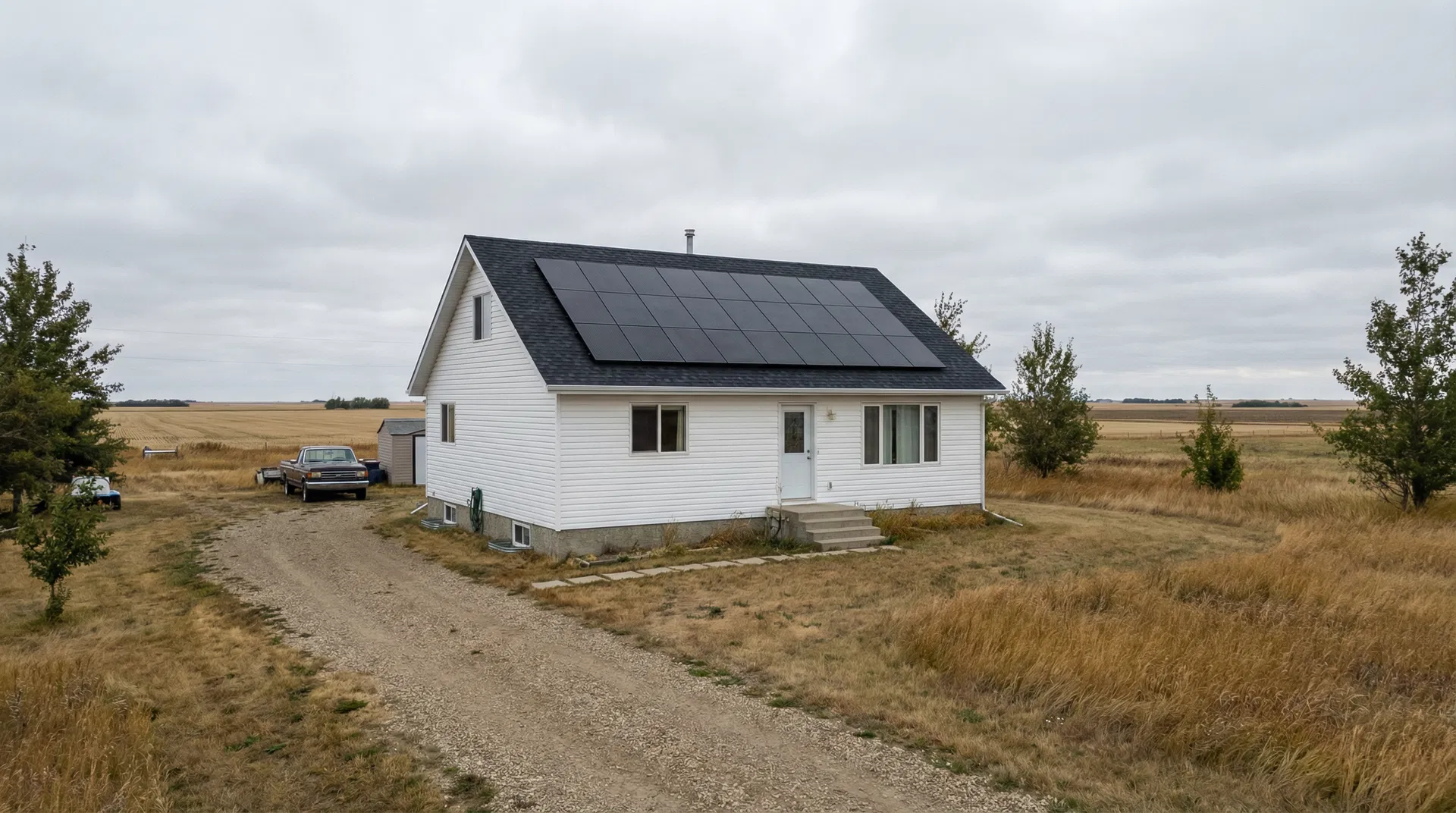
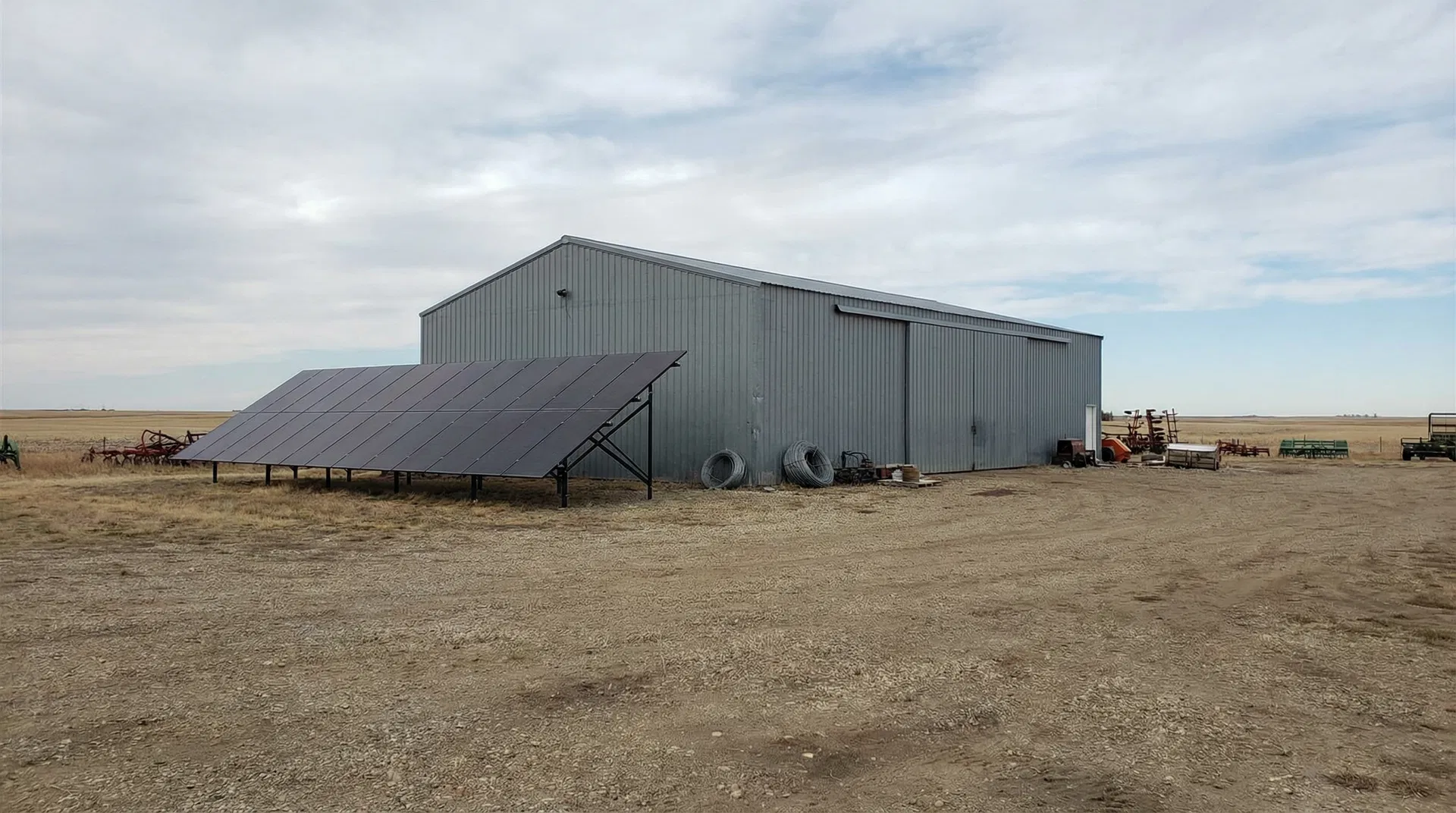
Rural Alberta properties typically need a bigger system than a comparable home in the city, simply because there's more than one load to cover. A house on its own might run on a modest system, but add a heated shop, a grain dryer, an irrigation pump, or a barn with supplemental lighting and water heating, and the math changes fast. We size for the whole property, not just the house meter. Roof or ground mount is a site-by-site call, not a default. A roof with clear southern exposure and a straightforward pitch is often the simpler and cheaper option. But if trees or a neighboring building shade the best roof planes, if the roof pitch or orientation is poor, or if the yard has open space and a roof layout that would scatter the array across multiple small sections, ground mount usually wins instead. Acreages with room to spread an array out on open land often do better with a ground-mounted system sized and angled on its own terms, independent of what the house roof will allow. Either way, we don't size off a rule of thumb like watts per square foot of roof or a flat multiplier on home size. We size off the 12-month usage graph printed on your most recent power bill, because that graph shows your actual seasonal load pattern, not an assumption about it. Combined with the site visit and design, that bill is what turns an estimate into a real system size and a real financed payment.
Typical Load Profiles We Design For
Home Plus Heated Shop
This profile covers a single-family home with a detached shop that's heated through the winter, usually with electric heat or a block heater circuit for equipment. The shop load often runs separately from the house but shows up on the same meter and bill, so we size the system against the combined usage graph rather than the house alone. Financing for this profile is usually structured as one system covering both loads from day one.
Acreage with Irrigation or Grain Handling
Properties with irrigation pumps, a grain dryer, or augers see sharp seasonal spikes rather than a flat year-round draw. Those spikes show up clearly on the 12-month usage graph on the power bill, and they're a major factor in sizing the system large enough to offset the peak months without over-building for the rest of the year. We finance these systems with that seasonal pattern in mind rather than averaging it away.
Standard Residential Home
This is the straightforward case: a single-family home on a standard residential lot with typical household usage and no major secondary loads. These are usually the most predictable systems to size and finance, often landing toward the smaller end of the 8 to 15 kW range we install in the area.
Interconnection Through Town of Ponoka
This property's electrical service is tied to a wire system owned and run by the Town of Ponoka directly, rather than a regional distribution utility. That's the entity that reviews every micro-generation interconnection application for a new solar install, and it covers the technical side of the connection, not just paperwork. Range Road Solar prepares that full application as part of every financed install here: panel layout, microinverter specifications, and single-line electrical diagrams, submitted on your behalf. We don't make claims about how long that review takes or what the current credit or billing policy looks like, since those details are specific to your account and change over time. We confirm the rules that currently apply when we build your design, and walk you through exactly what to expect before financing terms are finalized.
Project Economics and Design Review
| System Size | Annual Production | Year 1 Savings | Payback Period |
|---|---|---|---|
| 8-15 kW range, 10 kW typical |
Production, savings, and payback figures are only provided after a property-specific design review using your most recent power bill.
How We Work in Ponoka
Bill and Load Review
We review your power bill to understand your energy use in Ponoka and size the system to your actual consumption, not a generic estimate.
Site Assessment
We assess your roof or ground area, south-facing exposure, electrical service, and utility interconnection requirements specific to your property.
Design and Utility Application
We produce a system layout, production estimate, and cost summary, then submit your micro-generation application to your utility on your behalf.
Installation and Commissioning
Our crew installs racking, panels, inverter, and electrical connections. All work is performed by licensed electricians. We commission and test before handoff.
Current Program and Interconnection Review
Utility connection review
The Town of Ponoka reviews the technical side of every grid connection application for a new solar install, not just the paperwork. Range Road Solar prepares the full design package, including panel and inverter specifications and the electrical diagrams the review requires, and submits it as part of your project. We don't speculate on how fast that review moves or what it resolves, since that's specific to your application and the utility's current process.
Current program review
Residential, farm, and commercial eligibility for any current financing or utility program gets checked against the rules in place at the time we build your design, not against assumptions from a prior year. Programs and eligibility criteria change, so we verify what currently applies rather than quoting something that may no longer be active. This review happens before we finalize financing terms, not after.
Frequently Asked Questions
Get a Solar Assessment for Ponoka
Submit a recent power bill and we will review your consumption and provide an honest assessment for your Ponoka property. No obligation.
(587) 330-7502 Book a CallMore Solar Services in Ponoka