Education · November 2, 2026
What Size Solar System Does a Hobby Farm Need?
Wondering what size solar system you need for a large rural property or hobby farm in Canada? Here is how Alberta acreage owners size it right.
The City Installer Will Get This Wrong
A lot of people asking what size solar system they need for a large rural property or hobby farm in Canada get an answer built around a city house. A two-bedroom bungalow in the suburbs. Maybe 8,000 kWh a year. Slap on eight panels and call it a day.
That math does not apply here. A hobby farm has a shop. It has a heated water line. It might have a second building, a heated barn, or an electric water heater running around the clock. The loads are different and the utility rules are different.
I have seen undersized systems sold fast and cheap with no thought given to what that property is actually going to consume in five years. The homeowner ends up with a system that barely moves the needle. That is the mistake I want you to avoid.
The First Number I Ask For
When a hobby farmer calls me and asks how big a system they need, I ask for their blended rate first. Not just the kilowatt-hour number on the bill. The blended rate. That means the total dollar amount on the bill divided by the total kilowatt-hours used. Once you factor in transmission, distribution, and every other line item FortisAlberta stacks onto a rural account, that number tells me more than anything else.
Rural acreages in Alberta typically land somewhere between $0.20 and $0.28 per kWh on a blended basis. I have seen higher. That rate is the engine behind every savings calculation. A system that offsets 14,000 kWh per year is worth a lot more if you are paying $0.26 per kWh than if you are paying $0.18.
The second thing I need is a recent power bill. Not twelve months of bills. Just one. That bill carries a 12-month usage graph right on the back. It gives me everything I need to run first numbers over the phone before we ever set foot on your property.
Annual usage for a typical rural acreage runs between 12,000 and 18,000 kWh per year. A hobby farm with a shop, water heating, and outbuildings can push past that. The system size that matches that usage is usually somewhere between 10 kW and 16 kW, but we size to your bill, not to a range.
Loads That Blow Up the Numbers
City installers ask about the house. Bedrooms. Square footage. Maybe an electric vehicle charger.
For a hobby farm, I ask about the water heater. Specifically: is it on-demand electric? Because a tankless electric water heater running on a well-fed acreage draws a significant load. That single appliance can add thousands of kilowatt-hours to an annual total that a city installer would never think to ask about.
Then there is the shop. Is it heated? What runs in it? A welder, a compressor, a grain auger on a separate panel? These are loads that do not show up in any standard residential sizing formula.
Future loads matter too. If you are planning to add an electric vehicle in the next few years, or expand the operation, that needs to go into the sizing conversation now. I will come back to that point.
FortisAlberta and EQUS: How Utility Rules Affect Your System Size
Most rural properties north of Calgary in Rocky View County, Foothills, Mountain View, and Wheatland counties are served by FortisAlberta. Properties further out in the Peace Country northwest may fall under EQUS or ATCO Electric.
Under Alberta's Micro-generation Regulation, both utilities operate on the same basic principle: your system earns a credit for every kilowatt-hour you export to the grid, at the same energy rate you pay. There is no cap on credits that a residential or small farm system would realistically hit.
The sizing ceiling both utilities work with is roughly 110% of your previous year's usage. Build within that and the interconnection application goes through without drama. EQUS tends to process applications faster and with less back-and-forth than some other utilities. FortisAlberta gets there too, just on its own timeline.
What changes between the two is process, not the fundamental credit structure. The economics of net metering work the same either way. Your retailer choice can move the export credit rate significantly. Some premium solar retail plans in Alberta pay up to $0.35 per kWh for exports. That is worth looking at when we size your system because it changes the payback math.
The Real Math: A Hobby Farm Example
Here is a typical example. A rural acreage in Rocky View County on FortisAlberta. Annual usage of 15,000 kWh. Blended rate of $0.24 per kWh. Annual power bill of roughly $3,600.
A 13 kW system in central Alberta produces approximately 14,500 to 15,500 kWh per year depending on shading, tilt, and orientation. Call it 15,000 kWh for a clean south-facing roof. That offsets nearly 100% of the annual bill.
At $0.24 per kWh, the annual savings land around $3,600. If a premium retailer is paying $0.35 per kWh for exported power during shoulder months when usage drops, the annual return climbs higher.
Roughly half of our rural designs pay back in 7 to 10 years on the numbers alone. For eligible farm operations and businesses, the federal investment tax credit brings that range down to 5 to 6 years. That is not a teaser rate. That is the math on a decent south-facing rural roof with a real bill behind it.
The only payback number that should make you nervous is one quoted without a line-by-line look at your actual bill. If someone gives you a 6-year payback without seeing your usage, ask them to show their work. If someone tells you 12-plus years is normal for a rural property, ask them the same thing.
Frequently Asked Questions
Does it make financial sense if my monthly power bill is under $400?
For a rural property, a bill of $400 per month and over is almost always a strong candidate for solar. The savings are large enough that the numbers work clearly in your favour.
Below $400 per month, it still makes sense about 80% of the time for rural accounts. The higher distribution and delivery charges that rural customers pay on every FortisAlberta bill mean your blended rate is usually high enough that even a modest offset delivers real savings. The conversation changes if you are in the city. An urban bill under $200 a month rarely pencils out. Rural is a different situation.
My property has a house, a shop, and a second outbuilding. Does that help or hurt the sizing?
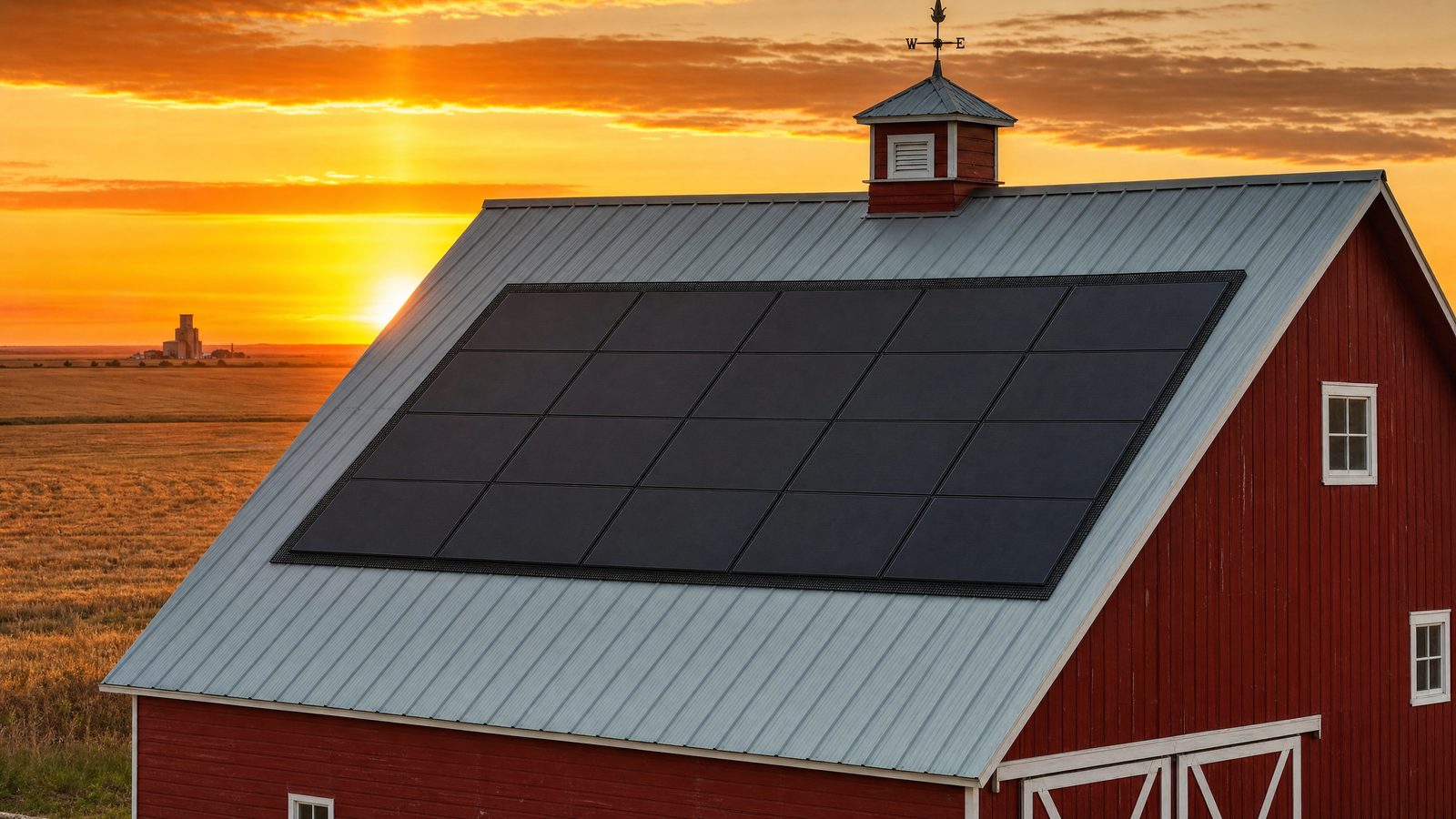
In almost every case, multiple buildings are an advantage. The house might have an east-west roofline that limits panel placement. The shop very often has a clean south-facing metal roof with no obstructions at all. More surface area means more flexibility in where the array goes, and that usually means a better-producing system.
The one spot where complexity enters is battery backup across multiple buildings fed off a single meter. That gets more involved. But for a straight solar install without batteries, multiple buildings on a hobby farm are a genuine asset, not a problem.
Should I size for what I use now or for what I expect to use in five years?
Size for where you are going, not just where you are today. Electricity prices in Alberta are not going to stay flat. With data centres coming online across the province and electric vehicle adoption climbing year over year, there is real upward pressure on rates. The money you spend on electricity now goes to the utility with nothing to show for it. The money you put into a properly sized solar system goes toward an asset you own.
If you are planning to add an electric vehicle, expand the shop, or add any significant load in the next few years, that conversation needs to happen before the system is sized. Undersizing to save a few dollars upfront and then paying full rate on the overflow is the mistake I see most often.
What utility serves my rural property north of Calgary?
Rocky View County, Foothills County, Mountain View County, and Wheatland County are all FortisAlberta territory. If your property is further northwest into the Peace Country, you may be on EQUS or ATCO Electric. The bill tells you which one. Your utility determines the interconnection process and timeline, but the credit structure for small systems is governed by the provincial Micro-generation Regulation and works the same way across utilities.
Is a 10 kW system big enough for a hobby farm?
It depends entirely on your usage. A 10 kW system is a reasonable starting point for a property using around 10,000 to 12,000 kWh per year. If your annual usage is 16,000 kWh or higher, a 10 kW system will cover a portion of your bill but leave a significant amount on the utility side. I would rather you knew that from the first conversation than six months after install. Send the bill, we run the numbers, and you know exactly where a given system size lands before anything is signed.
What Working With Range Road Solar Looks Like
It starts with your most recent power bill. One bill. It has the 12-month usage history printed right on it. Send it my way and I can run first numbers over the phone. No site visit required to get a ballpark.
If the numbers make sense to you, we set up a site visit. Nothing gets signed before I have been to the property. Roof orientation, shading, panel placement, and the service panel all need a physical look before a final design is done.
After you sign the agreement, we submit the permits and the interconnection application to FortisAlberta or EQUS. Design, engineering, and permits cost money, so yes, the agreement comes first. That is standard across the industry. What is not acceptable is pressure to sign the same night you meet. You should have time to read what you are agreeing to.
From a signed agreement to a running system is typically two to six weeks. The utility does the final inspection and swaps the meter to bi-directional. After that, every kilowatt-hour your system produces is working for you.
Ready to Run the Numbers?
If you are sitting on a power bill over $400 a month and you own a rural property with a decent south-facing roof or shop, the math is worth a phone call. Grab your most recent bill and call 403-367-5999. We will go through the numbers together before you commit to anything.
You can also find more information at rangeroadsolar.com.
Range Road Solar installs across Alberta. See Airdrie solar installer for service area details.
Ready to get a real number for your property?
Send us your most recent power bill. We'll review your consumption and give you an honest design and cost estimate. No obligation.