
Who Calls Us From Bergen
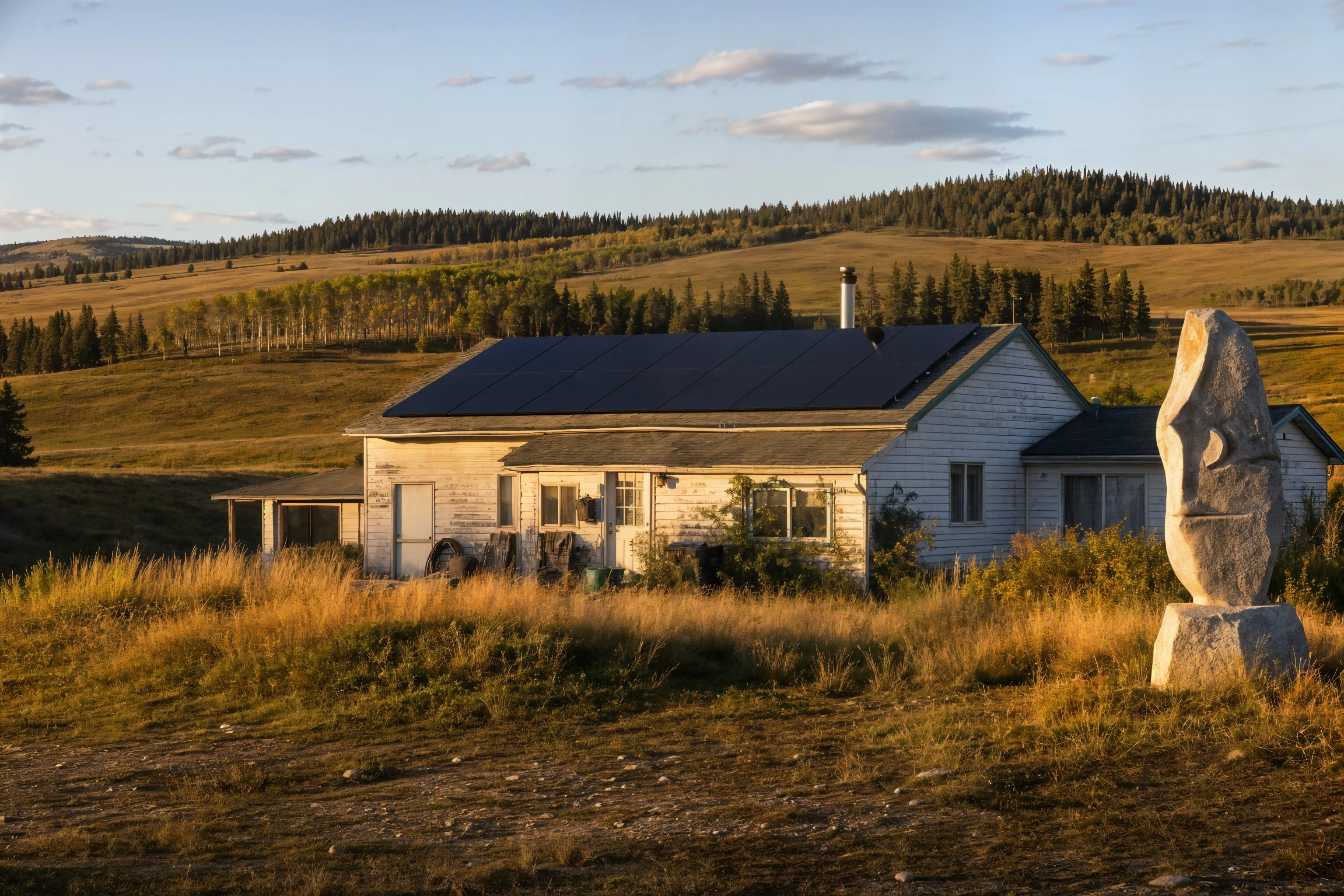
Bergen inquiries come from a specific kind of property: quarter sections and acreages tucked into the foothills where Highway 760 runs out, ranching and farming operations that have been on this land since the Norwegian settlers who founded the place in 1907. This is not suburban rooftop territory. It is Fallentimber Creek country, elevation over 1,100 metres, close enough to the mountains that the terrain rolls instead of running flat.
Most people who have heard of Bergen at all know it for one thing: Bergen Rocks, the international stone sculpture park artist Morton Burke built on his own property starting in 2008, drawing carvers from Mongolia, Kenya, Turkey, and a dozen other countries to a hamlet with no gas station. That same independent streak shows up in how people here handle their power. A lot of Bergen properties run a heated shop, a well pump, livestock waterers, and a house, all off one meter, and all paying whatever the grid charges that month. We install LONGi panels in ground-mount and rooftop configurations, and on most Bergen properties, ground-mount wins because the land is there and the southern exposure is clean.
Why Solar Works in Bergen
FortisAlberta is the wire service provider for this part of Mountain View County, based on the utility's own service territory and Sundre-area outage crews on the ground, which are consistently Fortis trucks, whether it is a wind event or a downed line. Any grid-tied system on a Bergen property has to be engineered to meet FortisAlberta's micro-generation application requirements: a bi-directional meter, a formal interconnection application, and sign-off before you are producing to the grid. We handle that paperwork start to finish.
Bergen sits at roughly 51.7 degrees north latitude, elevation 1,140 metres, in the foothills west of the Highway 22 corridor. The nearest weather station that actually measures bright sunshine hours, not just temperature, is Red Deer A, which logs 2,125 hours of bright sunshine a year on the Environment Canada climate normal. That is a sunshine duration figure, not a "peak sun hours" solar-production number, but it is a fair proxy for the region: Bergen is not shaded out by the mountains to its west, and the elevation means slightly thinner atmosphere and cold, clear winter days that are genuinely productive for panels. Cold silicon runs more efficiently than hot silicon.
Mountain View County is the governing jurisdiction for Bergen, and that matters for permitting: development permits and any required setback approvals for ground-mount arrays run through the county, not through Sundre or any other neighbouring town. We have pulled permits through Mountain View County before and know what they want to see on a site plan.
What a System Looks Like on a Bergen Property
The Fallentimber Ranch Operation
A working cattle operation with a heated calving barn, a shop running welding and mechanical equipment through winter, and a farmhouse. Monthly bills in the $380 to $520 range depending on season, driven mostly by barn heat and shop load. These operations typically need an 18 to 25 kW ground-mount system, running $45,000 to $87,500 installed before incentives (ground-mount runs $2.50 to $3.50 a watt). If the operation is incorporated, the 30% federal Investment Tax Credit brings that down substantially.
The Highway 760 Acreage
A residential acreage with a house, a detached garage or small shop, and maybe a well pump and outbuilding lighting. Bills typically land between $180 and $260 a month. A 9 to 12 kW ground-mount system covers most of that draw, running $22,500 to $42,000 installed. This is the most common profile we see out this way.
The Bergen Rocks-Adjacent Hobby Property
Smaller acreages closer to the sculpture park itself, often with a modest home and light outbuilding use, running $120 to $180 a month. A 6 to 8 kW ground-mount system is usually enough, at $15,000 to $28,000 installed.
Snow Load and Racking Note
Bergen sits in genuine foothills terrain, not open prairie, and that distinction matters for racking design. The National Building Code's own commentary on ground snow loads specifically calls out the foothills belt of Alberta as an exception to standard interpolation between weather stations, because snow accumulation swings sharply with elevation and local terrain in this zone, the code relies on supplemental snow-course data and valley-by-valley analysis rather than a flat regional number. We do not have a published ground snow load figure specific to Bergen or Sundre, so we will not invent one here. What we do instead is size every racking system to the site, not to a regional average, and we build in margin given the terrain. Frost depth in this part of Alberta typically runs deep enough that any ground-mount footing gets engineered well below grade regardless of the exact county number.
Bergen Solar System Sizing and Savings Estimates
Based on $2.50 to $3.50 a watt installed for the ground-mount systems most common on Bergen properties, and a standard central-Alberta production estimate of roughly 1,240 kWh per kWp per year (the regional proxy used elsewhere on this site for comparable FortisAlberta-territory foothills-adjacent towns, since a Bergen-specific NRCan figure is not published), at an Alberta residential rate near 22 cents/kWh.
| System Size | Annual Production | Year 1 Savings | Simple Payback |
|---|---|---|---|
| 6 kW | 7,440 kWh | ~$1,637 | ~9.2 to 12.8 yrs |
| 10 kW | 12,400 kWh | ~$2,728 | ~9.2 to 12.8 yrs |
| 20 kW | 24,800 kWh | ~$5,456 | ~9.2 to 12.8 yrs |
Incorporated farm or business operations claiming the 30% federal ITC cut effective payback to roughly 6.4 to 9.0 years, depending on where the installed price lands in the $2.50 to $3.50 a watt range. There is no Alberta residential rebate program currently available.
What We Install on Bergen Properties
LONGi panels on every system: Tier-1 manufacturer, 25-year product warranty, rated for the full range of Alberta conditions from minus 40 to plus 40 without performance degradation. APsystems microinverters for residential and acreage systems mean every pair of panels operates independently, which matters here because terrain, trees, and outbuildings can create shifting shade patterns through the day. Solis inverters handle larger farm and shop systems where string architecture makes more economic sense at scale.
How We Work with Bergen Properties
Power Bill Review
Send us your most recent power bill. We size the system to your actual consumption, not a regional average.
Site Visit to Bergen
We drive out and assess roof or ground conditions, southern exposure, shading from foothills terrain, and electrical service. Free, no obligation.
Custom Design
A system layout, production estimate, and fixed-price quote specific to your property, following Mountain View County's site plan requirements for ground-mount systems.
Permitting
We handle Mountain View County permits and the FortisAlberta micro-generation interconnection application. You sign once.
Installation
Licensed electricians install racking, panels, inverters, and electrical connections. Most acreage systems take one to three days on site.
Grid Connection
Final inspection, bi-directional meter swap, and commissioning through FortisAlberta. Your system goes live.
Bergen Solar, Frequently Asked Questions
218+ installations. Zero shortcuts.
Read what Alberta property owners say about our work.
Free Solar Assessment for Bergen Properties
Ranch, acreage, or hobby property, we will come to you and give you an honest number.
Also Serving Near Bergen
Bergen's Sculpture Park Draws Visitors From a Dozen Countries. Your Power Bill Doesn't Have to Draw From Anywhere But Your Own Roof.
Send us a recent power bill from your Bergen property. We will size a system against your actual consumption, quote it at a fixed price, and walk you through what FortisAlberta's interconnection process looks like for your site. No pressure, no generic pitch.
Also Serving Nearby Communities