
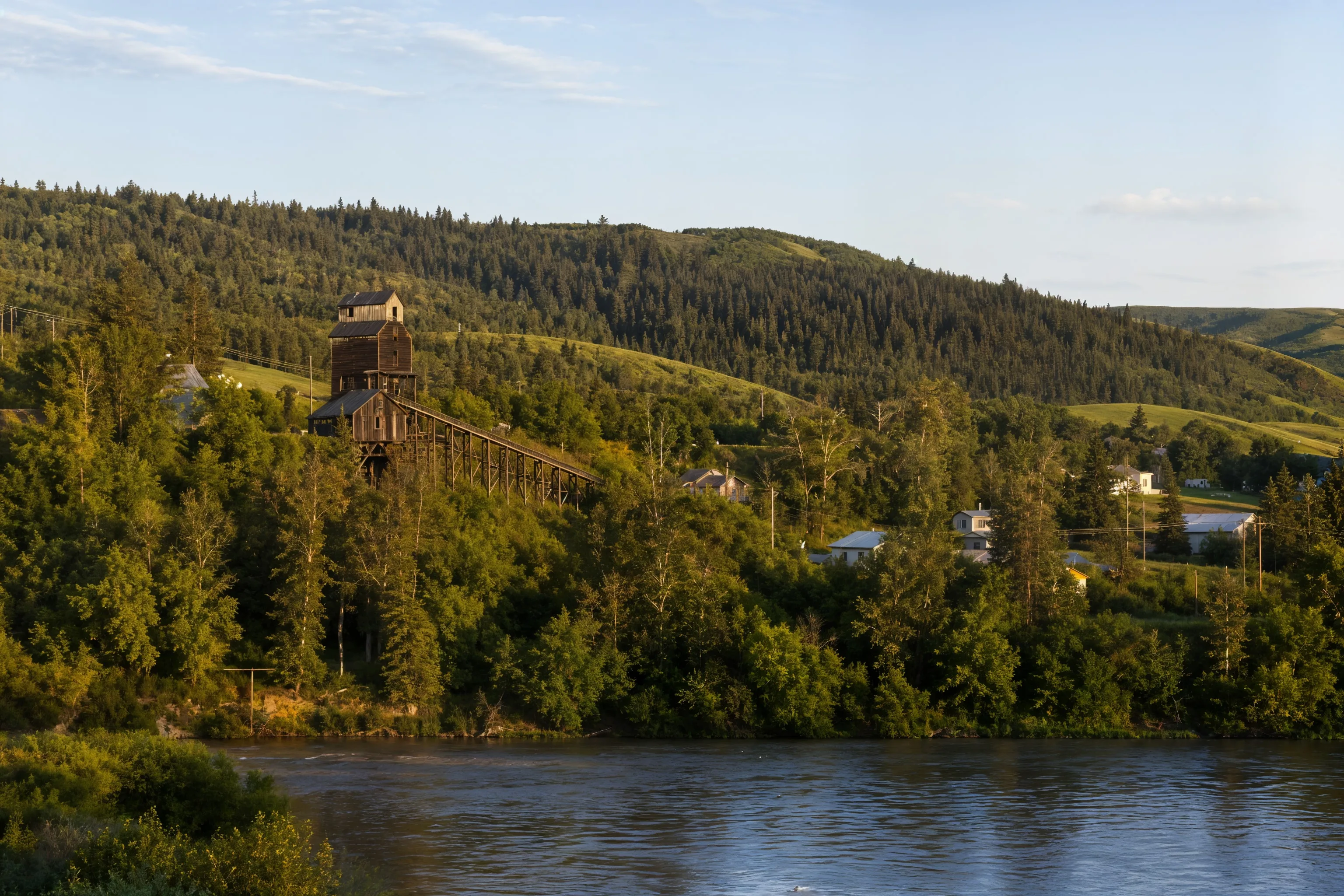
Solar in the Pembina River Valley
Evansburg exists because of two things: the Pembina River and the railway. The Grand Trunk Pacific reached the river in 1910, the fledgling community was named after Harry Marshall Erskine Evans, a former mayor of Edmonton who prospected for coal along the Pembina in 1904, and the Pembina Peerless Coal Mine powered the local economy for 24 years before closing in 1936. The hamlet rebuilt around mixed farming and its creamery, became a village in 1953, and reverted to hamlet status inside Yellowhead County in 1998. Today the county-owned Tipple Park Museum sits on the original mine site, and 717 people call the valley home, according to the 2021 census, down from 795 in 2016.
That history matters for solar because of what it left behind: a scatter of acreages, farmsteads, shops, and barns spread along the Yellowhead corridor, most of them on FortisAlberta rural feeders with the higher delivery charges that low-density service carries. Rural Albertans on acreage and farm service often pay a meaningfully higher share of their bill in delivery than city customers do. Every kilowatt-hour your own array produces is a kilowatt-hour you do not buy at that all-in rural rate, which is why solar on a Pembina valley acreage tends to pencil out faster than the same system on a suburban lot in Edmonton.
The resource itself is strong. Natural Resources Canada's photovoltaic potential database carries an entry for Evansburg itself, rating a south-facing array tilted at latitude at about 1,202 kilowatt-hours of production per kilowatt of capacity per year, and the nearest long-term bright sunshine record at Environment Canada's Edmonton City Centre Airport station averages roughly 2,345 hours of sunshine annually. Long, clear summer days do the heavy generation work, and cold, sunny winter days help panels run efficiently even when the thermometer drops. Add Alberta's Micro-Generation Regulation, which lets a grid-tied system export surplus power for credit through FortisAlberta with no battery bank required, and the pieces line up for valley properties.
Latitude
53.6° N, on the eastern edge of Yellowhead County
Population
717 (2021 census, down from 795 in 2016)
Wire service
FortisAlberta distribution territory
NRCan PV yield
1,202 kWh per kWp, south-facing latitude tilt
Local anchor
Pembina River valley, Tipple Park Museum
System type
Grid-tied, no batteries required
NRCan rates Evansburg at about 1,202 kWh per kWp per year for a south-facing, latitude-tilt array. That is a town-specific figure, not a regional average.
What Evansburg-Area Properties Actually Use
Yellowhead County's economy runs on forestry, oil and gas work, agriculture, and the steady stream of Yellowhead Highway traffic heading to Jasper. Most properties we design for around Evansburg fall into three load profiles. Ranges below assume a typical FortisAlberta rural all-in cost near 19 cents per kilowatt-hour, including delivery.
The Pembina valley acreage home
A 1,200 to 2,000 square foot home on a few acres outside the hamlet, running a well pump, septic lift, chest freezer in the garage, and either baseboard or furnace fan heat through a cold valley winter. Typical bills run $230 to $430 a month, which is 1,200 to 2,300 kilowatt-hours. A 7 to 9 kW system covers most of that annual usage under net metering.
The farmstead operation
A farmhouse plus heated shop, grain aeration fans on the bins, an auger, stock waterers, and yard lighting. These sites routinely pull 2,500 to 4,500 kilowatt-hours a month, or $450 to $900 in winter-weighted bills. This is the strongest solar case in the valley: big daytime loads, three-phase service available on many yards, and almost nothing wasted on export.
The Highway 16 business or campground
Pembina River Provincial Park draws Edmonton weekenders all summer, and the corridor supports stores, cafés, and RV parks with cooler banks, laundry, and hookup loads of $600 to $1,200 a month. These commercial roofs and yards are often ideal solar real estate, and daytime-heavy consumption lines up almost perfectly with solar production hours.
Cost and Payback in Evansburg
Our installed pricing for this area is $2.25 to $2.85 per watt for roof mounts and $2.50 to $3.50 per watt for ground mounts. The ground mount range is wider because trenching, piling depth in Pembina valley soil, and array size move the number more than they do on a roof. Travel from our Airdrie shop to Evansburg is roughly four hours each way, and it is built into these rates, not added as a surcharge.
A worked example: a 9 kW roof mount at the middle of the range costs 9,000 watts times $2.55, or about $22,950. At Evansburg's NRCan yield of 1,202 kilowatt-hours per kilowatt-peak, it produces roughly 10,800 kilowatt-hours a year. Valued against a FortisAlberta-area rural bill near 19 cents per kilowatt-hour all-in, that is about $2,050 a year back in avoided purchases, a simple payback near 11 years with panels warranted for 25 to 30 years of output. Nobody should promise you a faster number than the math supports, and we do not.
| System | Installed cost range | Annual production | Annual offset | Simple payback |
|---|---|---|---|---|
| 6 kW roof | $13,500 to $17,100 | About 7,200 kWh | About $1,370 | 10 to 12.5 years |
| 9 kW roof | $20,250 to $25,650 | About 10,800 kWh | About $2,050 | 10 to 12.5 years |
| 13 kW ground | $32,500 to $45,500 | About 15,600 kWh | About $2,970 | 11 to 15 years |
Production uses the NRCan town-level figure of 1,202 kWh per kWp. Offset value assumes roughly 19 cents per kilowatt-hour all-in on a FortisAlberta rural residential bill and a system that exports little of its output. If you enrol with a solar-friendly retailer offering enhanced daytime export rates, the export-heavy cases can do somewhat better. Payback is the number that matters, and these ranges are the honest ones for this town, this utility, and this irradiance.
FortisAlberta Interconnection for Evansburg
Evansburg properties are served by FortisAlberta, confirmed by Yellowhead County's listing in FortisAlberta's Alberta Utilities Commission approved franchise fee schedule, which is the authoritative record of who owns the wires in a given municipality. Your retailer, the company that bills you for energy, is a separate choice and does not change the interconnection process.
Under Alberta's Micro-Generation Regulation, we file the micro-generation application with FortisAlberta on your behalf through their customer generation portal, alongside the electrical permit and the Yellowhead County development permit. Systems up to 10 kW on a standard rural service are typically approved without a costly technical study, though single-phase rural lines sometimes trigger extra review for larger systems. Once your system passes inspection, FortisAlberta dispatches a crew to swap your meter for a bi-directional unit, a visit that usually takes a few weeks to schedule in their western territory. Your export credits then appear on your next full billing cycle and roll forward up to 12 months.
From signed approval to a commissioned, meter-swapped system, two to six weeks is the normal window. The physical install at your acreage takes one to three days depending on roof or ground mount, and you do not need to be home for the meter swap itself.
Working With an Airdrie Crew, Four Hours West
Evansburg is about 380 kilometres from our Airdrie shop, roughly four hours up Highway 2 and west along the Yellowhead past Entwistle and the Pembina River bridge. We batch our Yellowhead County work so that design visits, installs, and service calls for the Evansburg, Wildwood, and Edson corridor happen in coordinated trips rather than one-off drives, which keeps travel costs out of your quote and gets you on the schedule sooner.
The process starts remotely. Send us your most recent power bill and we pull the 12-month usage history, then combine it with satellite imagery of your roof and yard for a first-pass design and price. One site visit follows, where we measure roof structure or test ground conditions, check for valley shading, and photograph your FortisAlberta service entrance. Ground mounts in the Pembina valley get soil-specific pile depths, because valley fill behaves differently than the prairie tableland to the east.
Install day arrives with a crew of two or three, including a licensed electrician of record. A roof mount finishes in one to two days; a ground mount with trenching takes two to three. We book the inspection and the FortisAlberta meter swap, hand you the monitoring app login, and leave stamped engineering and permit documents in your inbox. If you ever need service, the same batching approach applies, and warranty work is never billed as a travel extra.
Evansburg Solar Questions
See what our clients say
Real reviews from Alberta homeowners and farmers.
Get a Free Solar Assessment
We serve Evansburg and surrounding areas. No obligation.
Also Serving Nearby Areas
Ready to Assess Your Property?
Submit a recent power bill and we will review your consumption and provide an honest assessment of what solar can do for your Evansburg property. No obligation.
Also Serving Nearby Communities