Solar financing in Crossfield, Alberta lets you put a system on your property without paying the full install up front, with monthly payments sized against the power bill the system replaces. We don't push one financing product. We walk through the options that fit your situation and put the payment next to the design, so you can see both on one page. The equipment is set by default: LONGi panels paired with APsystems microinverters. Each panel runs through its own microinverter, so shade on one panel doesn't pull down the rest of the array. That matters on acreage properties where a tree line or a shop roofline can throw shade across part of the array. Most residential and acreage systems we design here fall in the 8-15 kW range, with 10 kW typical. The final size comes from your site and your most recent power bill, and the financing gets built around that number. We'd rather show you a smaller system that fits the property than a bigger one that doesn't. Property type changes the conversation. A house on acreage often has a roof with a usable pitch and a yard with room for a ground mount. A farmyard with a shop, a machine shed, and grain handling may need an array split across more than one structure. Each one gets its own layout during the design review, and the payment follows from that layout.
Solar Planning for Crossfield Properties
Solar planning here starts with two companies, not one. Alberta's power market is deregulated, so the retailer on your bill and the wire service that delivers your power are separate businesses. In Crossfield, the wire service is FortisAlberta, and that's the utility whose connection review your system goes through. Getting that straight early keeps the design and the financing conversation on the same page. Rural properties rarely run on a single load. A house on acreage might sit beside a shop, a machine shed, and a well pump, and a working farm can add grain handling or livestock water on its own meter. Each of those changes what the system should look like, so we design for the whole property instead of just the roof over the kitchen. Local life shapes the planning too. Pete Knight Days (Annual Rodeo) and the Pete Knight Memorial Arena are part of what makes this area home, and many properties here mix a residence with open yard and outbuildings. The TAQA North Crossfield Gas Plant is one of the local economy anchors, so we also ask about commercial or equipment loads on every site we visit. We don't start with a generic kilowatt number. We start with your roof or open ground, shading from trees or buildings, and your most recent power bill. Financing gets sized against that design, not the other way around.
Electrical Site Review for Crossfield Properties
Voltage Rise
Voltage rise is what happens when your system pushes power back onto the distribution line and the voltage at the connection point climbs. How much it climbs depends on the condition of the line serving your property, and FortisAlberta looks at that during the connection review. When voltage runs high, an inverter may clip its output to stay within limits, so we factor that into how large the array should be.
Single-Phase vs Three-Phase
Rural properties can have single-phase or three-phase service, and the difference shapes which inverter setup fits and how much capacity you can connect. Single-phase service suits many homes and smaller systems, while three-phase service leaves more room for larger arrays and heavier motors. We confirm which one you have before we select equipment, because the phase decides the design.
Panel Infrastructure
Older electrical panels on rural properties were often sized for the loads of their era, not for a shop, a well pump, and a solar system. We check the panel's age, its rated capacity, and how many breaker spaces are free. If the panel can't support the system, the upgrade means a new panel with enough capacity and breakers sized for the array, and we scope that before any work starts.
Service Entrance Review
We check the service entrance and the meter base because they carry the connection between your system and the grid. A corroded, undersized, or damaged meter base can hold up the micro-generation application even when the array design is sound. If an upgrade is needed, we'll explain what it involves before any work starts.
Right-Sizing Solar for Crossfield Properties
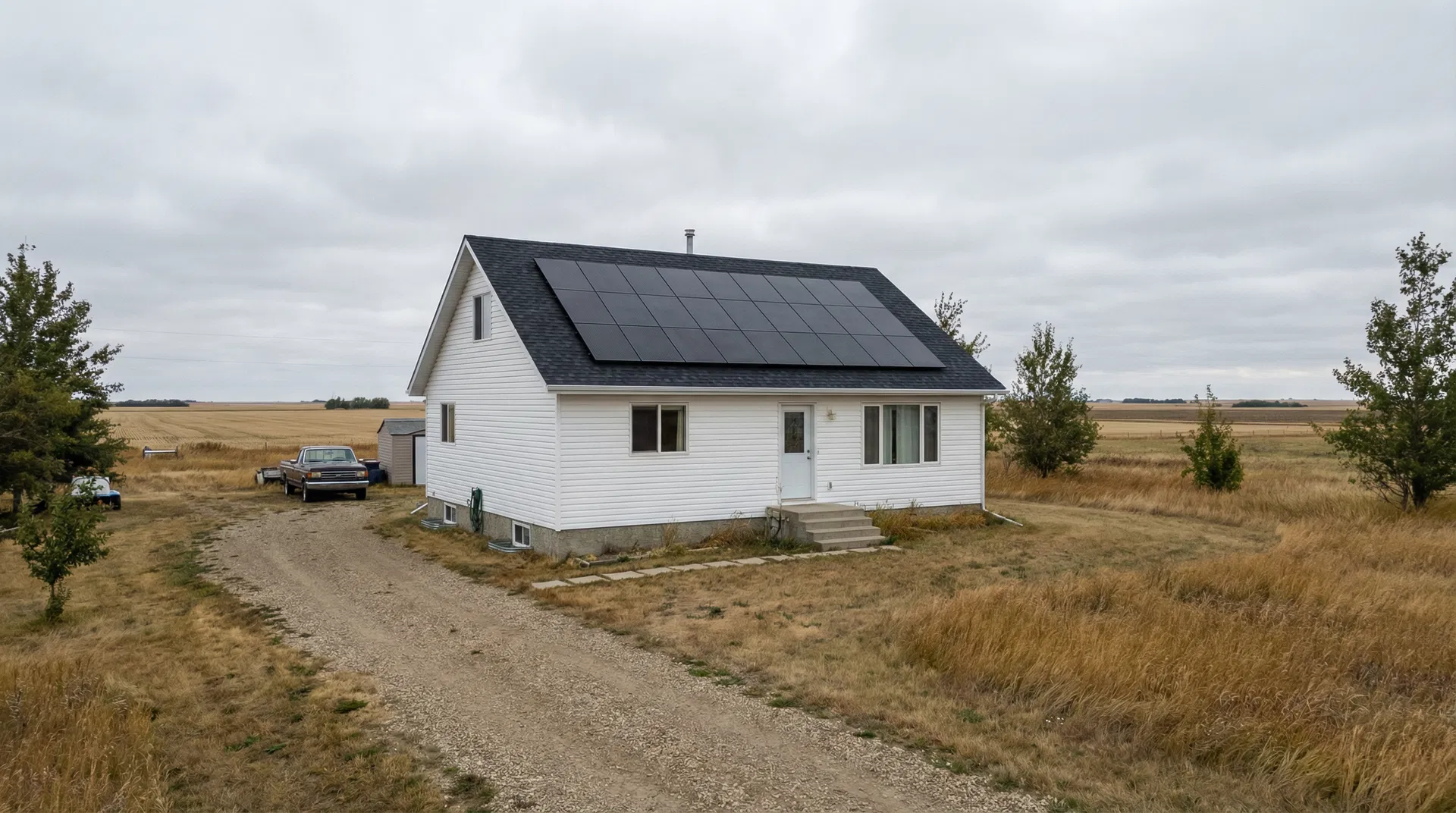
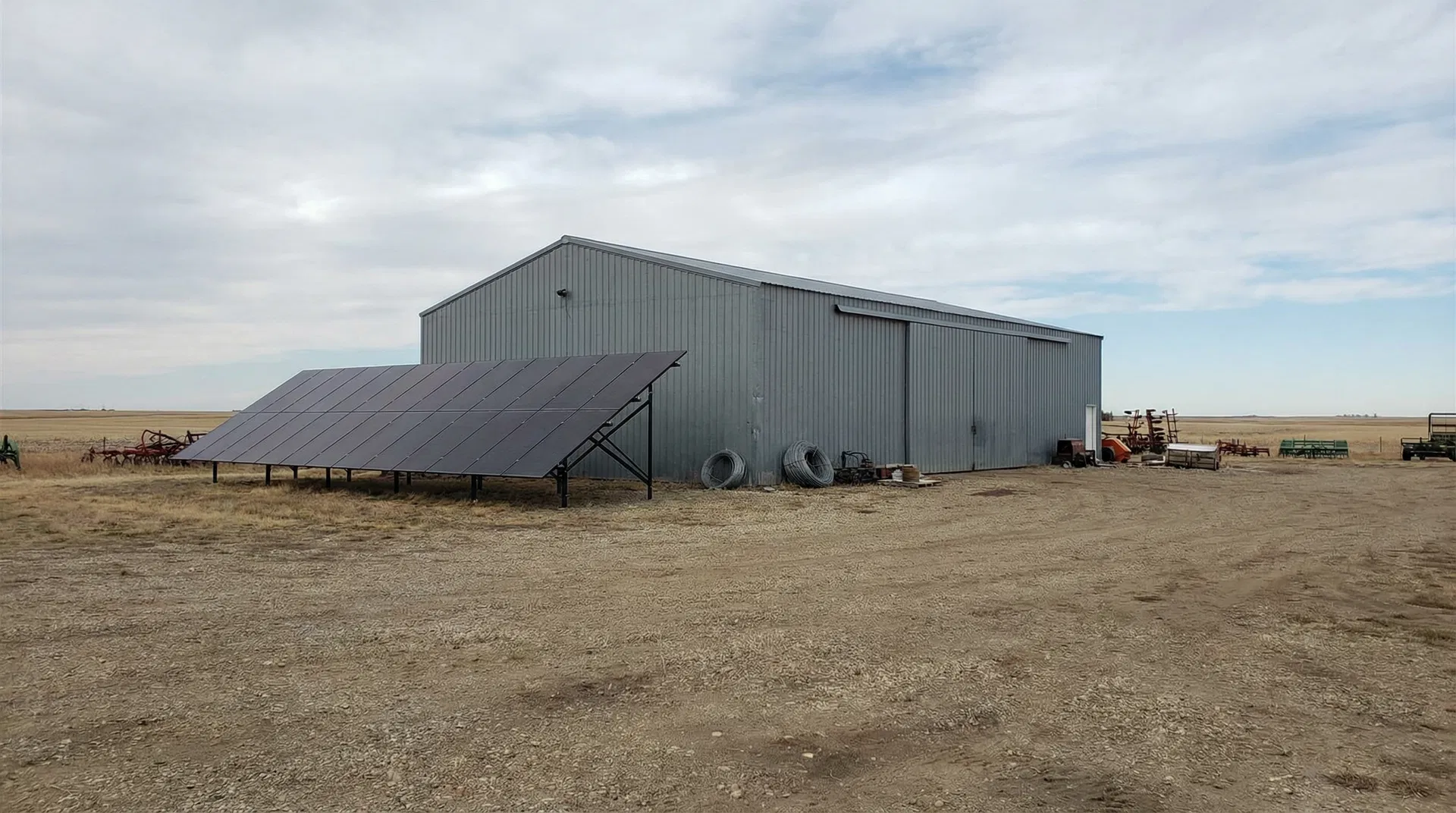
Rural Alberta systems tend to run bigger than urban ones because the property carries more loads. A house might share its power with a heated shop, a block heater outlet, a few outbuildings, and an irrigation pump or grain dryer. Each of those adds to the daily demand, and the array has to cover the combined load, not just the house. Roof or ground mount is the first real decision. A roof works well when the pitch faces a useful direction, the roof is in good shape, and nothing shades it for much of the day. Ground mount makes more sense when trees or buildings cast shadows on the roof, when the pitch is poor, or when the yard has open land and you'd rather keep the system off the house. We look at each option against the site, and we'll tell you when the roof is the wrong call. Size comes from your usage, not a rule of thumb. We size from the 12-month usage graph on your most recent power bill, which shows how the property's demand moves across the year. Then we check the roof or ground layout to see how much array actually fits. Two properties with the same house can need very different systems, and a current power bill plus a site design is how we tell them apart.
Typical Load Profiles We Design For Near Crossfield
Home + Heated Shop
A house and a heated shop share the power, but they draw it on different schedules. The shop often runs for longer stretches on weekends, which changes the daily curve the system has to cover. We'd typically start the design between 9 kW and 11 kW for this mix, then adjust from the usage graph on your most recent power bill.
Acreage Home + Irrigation Pump
A residence with a seasonal irrigation pump has demand that spikes whenever the pump runs, usually through the growing season. A pump that runs for hours at a stretch can outweigh the house during those months. For this profile we typically look at an 11 kW to 14 kW array and check the summer peak against the rest of the year on the usage graph.
Farmyard with Grain Handling
A yard with a grain dryer, an auger, and a machine shed draws heavy loads in short bursts, mostly during harvest. Those spikes affect inverter layout and the service entrance review, so we scope them separately from the house. Designs for this kind of yard tend to land between 12 kW and 15 kW, with the final number confirmed against the usage graph and site layout.
FortisAlberta Interconnection in Crossfield
FortisAlberta is the wire service for Crossfield, Alberta, so every grid-connected system here goes through FortisAlberta's connection review before it runs in parallel with the grid. Your retailer and FortisAlberta are separate companies. The retailer sells you electricity, and FortisAlberta runs the wires that connect your property to the grid. We handle the application from our side. That means preparing the design package, assembling the site details FortisAlberta asks for, and submitting the micro-generation application on your behalf. We keep the file organized so nothing stalls on a missing detail, and we'll tell you early if the site needs something extra. What you need to provide is your most recent power bill. It carries the account details and the 12-month usage graph we size from, so you won't be hunting down a pile of documents to get started. From there, we confirm the design and the application package together. We don't guess at how long FortisAlberta takes to review a file, and we won't promise a timeline we don't control. What we can promise is a complete package and a straight answer on where your project stands at each stage.
Project Economics and Design Review
| System Size | Annual Production | Year 1 Savings | Payback Period |
|---|---|---|---|
| 8-15 kW range, 10 kW typical |
Production, savings, and payback require a property-specific design and your most recent power bill.
How We Work in Crossfield
Bill and Load Review
We review your power bill to understand your energy use in Crossfield and size the system to your actual consumption, not a generic estimate.
Site Assessment
We assess your roof or ground area, south-facing exposure, electrical service, and utility interconnection requirements specific to your property.
Design and Utility Application
We produce a system layout, production estimate, and cost summary, then submit your micro-generation application to your utility on your behalf.
Installation and Commissioning
Our crew installs racking, panels, inverter, and electrical connections. All work is performed by licensed electricians. We commission and test before handoff.
Current Program and Interconnection Review
Utility connection review
FortisAlberta, the wire service for this area, reviews grid connection applications for every system that ties into the grid. Range Road Solar prepares the design package and handles the application paperwork on your behalf. Credit and payout questions are answered during the design review, not on this page.
Current program review
Commercial, farm, and residential eligibility is checked against current rules at design time. We don't name or describe any specific incentive or program here, because rules change and eligibility depends on the property. If something applies to your project, we'll confirm it before it goes into your numbers.
Frequently Asked Questions
Get a Solar Assessment for Crossfield
Submit a recent power bill and we will review your consumption and provide an honest assessment for your Crossfield property. No obligation.
(587) 330-7502 Book a CallMore Solar Services in Crossfield