
Why Solar Fits Brazeau County
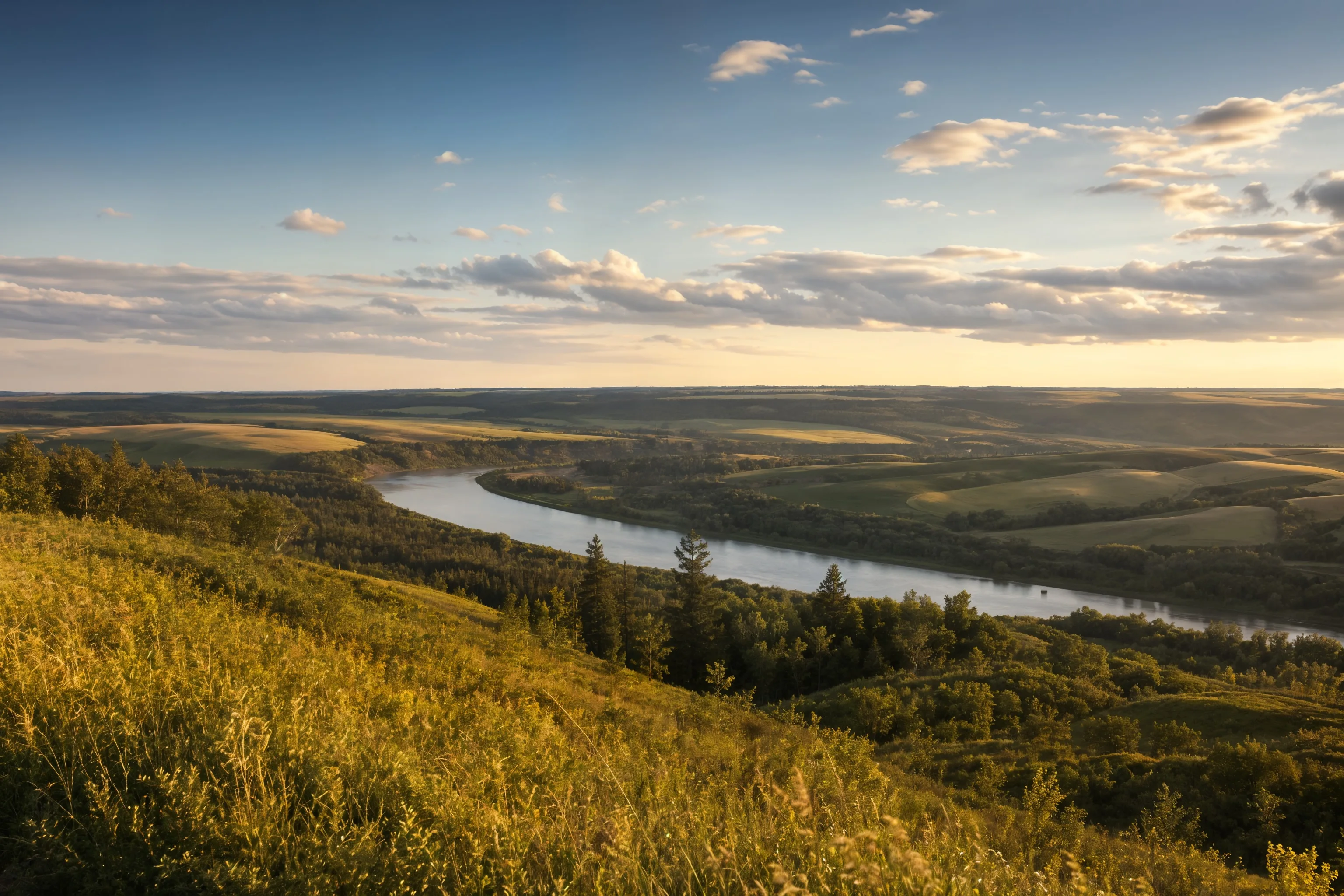
Brazeau County is a municipal district of roughly 3,000 square kilometres in west-central Alberta, and the 2021 census counted 7,179 people in it, about 2.4 residents per square kilometre. The Town of Drayton Valley, population 7,291 in 2021, sits in the centre of the county as a separate municipality and the region's commercial hub. Around it sit the Village of Breton, the hamlets of Cynthia, Lodgepole, Buck Creek, Rocky Rapids, and Violet Grove, and the rural localities of Alsike, Carnwood, and Round Valley. The North Saskatchewan River valley forms the county's western edge, the Brazeau River runs north through it to TransAlta's largest hydroelectric plant upstream in the foothills, and the Pembina River valley lies to the east. That is a lot of open ground holding a small number of very large electrical footprints, which is precisely where solar earns its keep.
This is oil country, and has been since the 1953 discovery that turned Drayton Valley from a farming hamlet into a boom town within four years. The county remains one of Alberta's oil and gas production leaders, and that heritage shows up in the electrical loads we see on site: heated welding shops, compressor and pump services, battery charging for field equipment, and farm operations running everything from grain handling to livestock waterers. Layered over that is a working agricultural base, cattle and forage mostly, plus forestry in the river valleys. Properties here tend to use two to four times the electricity of a city house, which is exactly the usage profile a grid-tied array offsets best.
The solar resource is solid without being exotic. Natural Resources Canada's PV potential dataset has no separate Brazeau County row, but its municipal table lists Drayton Valley at 1,143 kWh per kWp per year for a south-facing array tilted at latitude, and that figure is representative of the county's open farm country. Drayton Valley has taken its own swing at the resource: the town's Clean Energy Technology Centre, the anchor building of the Bio-Mile industrial park on 24 Avenue, has carried a 29.1 kW rooftop solar array since it was installed in October 2016 under the Alberta Municipal Solar Program. If a county that pumps oil for a living puts panels on its showcase building, the economics are worth a serious look at your own yard.
The financial case rests on Alberta's Micro-Generation Regulation, not on any subsidy program. A grid-tied system exports surplus power and earns a kilowatt-hour credit on your bill at the retail rate, rolling forward month to month. No batteries, no special rate class, no change to how you live or work. You keep buying power from your chosen retailer the same as always; the array simply displaces the most expensive energy you would otherwise buy, and the payback math improves every time retail rates rise.
What Brazeau County Properties Actually Use
System design starts with the 12-month usage graph on your power bill. Three property types cover most of Brazeau County:
Farm or Oilfield Yard Site
A working yard site outside Drayton Valley, Lodgepole, or Cynthia: a heated welding shop, welders and compressors, well pumps, a battery charging area for field equipment, and usually a home on the same service. Many of these sites have three-phase power. Annual usage commonly runs 20,000 to 40,000 kWh, and monthly bills swing with the work. These are the county's best solar candidates: big steady loads, open ground, and a ground mount sized 15 to 30 kW that pairs naturally with a shop roof carry when both are viable.
River-Valley Acreage with Shop and Well
The country-residential properties along the North Saskatchewan, Brazeau, and Pembina valleys and the rolling farm country east of Drayton Valley: a house, a detached or radiant-heated shop, a well pump, and shelterbelts that shade part of the yard for half the day. Bills typically run $250 to $550 a month for 12,000 to 20,000 kWh a year. A 10 to 14 kW array, on the shop roof or on a ground mount in the open pasture, offsets most of that and banks the summer surplus against winter.
Hamlet or In-Town Home
A standard residential service in Drayton Valley, Breton, Cynthia, or Lodgepole, usually 7,000 to 12,000 kWh a year with bills of $140 to $300 a month depending on heating fuel and household size. A 7 to 11 kW rooftop system covers most of that usage, and the long clear days of a west-central Alberta summer carry the export credit while the air conditioning or well pump runs.
Solar Costs and Savings in Brazeau County
Installed pricing in this territory runs $2.25 to $2.85 per watt for rooftop systems and $2.50 to $3.50 per watt for ground mounts, with the rural ground range reflecting trenching from the array to your service, racking, and ground conditions. Those numbers include panels, inverter hardware, racking, permits, the FortisAlberta micro-generation application, and commissioning. We quote a fixed installed price after the site assessment, and we do not pitch financing products.
A worked example, using the range honestly: a 10 kW ground mount on an acreage south of Drayton Valley costs between $25,000 (at $2.50 per watt, easy site, short trench) and $35,000 (at $3.50 per watt, long trench run, tough ground). Using the Drayton Valley-area NRCan yield of 1,143 kWh per kWp, that array produces roughly 11,400 kWh a year. At a realistic all-in residential rate near 17 cents per kWh, that is about $1,940 a year off the bill, which puts simple payback between 13 and 18 years depending on where the install price lands. Yard sites with heavier shop loads often do better because every produced kilowatt-hour displaces more usage; small in-town systems on easy roofs land nearer the middle. We show you this math with your actual bill before you commit to anything.
| Property profile | Typical system | Est. annual production | Est. annual savings | Simple payback |
|---|---|---|---|---|
| Farm or oilfield yard site, shop and well | 20 kW ground mount | ~22,900 kWh | $3,400 to $4,500 | 13 to 18 years |
| River-valley acreage with heated shop | 12 kW ground mount | ~13,700 kWh | $2,000 to $2,900 | 13 to 18 years |
| In-town Drayton Valley or Breton home | 8 kW rooftop | ~9,100 kWh | $1,400 to $1,900 | 12 to 15 years |
Savings assume an all-in rate near 17 cents per kWh and full usage of annual production; actual results depend on your retailer, rate plan, and consumption pattern. Panels carry 25-year production warranties, so a system that pays back in 15 years still delivers a decade or more of effectively free power afterward.
FortisAlberta Interconnection in Brazeau County
Wire service here runs through FortisAlberta, and that is verifiable rather than assumed. The Town of Drayton Valley's franchise agreement with FortisAlberta is public record: Bylaw 2015/11/F, adopted in 2015, grants FortisAlberta the exclusive right to provide distribution access services within the town for a ten-year term at a 10 per cent municipal franchise fee, superseding the town's earlier franchise bylaws. Brazeau County itself does not operate an electrical utility and points residents to third-party providers for power, with FortisAlberta as the wire owner across the rural municipality.
One local nuance worth knowing: the Drayton Valley REA, a member-owned rural electrification association, serves some rural services around Drayton Valley, and FortisAlberta lists the Drayton Valley REA among the REAs whose systems it services under contract. In practice that means the application path runs through FortisAlberta's micro-generation process whether your meter says FortisAlberta or the REA. The surest answer for your specific address is the distribution charge on your power bill, and we confirm it as the first step of every assessment so the paperwork is filed with the right party from day one.
Under the Micro-Generation Regulation, systems up to 150 kW qualify for streamlined grid-tied connection, and exported surplus earns a kilowatt-hour credit at your retail rate that rolls forward month to month for up to a year. We file the application in our Master Electrician's name, handle the safety code filing, and coordinate the bi-directional meter swap. From submission to a swapped meter, plan on two to six weeks. Yard-site systems above 10 kW on a single-phase line sometimes trigger a utility technical review, which we flag at the design stage before you have committed to anything.
Working With an Airdrie Crew 300 Kilometres Out
Brazeau County is a deliberate trip for us, not a neighbour we wander over to. The drive from our Airdrie shop to Drayton Valley is roughly 300 kilometres southwest, about three and a half hours via Highway 22 and Highway 20 through Cochrane and the foothills. We serve the county anyway, because the properties here, oilfield yard sites, river-valley acreages, and open farm ground, are exactly the work we want, and we batch assessments and installation days for the west-central region so the geography does not inflate your quote.
Bill review by phone or email
Send a photo or PDF of your power bill. We read the 12-month usage graph, confirm whether FortisAlberta or the Drayton Valley REA appears on the distribution line, and tell you straight whether solar pencils out for your property before anyone drives west.
Batched site assessment day
We group Brazeau County assessments into regional days, walk your roof or ground-mount sites, check panel condition and breaker service, and measure shading from the valley trees. Your production estimate is modelled in Azgard and you get a fixed installed price within days.
Permits and FortisAlberta filing
We file the micro-generation application and coordinate the bi-directional meter swap, then pull the electrical permit through the Town of Drayton Valley, the Village of Breton, or Brazeau County, whichever has jurisdiction over your address.
Install and commissioning trip
One crew installs racking, LONGi panels, APsystems microinverters, and the AC disconnect, then coordinates inspection and the meter swap. Most county systems commission within two to six weeks of the utility filing.
Brazeau County Solar Questions, Answered
See what our clients say
Real reviews from Alberta homeowners and farmers.
Get a Free Solar Assessment
We serve Brazeau County and surrounding areas. No obligation.
Also Serving Nearby Areas
Ready to Assess Your Brazeau County Property?
Submit a recent power bill and we will review your consumption, confirm your wire service, and provide an honest assessment of what solar can do for your property. No obligation.