
A City That Knows Energy
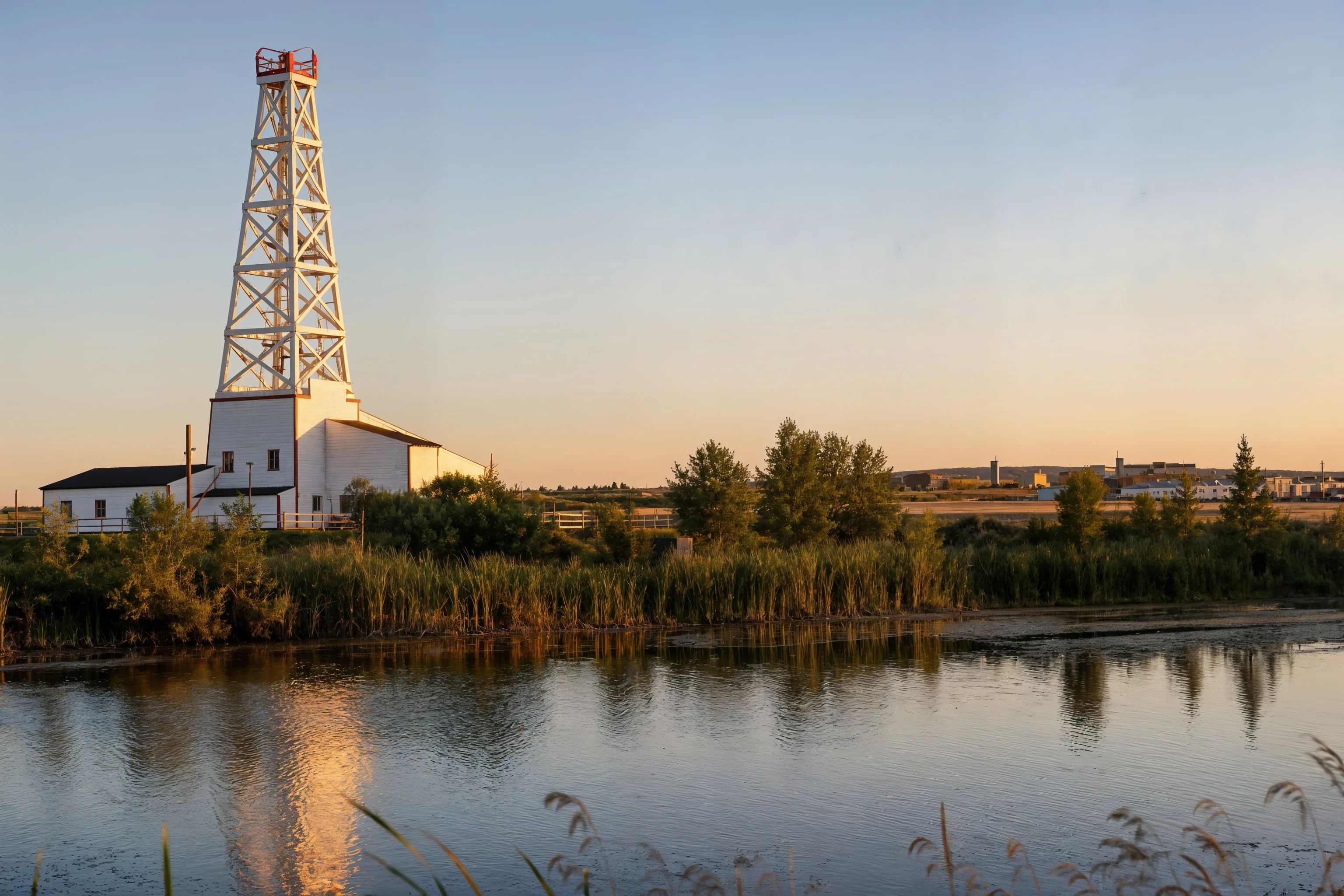
On February 13, 1947, Imperial Oil brought the Leduc No. 1 well into production on Mike Turta's farm west of the town, after 133 dry holes across the Prairies. The discovery of oil in a Devonian reef beneath Leduc ended decades of failed drilling, touched off the boom that built modern Alberta, and turned a quiet farming community into the anchor of the Leduc-Woodbend oilfield. The discovery site, on Highway 60 in Leduc County, is now home to the Canadian Energy Museum. That history matters for solar buyers because this is a city that understands production economics: Leduc households and businesses have always evaluated energy on cost per unit, and solar competes on exactly that basis.
Leduc has not stood still since. Statistics Canada counted 34,094 residents in the 2021 census, up 13.7 percent from 29,993 in 2016, making it one of the faster-growing small cities in the province. Edmonton International Airport sits on the city's eastern edge, and the Nisku Business Park next door hosts one of western Canada's densest clusters of oilfield services, fabrication, and logistics employers. Telford Lake, the 10-kilometre Multiway loop around it, and the Stone Barn in William F. Lede Park give the city a recreation core that keeps growing families rooted here rather than commuting them away.
Solar fits this profile on the numbers. The Edmonton-area weather normals from Environment Canada, measured at the Edmonton City Centre station about 35 kilometres north, record roughly 2,300 hours of bright sunshine a year, and the airport's own weather station sits inside Leduc itself. Natural Resources Canada's photovoltaic potential data for the Edmonton region works out to about 1,150 to 1,250 kilowatt-hours per kilowatt of panel per year for a south-facing array tilted at local latitude; we use roughly 1,150 after real-world losses when we model Leduc systems. Cold winter air helps, since panels convert sunlight more efficiently when they run cool. All of it is captured with a plain grid-tied system, no batteries, feeding FortisAlberta's wires.
Three Leduc Homes, Three Different Solar Cases
Leduc is not one housing market. The city mixes newer commuter suburbs, established neighbourhoods, and a wide rural ring in Leduc County, and each carries a distinct electrical load. These are the three profiles we design around most often.
The Commuter Family (Southfork, West Haven, Deer Valley)
A two-adult household with two or three kids in one of the post-2010 subdivisions off 50 Street, with two vehicles in the driveway, often including an EV or plug-in hybrid charging overnight, plus a finished basement and air conditioning running through July and August. Typical bills run $180 to $300 a month. An 8 to 9 kilowatt rooftop array covers most of that annual usage, and the panels sit on a young roof with decades of life left, which keeps the economics clean.
The Airport and Nisku Shift-Worker Household
One or two adults working rotating shifts at Edmonton International Airport, the Nisku Business Park, or the warehouses and fabrication shops along Highway 2 and 19 Avenue. The load is steady rather than spiky, because a shift-worker's home runs around the clock: hot water, a deep freeze, and heating or cooling that never quite gets a break. Bills land between $140 and $230 a month. A 6 to 7 kilowatt roof system usually zeroes out the annual balance, and because consumption is spread across all hours, nearly every kilowatt-hour the panels make is one the household would otherwise buy.
The Acreage on the County Edge
A five-to-ten-acre parcel minutes outside city limits toward Calmar, New Sarepta, or the airport's west side: a well pump, septic lift, heated or soon-to-be-heated shop, maybe a horse barn with a trough heater that runs all winter. These are the $280 to $500 a month bills, and they climb fast the day the shop gets wired for welding or a compressor. A 10 to 12 kilowatt ground mount on Azgard racking, set at a snow-shedding tilt, is the usual answer, with three-phase-ready equipment if the shop service allows it.
What Solar Costs in Leduc
Our installed pricing for the Leduc area runs $2.25 to $2.85 per watt for rooftop systems and $2.50 to $3.50 per watt for ground mounts. The spread reflects roof pitch and access, trenching and racking for ground arrays, panel and inverter selection, and the electrical work at the service entrance. Every system we quote uses tier-one equipment: LONGi panels, APsystems microinverters, and racking engineered to National Building Code snow and wind loads, with the Edmonton-region base design snow load running near 1.8 kPa under the current code cycle.
A worked example, priced honestly inside the range. Take the commuter family above with a $220 average bill. An 8.2 kilowatt rooftop system at $2.55 per watt comes to about $20,900 before any retailer or tax treatment. At the Edmonton-area yield of roughly 1,150 kWh per kWp, that array produces about 9,400 kilowatt-hours a year. With all-in residential power prices commonly between $0.15 and $0.19 per kilowatt-hour in Alberta, annual savings land around $1,400 to $1,800, putting simple payback in the 12-to-15-year range on a panel set warrantied for 25 years of production. Nobody should promise you more precision than that on a website; the point of the site assessment is to sharpen these numbers to your actual roof and actual bill.
| Profile | System | Installed cost range | Est. annual savings | Simple payback |
|---|---|---|---|---|
| Commuter family, $180 to $300/mo bill | 8 to 9 kW rooftop | $18,000 to $25,700 | $1,400 to $1,900 | 12 to 15 years |
| Airport or Nisku shift household, $140 to $230/mo | 6 to 7 kW rooftop | $13,500 to $20,000 | $1,000 to $1,500 | 12 to 16 years |
| Leduc County acreage with shop, $280 to $500/mo | 10 to 12 kW ground mount | $25,000 to $42,000 | $2,000 to $2,900 | 12 to 17 years |
Ranges assume standard wood-frame construction, a code-compliant service panel, and FortisAlberta single-phase residential service. Savings use Alberta all-in residential rates of roughly $0.15 to $0.19 per kWh and NRCan Edmonton-region yield figures; your bill decides the real numbers.
FortisAlberta Territory
We verified the wire service rather than assume it: FortisAlberta's own 2025 Farm Customer Guide lists Leduc in its published service area, and the City of Leduc's franchise arrangements sit with FortisAlberta. In other words, the meter base, distribution lines, and the bi-directional meter your solar system needs all belong to FortisAlberta, while you keep buying your actual energy from whichever retailer you prefer. Worth a small aside: FortisAlberta's grid control centre operates out of Airdrie, our home base, so the utility reviewing your application works a few kilometres from our shop.
Every grid-tied system in Leduc connects under Alberta's Micro-generation Regulation. We submit the customer generation application on your behalf with a single-line diagram, equipment certifications, and site details. Approval and the bi-directional meter swap together typically run two to six weeks, and we schedule the work so utility processing overlaps with municipal permits instead of stacking at the end. Once FortisAlberta gives permission to operate, your surplus flows to the grid and earns credits against the energy portion of your bill, month by month, for the year.
Working With a Crew Based Two and a Half Hours South
Our shop is in Airdrie, and Leduc sits about 240 kilometres north at the far end of the territory we cover between Calgary and Edmonton. We are straightforward about what that means. Most of a solar project is paperwork and design, and all of that happens by phone and email: you send a recent power bill, we pull the 12-month usage history from it, review it with you, and build the production model before anyone drives anywhere. One consolidated site visit covers the assessment, roof or ground measurements, and electrical service check. The installation itself takes two to four days for most Leduc properties, and we book Leduc work in runs so you are never waiting on a crew that got stuck on a job in another town.
The process from first call to permission to operate runs like this. Bill review comes first, because a system sized without your real usage is a guess. Site assessment and design follow, with a fixed quote that spells out equipment and production. Permits and the FortisAlberta application go in together. Installation is performed by our own crew with licensed electricians making the service connections. Commissioning, inspection, and the meter swap close the loop, and you watch your first net-billed cycle come in. From signature to switch-on, most Leduc projects land between eight and fourteen weeks, dominated by utility and permit timelines rather than construction.
Leduc Solar Questions, Answered Honestly
See what our clients say
Real reviews from Alberta homeowners and farmers.
Get a Free Solar Assessment
We serve Leduc and surrounding areas. No obligation.
Also Serving Nearby Areas
Ready to Assess Your Property?
Submit a recent power bill and we will review your consumption and provide an honest assessment of what solar can do for your Leduc property. No obligation.
Also Serving Nearby Communities