
The Town, and the Sun Numbers Behind It
Nobleford began as a rail-siding hamlet in 1908 and 1909, when CPR land agent Dr. Charles S. Noble laid out the townsite in what is now Lethbridge County, about 32 kilometres northwest of the City of Lethbridge. The hamlet, first known simply as Noble, was renamed Nobleford in 1913, and on February 28, 1918, with a population past 100, it incorporated as a Village with C.S. Noble himself serving as its first mayor. Exactly one hundred years later, on February 28, 2018, Nobleford became a Town.
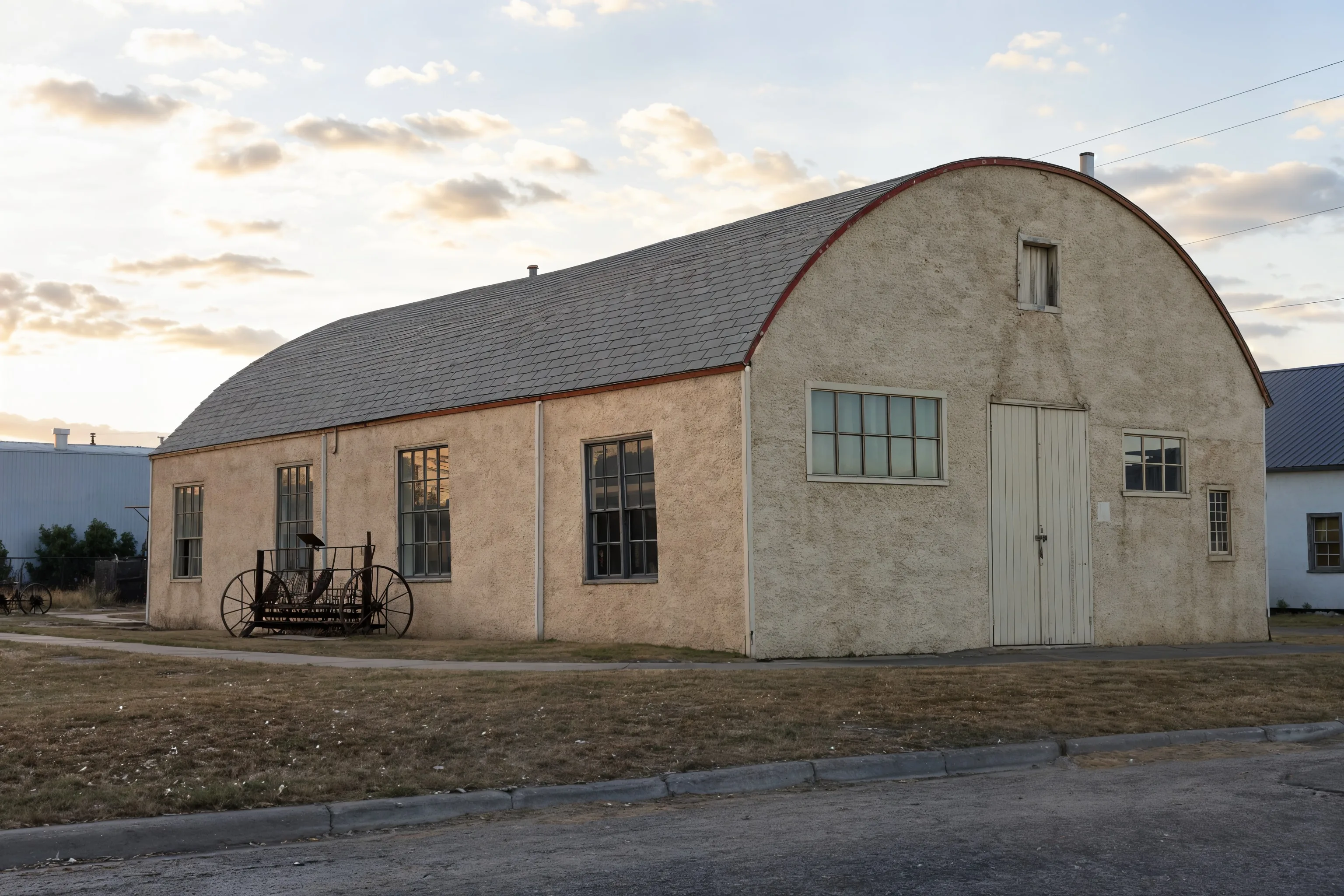
Noble is remembered locally for more than the townsite. At the factory that ran here from the 1930s until 1998, he developed the Noble blade, a dryland-farming plow that earned an international reputation and carried Nobleford's name well beyond the county. That same building on Highway Avenue, a wood-frame structure with a stucco exterior and a vaulted roof, now houses the Nobleford Area Museum, which opened in 2004 and shares the site with the town office and a community meeting room. The agricultural manufacturing and service trade the Noble blade started never really left; something like 300 people still work in that sector in and around town today. Nobleford also owns and runs its own water treatment facility, drawing from the LNID canal, and supplies drinking water into regional pipelines serving Barons and the rest of Lethbridge County, the only municipality in the county that produces its own water. Growth has followed: 1,438 residents at the 2021 Census, up from 1,278 in 2016.
Nobleford sits at 49.884 degrees north, about as far south as Alberta gets, and that matters for solar. There is no complete Environment Canada bright-sunshine normal published for a station inside Lethbridge County, so the honest regional benchmark comes from Calgary International Airport, the nearest station with a full 1981 to 2010 normal on record: roughly 2,396 hours of bright sunshine a year. What is not a regional stand-in is the production number. Natural Resources Canada publishes a direct photovoltaic yield rating for Nobleford itself, 1,323 kilowatt-hours per kilowatt of south-facing, latitude-tilt panel per year, a strong figure that beats a lot of the province.
FortisAlberta Runs the Wires Here, Out of Coaldale
Nobleford is straightforward FortisAlberta territory, with no member-owned co-op wrinkle to sort out first. The lines here are managed out of FortisAlberta's Coaldale operations centre, the same crew that looks after Coaldale, Coalhurst, Magrath, Milk River, Picture Butte, and Raymond, along with the villages of Barons, Carmangay, Coutts, Stirling, and Warner. If you have ever called in an outage, that is the dispatch you talked to.
Electric service reached the village originally through a 1929 Calgary Power franchise, the company that eventually became FortisAlberta's distribution business in this part of the province. Almost a century later the poles and transformers are a lot newer, but the basic arrangement, a franchised utility running distribution while retailers sell the energy, has not changed.
Under Alberta's Micro-Generation Regulation, any system up to 150 kilowatts can interconnect and earn credit for the power it sends back through the meter. We file that application to FortisAlberta as part of every project, along with the electrical permit, and approval through their Coaldale-area process typically takes two to six weeks. You sign the paperwork; we handle the rest.
Three Load Profiles We See Around Nobleford
Lethbridge County power bills follow the crop and the season more than the clock. Irrigation pumps, grain handling, and shop heat push bills up in exactly the months the panels are working hardest. The ranges below come from bills we have reviewed across the county; your own 12-month history is what actually sizes your system.
The in-town home. A bungalow or newer build off Highway Avenue or one of the side streets, electric or gas heat, a freezer in the garage. Bills typically run $170 to $320 a month, and a 6 to 8 kilowatt roof system covers most of that.
The acreage with a heated shop. Properties on the edge of town or out toward Barons carry a shop with overhead or in-floor heat plus a pressure system for the house. $380 to $650 a month is common, and a 10 to 12 kilowatt system, roof or ground, makes a real dent in it.
The grain and seed operation. Grain drying, augers, and yard lighting on the farms around Nobleford can push a harvest-season bill to $550 to $950 a month. These are the properties where a 12 to 16 kilowatt ground mount on open land pencils out fastest, because every kilowatt-hour it makes displaces one bought at full retail during your busiest season.
Building for Open Prairie Wind and Prairie Snow
Nobleford sits on open, largely treeless prairie, and that means two things for a solar install: the wind loads are real, and there is nothing around to block the sun once panels go up. Racking here is specified for that higher wind exposure rather than for a sheltered acreage further north, and every roof gets checked for structure and fastening before we quote it, not after.
Snow load is moderate by Alberta standards, closer to what you would expect anywhere on the open southern prairie than to the heavy wet snow further west in the foothills. Ground-mount footings and conduit still go in below the frost line, and panels set at a sensible tilt shed what snow does fall once the sun is back out, which around here does not take long.
We spec LONGi panels, hail-rated to withstand 35 millimetre stones at 97 kilometres an hour with a 25-year product warranty, alongside APsystems microinverters for homes and acreages or Solis string inverters for larger farm and shop arrays. Cold, clear days actually improve panel output per watt, one more reason a southern Alberta winter is not the production problem people sometimes assume.
What Solar Costs in Nobleford
Roof-mounted systems run $2.25 to $2.85 per watt installed, so a 6 to 8 kilowatt in-town system runs roughly $13,500 to $22,800 depending on the roof and equipment. Ground mounts, the common choice on farms and larger acreages, run $2.50 to $3.50 per watt to cover trenching, piles, and heavier racking.
| Property profile | System size | Installed cost range | Est. first-year production |
|---|---|---|---|
| In-town home | 6-8 kW roof | $13,500 to $22,800 | About 7,900 to 10,600 kWh |
| Larger home or acreage home | 10-12 kW roof | $22,500 to $34,200 | About 13,200 to 15,900 kWh |
| Farm or acreage with shop | 12-16 kW ground | $30,000 to $56,000 | About 15,900 to 21,200 kWh |
Those production figures use Nobleford's own NRCan solar yield of 1,323 kilowatt-hours per kilowatt per year, a strong number for the province, not a generic estimate borrowed from somewhere else. FortisAlberta interconnection and permitting are included in every quoted price.
Payback depends on your usage and your retailer's rate, but across the load profiles above, a realistic range is roughly 8 to 12 years, backed by 25 to 30 years of expected panel life. Incorporated farms and businesses can also claim the federal 30 percent Investment Tax Credit on the equipment, which shortens that payback further. Alberta currently has no separate residential rebate, so we quote the real number up front rather than promise one that is not there.
The Process, From Your Power Bill to a Spinning Meter
Send Your FortisAlberta Bill
We start with the 12-month usage graph on your bill, the real record of your consumption and the number that actually sizes your system.
Site Assessment in Nobleford
We walk the roof or the yard, check wind exposure, shading, and your electrical service, and talk through roof-mount versus ground-mount right there on site.
Design, Quote, and Interconnection
You get an itemized quote with a production estimate built from Nobleford's own solar yield data. We file the FortisAlberta micro-generation application and the electrical permits.
Install and Commission
Our crew installs racking, panels, inverter, and tie-in, typically over one to three days depending on system size. Inspection and the meter swap follow.
Production Check-In
We confirm the system is producing as designed after commissioning and stay a phone call away if anything about your FortisAlberta bill looks off down the road.
The Drive Reality: Airdrie to Nobleford
Our shop is in Airdrie, just north of Calgary. Nobleford is about 215 kilometres south, roughly a 165 minute drive. That is a full afternoon in a truck for one property, so we do not send a crew down for a single stop.
Site assessments and installs around Nobleford get grouped into scheduled trip windows: several properties on the same run, materials staged ahead of time, your install day booked around that plan rather than around one truck making a solo trip. From deposit to a commissioned system, the whole process typically runs two to six weeks, and most of that is permitting and the FortisAlberta interconnection queue, not time on your roof.
Whether you are in town, out toward Barons, or elsewhere in Lethbridge County, we run the same process: one visit, one design, one crew that already knows the wind loads and FortisAlberta's Coaldale-area paperwork.
Frequently Asked Questions
Get a Solar Design for Your Nobleford Property
Send a recent FortisAlberta bill and we will come back with an honest assessment: system size, cost range, and what solar can realistically do for your property. No pressure, no brochure numbers.
Also Serving Nearby Communities