
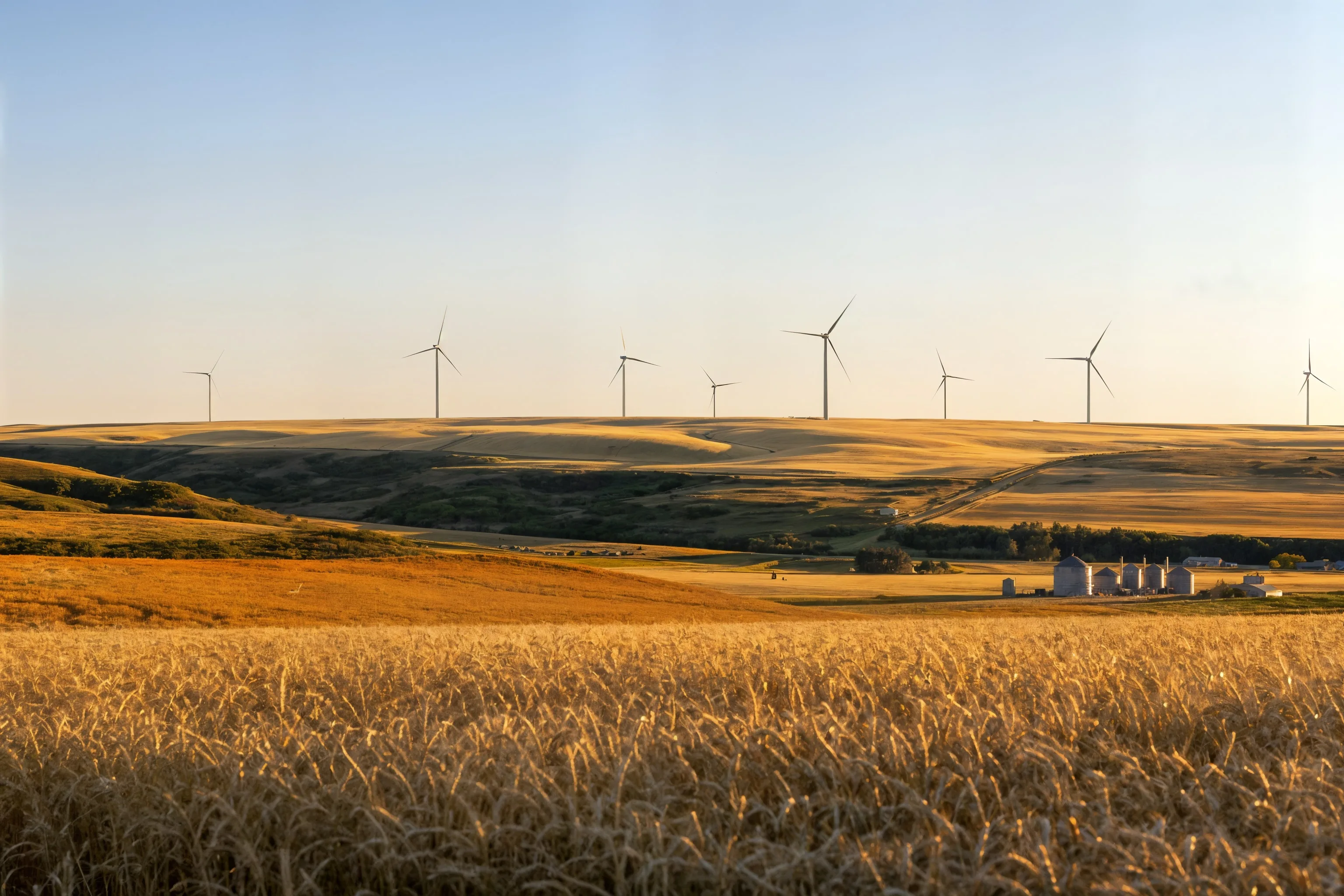
Solar on the Dryland Prairie East of Stettler
The County of Paintearth No. 18 spreads across roughly 3,240 square kilometres of east-central Alberta prairie, and according to the 2021 Census it is home to 1,990 people outside its two towns. That works out to about 0.6 people per square kilometre, which tells you most of what you need to know about the landscape: this is farm country, organized around quarter sections, grain bins, cattle pasture, and the hamlets of Brownfield, Federal, Fleet, Throne, and, since its dissolution on January 1, 2025, Halkirk. The county takes its name from Paintearth Creek, a reference to the banded, paint-coloured clays and bentonite banks that show in valley walls through this part of the province.
Paintearth County is not new to energy. The Battle River Generating Station near Halkirk, converted from coal to natural gas, anchors the local economy, and Capital Power's Halkirk wind farm has turned 83 turbines in the coulees since 2012, making it one of Alberta's pioneering large wind projects. The county's own business development material lists high annual sunlight alongside its wind resources. At 52 degrees north, Natural Resources Canada's PV potential maps place this corner of east-central Alberta in the 1,200 to 1,300 kilowatt-hours per kilowatt-peak band for a south-facing array tilted at latitude, with sixteen and a half hours of daylight at the June solstice carrying long summer production well past suppertime.
What makes solar fit this particular county is the property mix. Dryland grain and oilseed farms run bin fans, augers, well pumps, and heated shops, often on long single-phase rural lines. Cattle operations run water bowls and barn ventilation through a cold winter. Meanwhile the towns of Castor and Coronation hold older bungalows and farm-service businesses with straightforward roof planes. Nearly every one of those properties has either an open, unshaded field or an uncomplicated roof, which is why ground mounts dominate our work here and why a grid-tied system, no batteries required, can quietly cut the farmyard power bill for decades.
What Power Bills Look Like Here
Every property is different, but three load profiles cover most of what we see on FortisAlberta meters across Paintearth County. Ranges reflect real billing history we review during design, not averages from a province-wide database.
The Dryland Grain Farm
A quarter or half section with a bin site, auger, bin fans, well pump, and a heated shop. Monthly bills swing from a few hundred dollars in quiet winter months to $700 or more during harvest handling, with annual totals commonly between $4,000 and $7,000. These sites are the natural home of a 15 to 25 kilowatt ground mount parked beside the bins.
Typical monthly bill: $250 to $900 depending on the season
The Cattle Operation
Calving barns, heated water bowls, feed processing, and yard lighting draw steadily through the coldest months, which is exactly the pattern net metering rewards. Annual consumption often lands between 18,000 and 30,000 kilowatt-hours.
Typical monthly bill: $350 to $700
The Small-Town Home
The post-war bungalows and newer infill homes of Castor and Coronation, many of them on ATCO Electric distribution, usually run 7,000 to 12,000 kilowatt-hours a year. A 6 to 10 kilowatt rooftop system covers most of that on an annual basis.
Typical monthly bill: $130 to $260
What Solar Costs in Paintearth County
Installed pricing for this area follows two honest ranges. A rooftop system runs $2.25 to $2.85 per watt installed. A ground mount, which needs posts, racking, trenching, and more material, runs $2.50 to $3.50 per watt. Ground mounts cost more because they are built for snow, wind, and decades of service in an open field, and they dominate here because farmyards almost always have the space.
One worked example, using the range honestly: a 20 kilowatt ground mount beside a bin site is 20,000 watts. At $2.50 to $3.50 per watt, the installed price lands between $50,000 and $70,000. Using the NRCan band for this latitude, that system produces roughly 25,000 kilowatt-hours a year. At a typical rural all-in rate near 20 cents per kilowatt-hour once energy, delivery, and riders are counted, that is about $5,000 a year off the farm bill, which puts simple payback in the 10 to 14 year range on energy savings alone, inside the 25 to 30 year life of the equipment.
| Property type | System size | Installed range | Est. annual production | Est. annual savings | Simple payback |
|---|---|---|---|---|---|
| Town home or acreage rooftop | 8 kW rooftop | $18,000 to $22,800 | About 10,000 kWh | $1,900 to $2,200 | 9 to 12 years |
| Grain farm ground mount | 20 kW ground mount | $50,000 to $70,000 | About 25,000 kWh | $4,800 to $5,600 | 10 to 14 years |
| Larger farm or livestock site | 40 kW ground mount | $100,000 to $140,000 | About 50,000 kWh | $9,500 to $11,000 | 10 to 14 years |
Savings assume an all-in rural rate near 20 cents per kilowatt-hour and NRCan map values for a south-facing latitude-tilt array at this latitude. Your rate plan, shading, and panel orientation shift the numbers, which is why every quote we issue starts from your actual bill history.
Wire Service and Interconnection in Paintearth County
This is the part of east-central Alberta where a single county splits between two wire owners, and getting it right matters before any design work starts. The rural County of Paintearth No. 18 sits inside FortisAlberta's service territory. That is confirmed in the Alberta Utilities Commission's approved franchise fee schedules, which list Paintearth No. 18, County of, by name with its own municipal rider. Your bill's distribution charges come from FortisAlberta, and your micro-generation application goes to FortisAlberta.
Inside the town boundaries the picture is different. Castor and Coronation are ATCO Electric distribution territory, a fact the county's own business development page reflects when it describes regional electricity as available through ATCO Electric. An in-town rooftop project on 50 Street in Coronation files with ATCO Electric, not FortisAlberta. We confirm your wire owner from your site ID on the bill before filing anything, so the application never bounces between the two utilities.
Under Alberta's Micro-generation Regulation, surplus power your panels export earns bill credits, and the meter runs both ways. Approval from either FortisAlberta or ATCO Electric typically takes two to six weeks on a complete application. We prepare the single-line diagram, site details, and paperwork as part of the project, and the approval window runs at the same time as equipment ordering rather than after installation.
Working With an Airdrie Crew From This Distance
Our shop is in Airdrie, about 300 kilometres west of the county office at the Highway 12 and 36 junction, which works out to roughly three and a half hours behind the wheel through the Stettler area. We will not pretend that is next door. What makes it work is batching: site assessments, deliveries, and installations for Paintearth County and the surrounding east-central region are grouped into planned trips, so the same crew that measures your roof or walks your field is the crew that sets the racking and commissions the inverter.
The process starts with your last twelve months of bills, which we can review from a photo or PDF before anyone drives east. That tells us your consumption pattern, your wire owner, and roughly what size makes sense. From there it is a site visit to check structure, shading, and service capacity, then a written design with production and pricing ranges, permits and the micro-generation filing, installation by licensed electricians, and final commissioning once the utility sets the bi-directional meter. You deal with one company start to finish, and there is no subcontractor hand-off halfway through.
Frequently Asked Questions
See what our clients say
Real reviews from Alberta homeowners and farmers.
Get a Free Solar Assessment
We serve Paintearth County and surrounding areas. No obligation.
Also Serving Nearby Areas
Ready to Assess Your Property?
Submit a recent power bill and we will review your consumption and provide an honest assessment of what solar can do for your Paintearth County property. No obligation.
Also Serving Nearby Communities