
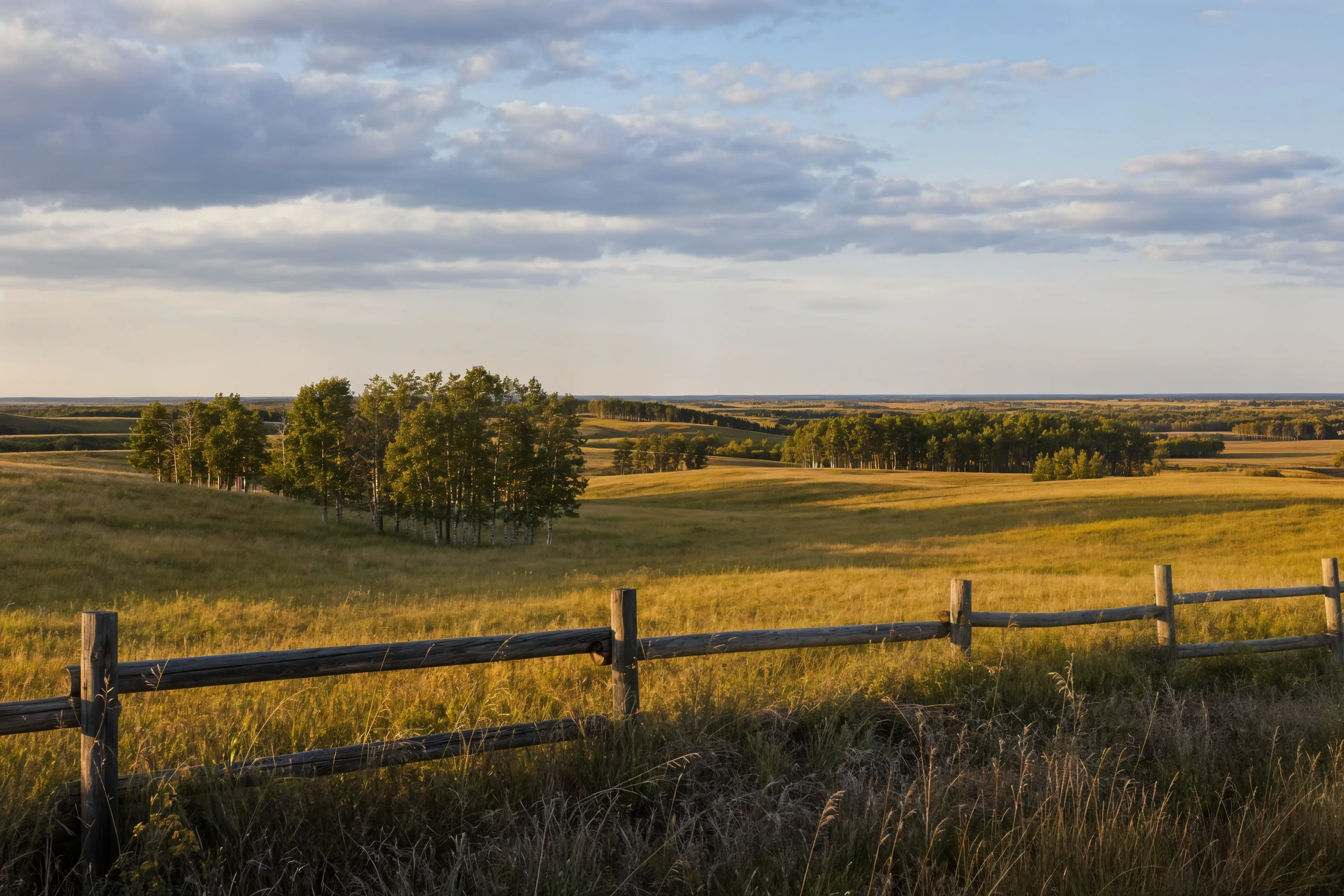
About Rural Strathcona County
Strathcona County is a specialized municipality that wraps a dense suburb around Sherwood Park together with a much larger stretch of open country. Roughly 28,000 people live in that rural service area, on estate acreages and working farms spread across the county rather than inside Sherwood Park's own urban boundary. It is a different property type entirely: more land, more outbuildings, and a heavier year-round electrical load than a townsite lot.
The clearest landmark out here is Elk Island National Park, a fenced wildlife sanctuary established in 1906 and one of Canada's older protected areas, sitting partly within Strathcona County along the Yellowhead Highway. It is best known as a conservation range for plains and wood bison, and it anchors the rural, open character of this part of the county, a world away from the refinery skyline on the Sherwood Park side. Scattered around that countryside are the smaller hamlets and lake communities that make up the rest of rural Strathcona County, the kind of places where a farm roof or a quarter section of open land is the norm rather than a subdivision lot.
Solar Potential in Rural Strathcona County
Rural Strathcona County sits at roughly 53.5 degrees north, and the nearest Environment Canada station, Edmonton City Centre, logs about 2,345 bright-sunshine hours a year. Local systems tend to deliver a specific yield around 1,150 kWh for every installed kilowatt, so a 7.6 kW reference system produces roughly 8,700 kWh annually, and a 10 kW system scales that to about 11,500 kWh. Acreage and farm systems commonly run larger than that to cover a heated shop, a well pump, or farm equipment.
| Property type | Typical system | Installed cost range | Est. annual production |
|---|---|---|---|
| Acreage farmhouse roof | 6-8 kW roof-mount | $13,500 - $22,800 | ~6,900 - 9,200 kWh |
| Working farm shop or barn | 10-15 kW ground-mount | $25,000 - $52,500 | ~11,500 - 17,250 kWh |
| Larger grain or livestock operation | 20-30 kW ground-mount | $50,000 - $105,000 | ~23,000 - 34,500 kWh |
Pricing is a range because roof or ground conditions, panel count, and electrical work all move the final number. We confirm one fixed figure at the site visit.
Snow Load, Wind, and the Local Build
Rural Strathcona County falls in snow load zone S2 and wind load zone R3, the Edmonton-region rating used across this part of the province. Open farmland and exposed quarter sections can see more sustained wind than a sheltered subdivision lot, so racking is engineered to that local load rather than a generic spec. On a ground mount, which is common where a farmyard has open land and a shop or barn to feed, footings are set below frost depth so freeze-thaw cycles do not shift the array over the years. On a farmhouse or shop roof, tilt is set steep enough that snow sheds within a day or two of sun.
Cold weather is actually a production advantage here: panels are semiconductors, and they output more power per watt in a clear, cold prairie January than in July heat. LONGi panels paired with APsystems microinverters cover most acreage and farmhouse roof jobs; Solis string inverters handle larger ground-mount arrays sized to a shop, barn, or grain operation.
Grid Connection and Net Metering
FortisAlberta owns and operates the distribution lines across rural Strathcona County, every acreage and farm outside Sherwood Park's own urban core included. EPCOR's network never reaches this far; it stops at Edmonton's city limits. We prepare and submit the micro-generation interconnection application to FortisAlberta on your behalf, coordinate the technical review, and schedule the bi-directional meter swap. Approval typically takes two to six weeks from a complete application.
Once the meter is swapped, Alberta's net metering rules apply the same way on a quarter section as on a town lot: your system produces, your meter nets against your usage, and surplus power exported on a long summer day banks a credit that carries into the shorter days of winter. What changes on a farm or acreage is simply the scale of the load the system is sized against.
Six Steps From Power Bill to Power Producer
Bill Review
Send your most recent power bill. We calculate your annual consumption, including shop, well pump, and farm equipment loads, to size the system right.
Site Assessment
We visit your acreage or farm in person: roof or ground evaluation, electrical service inspection, shading analysis, and interconnection scoping.
System Design and Quote
A complete layout, production estimate, and fixed-price quote. On rural properties we show roof and ground-mount options side by side.
Permitting
We pull building and electrical permits and submit your micro-generation application to FortisAlberta. You never call the utility yourself.
Installation
Our licensed electricians install the racking, panels, inverters, and wiring, whether that is rails on a shop roof or piles in the yard.
Commissioning
Inspection, meter swap, and connection to the FortisAlberta grid. Your meter starts banking credit.
Rural Strathcona County Solar, Common Questions
See what our clients say
Real reviews from Alberta homeowners and farmers.
Free Solar Assessment for Rural Strathcona County
Acreage, farm, or shop. Roof-mount or ground-mount. Tell us about your property and we will size it. No obligation.
Also Serving Nearby Areas
From the Farmyard to the Quarter Section, We Know Rural Strathcona County
Submit a recent power bill from your acreage or farm and we will size a system to your actual load, quote it to the dollar, and handle every step of the FortisAlberta filing. No obligation.
Also Serving Nearby Communities