
Why Solar Fits Wembley and the Wapiti River Valley
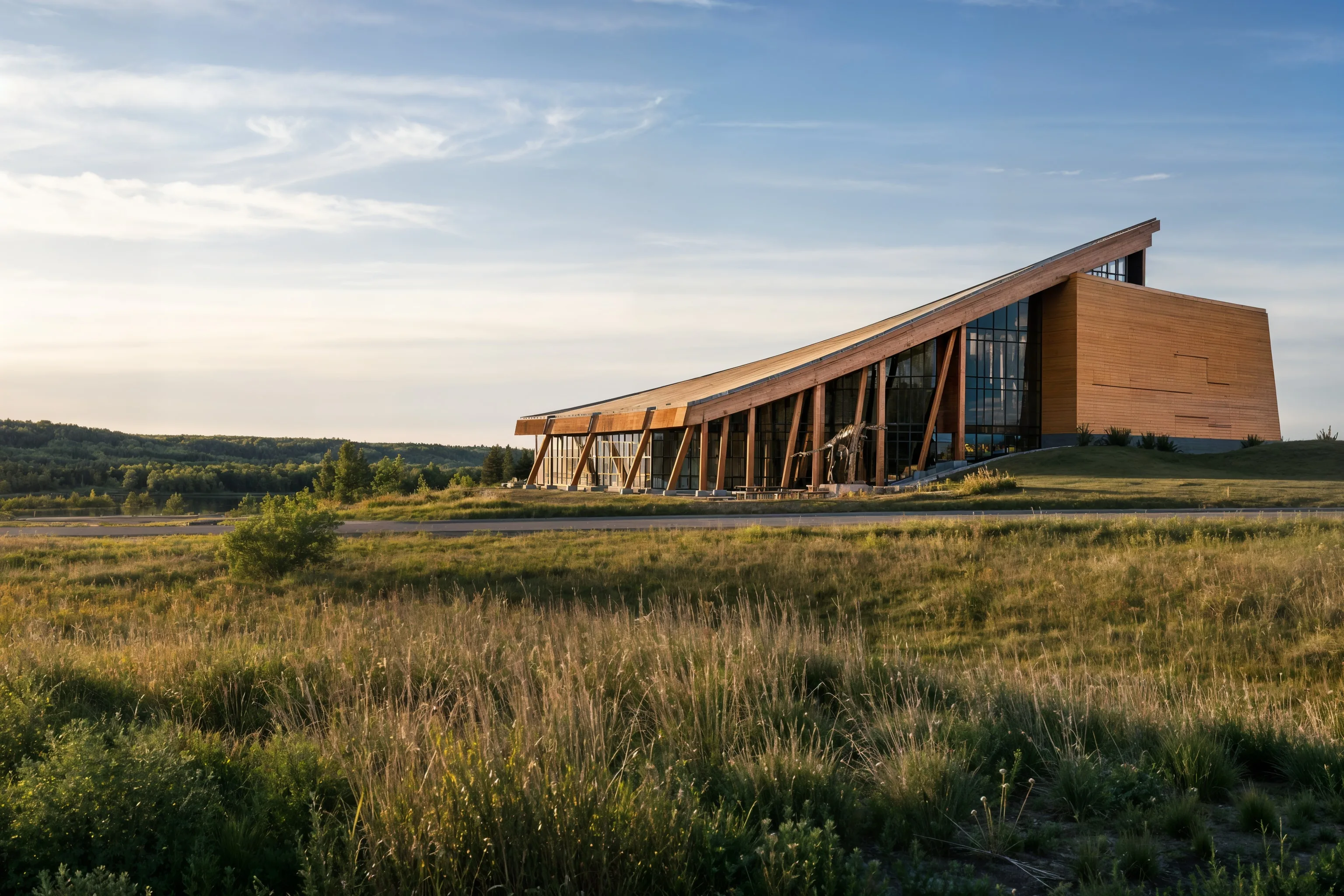
The Town of Wembley is small, 1,432 residents in the 2021 census spread over 4.74 square kilometres, but it punches above its weight as a service point for the farm country around it. It sits in the County of Grande Prairie No. 1, roughly 24 kilometres west of the city on Highway 43, and most people know it for the Philip J. Currie Dinosaur Museum, opened in 2015 beside the Pipestone Creek Bonebed in the Wapiti River valley. The land around town is working agricultural country: beef and hay operations, seed cleaning, bee yards, and the orchards and berry farms that draw weekend traffic up from Grande Prairie. That mix means a lot of shops, wells, barns, and yard sites with steady electrical loads spread across open, unshaded land.
Yes, the solar resource works here, and we quote it straight. Wembley's figure from Natural Resources Canada's PV potential data is 1,113 kWh annually per kWp of capacity on a south-facing array pitched at latitude tilt. Southern Alberta posts higher numbers; even so, this is a genuinely solid northern resource rather than a borderline one. At 55 degrees north the days run extremely long through summer, June and July concentrate the production hours, and the deep cold works in your favour because panels generate more from each hour of sunlight when they run cool. Snow slides off tilted modules within days, and a ground mount angled for shedding can be brushed clear in minutes if a wet spring dump sticks.
None of this rests on a subsidy program. The entire financial case is Alberta's Micro-Generation Regulation: anyone in town or on the surrounding farms who buys power through ATCO Electric can tie a grid-connected system into the wires, send surplus energy back, and accumulate a kilowatt-hour credit that keeps rolling forward month after month. At the retail prices of the last few years, a well-sited Wembley property usually sees simple payback in the low-to-mid teens of years, then keeps producing for 25 to 30 more. Batteries are optional, there is no special rate class to qualify for, and nothing about your daily routine needs to change.
What Wembley-Area Properties Actually Use
Every design begins with a full year of consumption data from your ATCO Electric bill. Around Wembley, properties sort into three broad types:
Farm or Large Acreage with Three-Phase Service
An operating farm in the Wapiti River valley or toward Saskatoon Lake and Dimsdale, with a heated shop, well pumps, grain or hay handling equipment, and a home at the yard site. Bills track the season closely: $500 to $1,400 through the busy months and $150 to $350 over winter, adding up to 18,000 to 40,000 kWh a year. High annual usage plus open, unshaded ground makes these the strongest solar candidates in the Wembley area, with space for a 15 to 30 kW ground mount.
Acreage with Shop and Well
Hobby farms and country-residential places on the range roads around town: a house, a detached or radiant-heated shop, a well pump, and sometimes a small barn. Figure on $250 to $550 in monthly bills across the whole year, or 12,000 to 20,000 kWh annually. A 10 to 14 kW array, on the roof or on the ground, offsets the bulk of that consumption, and net metering credits carry the remainder across the seasons.
In-Town Wembley Home
An ordinary residential service in town, drawing 7,000 to 12,000 kWh a year on monthly bills of $140 to $300, with the spread set by heating fuel and how many people live under the roof. A rooftop array of 7 to 11 kW covers most of that consumption, and whatever the summer sun produces beyond the load flows to the grid as credit.
Solar Costs and Savings in Wembley
Rooftop work in this territory prices at $2.25 to $2.85 per watt, while ground mounts run $2.50 to $3.50 per watt; the wider ground range pays for trenching, racking, and the distance back to the service. Panels, inverter hardware, Azgard racking on ground builds, permits, the ATCO Electric micro-generation application, and commissioning are all inside those numbers. Once the site assessment is complete you receive a single fixed installed price, and financing pitches are not part of our process.
Here is the arithmetic on a realistic case. Take a 12 kW ground-mount array for an acreage outside Wembley: on an easy site it prices at $30,000 all-in at $2.50 per watt with a short trench and easy digging, while a long trench run and rock to drill through push the hard version to $42,000 ($3.50 per watt). Using Wembley's NRCan figure of 1,113 kWh per kWp, annual output lands near 13,400 kWh. At an all-in residential rate of roughly 17 cents per kWh, that output trims about $2,270 from the yearly bill, and dividing one number into the other gives a simple payback that works out to somewhere between 13 and 19 years, driven by where the installation price lands. Straightforward rooftop jobs with short wire runs beat that range; farms facing long trenches and panel upgrades land on the slower end. Before you sign anything, we work through the identical calculation using your own bill.
| Property profile | Typical system | Est. annual production | Est. annual savings | Simple payback |
|---|---|---|---|---|
| Farm or large acreage, three-phase yard site | 20 kW ground mount | ~22,260 kWh | $3,600 to $3,900 | 13 to 19 years |
| Acreage with shop and well | 12 kW ground mount | ~13,400 kWh | $2,100 to $2,400 | 13 to 19 years |
| In-town Wembley home | 8 kW rooftop | ~8,900 kWh | $1,400 to $1,600 | 12 to 15 years |
These figures price power at an all-in rate of about 17 cents per kWh and assume the property uses everything it produces; your retailer, your rate plan, and the shape of your consumption will move the real result.
ATCO Electric Interconnection in Wembley
Wembley is ATCO Electric territory. The utility's lines serve both the town and the surrounding County of Grande Prairie No. 1, and the town's own outage notices name ATCO Electric when power goes out. Flip over your bill and the distribution charge names ATCO no matter which retailer supplies the energy. That distribution line is the one that matters for solar: the micro-generation application, the swap to a bi-directional meter, and any technical review are all handled through ATCO Electric's customer generation process, not by your retailer.
Alberta's Micro-Generation Regulation streamlines grid-tied connection for anything up to 150 kW. Whatever you export beyond what the property uses becomes a kilowatt-hour credit on your account, and unused credit keeps carrying forward from month to month for as long as twelve months. Our Master Electrician signs and files the application, we manage the safety code filing, and we book the meter swap with the utility. Between filing and a swapped meter, budget two to six weeks. Older single-phase rural services often run systems above 10 kW, and those can prompt a utility technical review; we raise that possibility while the design is still on paper so nothing catches you off guard.
Working With an Airdrie Crew Based a Full Day's Drive Away
Getting to Wembley takes deliberate planning on our side: roughly 700 kilometres and about seven hours from the Airdrie shop, northwest by way of Highways 2 and 43 through Edmonton and Valleyview. We still make the trip, because Peace Country farm yards and open acreages with strong exposure and genuine electrical loads are precisely the projects we want. Assessments and installation days get grouped into batched runs, so the distance never appears as a line item in your quote.
Phone or email bill review
Email or text us a photo or PDF of your ATCO Electric bill. From it we pull your rate class and service size, read a full year of consumption, and give you a straight answer on whether solar pencils out for your place, all before anyone gets in the truck.
Batched site assessment day
Several Peace Country assessments happen on the same day. We walk your rooftop or ground-mount locations, inspect the electrical panel and service capacity, and measure shading. Then a firm installed price plus a production estimate reaches you within days.
Permits and ATCO Electric filing
The micro-generation application goes to ATCO Electric, and we pull the electrical permit from the Town of Wembley or the County of Grande Prairie No. 1, depending on which authority your address falls under.
Install and commissioning trip
A single crew sets the racking, the LONGi panels, the APsystems microinverters, and the AC disconnect, then lines up inspection and the swap to a bi-directional meter. Most Wembley-area systems reach commissioning roughly two to six weeks after the utility filing.
Wembley Solar Questions, Answered
See what our clients say
Real reviews from Alberta homeowners and farmers.
Get a Free Solar Assessment
We serve Wembley and surrounding areas. No obligation.
Also Serving Nearby Areas
Ready to Assess Your Property?
Submit a recent power bill and we will review your consumption and provide an honest assessment of what solar can do for your Wembley property. No obligation.
Also Serving Nearby Communities