
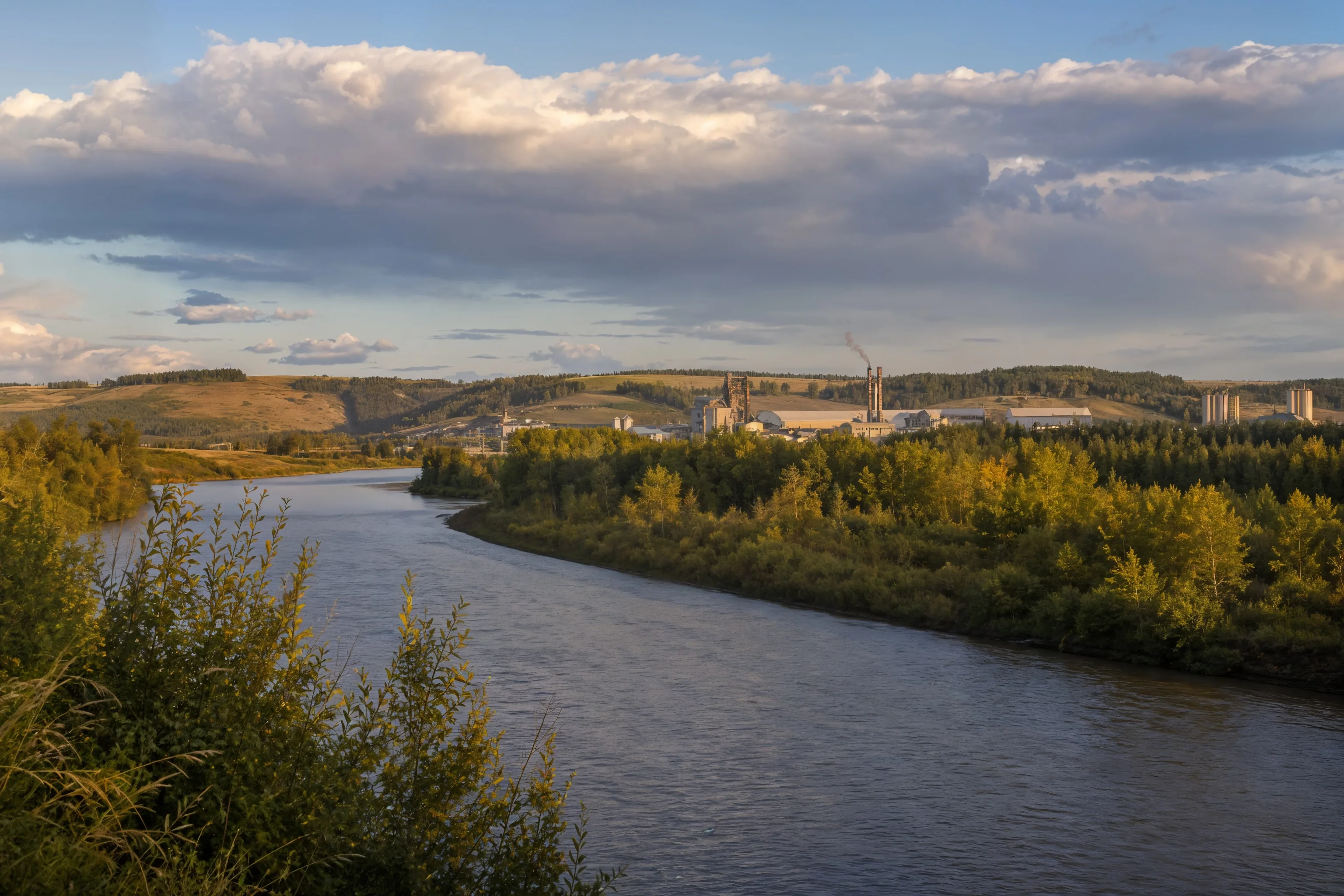
Why Solar Fits Whitecourt's Shop and Acreage Country
Whitecourt is a working town of 9,927 people (2021 census) stretched across 29.5 square kilometres of river valley and hilltop at latitude 54.1 north. Four waterways converge here, the Athabasca, McLeod, Sakwatamau, and Beaver Creek, and the local economy leans on what grows and moves through the surrounding boreal forest. Four forestry-related mills operate in town, including the Millar Western pulp mill and sawmills run by West Fraser and Canfor, and the Canadian Forestry Association named Whitecourt and Woodlands County the Forest Capital of Canada for 2013. Alongside the mills, a deep bench of oilfield service companies runs trucks, shops, and yard facilities across the region, and the town brands itself the Snowmobile Capital of Alberta, with trail systems radiating out past the Whitecourt meteor crater on Whitecourt Mountain.
That economy points straight at solar. The properties with the biggest power bills here are not small in-town houses; they are heated shops with welders and compressors, acreages and farmsteads in the surrounding Woodlands County with wells and outbuildings, and yard sites that run lighting and equipment year-round. Those are exactly the load profiles solar handles best, because they pair big daytime consumption with open, unshaded land. When the crew at the Allan & Jean Millar Centre is quiet on a weekday morning, half the industrial loads in this town are still drawing power, and every one of those kilowatt-hours is a billable one.
The solar resource holds up even this far north. Natural Resources Canada's PV potential data gives Whitecourt 1,127 kWh per kWp per year for a south-facing array tilted at latitude, a strong number for a town this close to the 54th parallel. Cold winters help rather than hurt, because panels produce more per hour of sunlight when they run cool, and snow sheds off a tilted module within days of a storm. The financial case rests on Alberta's Micro-Generation Regulation rather than any subsidy program: connect a grid-tied system, export your surplus, and take the kilowatt-hour credit. A well-sited array here typically keeps producing for 25 to 30 years.
What Whitecourt Properties Actually Use
System design starts with the 12-month usage graph on your FortisAlberta bill. Three property types cover most of the Whitecourt area:
Oilfield or Forestry Shop and Yard
A service company yard in town or on the Highway 43 commercial strip, running three-phase welders, compressors, overhead unit heaters, a heated bay, and yard lighting through a long northern winter. Bills commonly run $600 to $1,500 a month depending on how busy the yard is, for 20,000 to 40,000 kWh a year. These are the area's best solar candidates: heavy daytime consumption, three-phase service, and flat, open land that takes a ground mount sized 15 to 30 kW.
Acreage or Farmstead Outside Town
The country-residential properties and farmsteads on Woodlands County addresses around Whitecourt: a house, a detached or radiant-heated shop, a well pump, and often a barn or quonset. Bills typically run $250 to $550 a month, year-round, for 12,000 to 20,000 kWh annually. A 10 to 14 kW array, roof or ground, offsets most of it, and the micro-generation credit rolls the summer surplus into the heating season.
In-Town Whitecourt Home
A standard residential service in the Valley, the Hilltop, or West Whitecourt, usually 7,000 to 12,000 kWh a year and bills of $140 to $300 a month depending on heating fuel and household size. A 7 to 11 kW rooftop system covers most of that usage and exports the summer surplus while the long July days run.
Solar Costs and Savings in Whitecourt
Installed pricing in this territory runs $2.25 to $2.85 per watt for rooftop systems and $2.50 to $3.50 per watt for ground mounts, with the ground range reflecting trenching, racking, and distance to the service entrance. Those numbers include LONGi panels, APsystems microinverter hardware, Azgard racking, permits, the FortisAlberta micro-generation application, and commissioning. We quote a fixed installed price after the site assessment, and we do not pitch financing products.
A worked example, using the range honestly: a 12 kW ground mount on an acreage west of town costs between $30,000 (at $2.50 per watt, short trench run, easy ground) and $42,000 (at $3.50 per watt, long trench, rocky digging). Using the NRCan yield of 1,127 kWh per kWp, that array produces roughly 13,500 kWh a year. At a realistic all-in residential rate near 17 cents per kWh, that is about $2,300 a year off the power bill, which puts simple payback between about 12 and 21 years depending on where the install price lands. Shops with heavy three-phase usage often do better because they consume nearly everything they produce during daylight hours. We show you this math with your actual bill before you commit to anything.
| Property profile | Typical system | Est. annual production | Est. annual savings | Simple payback |
|---|---|---|---|---|
| Oilfield or forestry shop, three-phase yard | 20 kW ground mount | ~22,500 kWh | $3,200 to $4,500 | 11 to 22 years |
| Acreage with shop and well | 12 kW ground mount | ~13,500 kWh | $2,000 to $2,600 | 12 to 21 years |
| In-town Whitecourt home | 8 kW rooftop | ~9,000 kWh | $1,300 to $1,800 | 10 to 18 years |
Savings assume an all-in rate near 17 cents per kWh and full use of annual production; actual results depend on your retailer, rate plan, and consumption pattern.
FortisAlberta Interconnection in Whitecourt
Here is the fact that surprises nearly every Whitecourt owner who calls us: the town is FortisAlberta territory, not ATCO. Most of northern Alberta, from Edmonton north and west, is wired by ATCO Electric, and people assume Whitecourt follows the same pattern. It does not. The Town of Whitecourt appears on FortisAlberta's AUC-approved 2026 rate schedules, under Decision 30274-D01-2025 effective January 1, 2026, as \"Whitecourt, Town Of\". The surrounding Woodlands County addresses can sit on a different service arrangement, which is one reason we read the distribution line on your actual bill before quoting anything.
For your project, the practical effect is that the micro-generation application, bi-directional meter swap, and any technical review all run through FortisAlberta's customer generation process, regardless of which retailer bills you for energy. Under Alberta's Micro-Generation Regulation, systems up to 150 kW qualify for streamlined grid-tied connection, and exported surplus earns a kilowatt-hour credit that rolls forward month to month for up to a year. We file the application in our Master Electrician's name, handle the safety code filing, and coordinate the meter swap. From submission to a swapped meter, plan on two to six weeks. Systems above 10 kW on a single-phase line, common on older acreage services, sometimes trigger a utility technical review; we flag that possibility at the design stage so there are no surprises.
Working With an Airdrie Crew From 370 Kilometres Out
Whitecourt is a deliberate trip for us, not a neighbour we wander over to. The drive from our Airdrie shop is roughly 370 kilometres, about four hours up Highway 43 past Fox Creek and Edson's turnoff at the Yellowhead. We serve the town anyway, because the properties here, shops and yards with heavy three-phase loads, acreages with open ground and strong solar exposure, are exactly the work we want, and we batch trips so the geography does not inflate your quote.
Bill review by phone or email
Send a photo or PDF of your FortisAlberta bill. We read the 12-month usage graph, check your rate class, service size, and confirm FortisAlberta is your wire owner, then tell you straight whether solar pencils out before anyone drives north.
Batched site assessment day
We group Whitecourt-area assessments, walk your roof or ground-mount sites, check panel condition and breaker service, and measure shading. You get a fixed installed price with a production estimate within days.
Permits and FortisAlberta filing
We file the micro-generation application with FortisAlberta and pull the electrical permit through the Town of Whitecourt or Woodlands County, whichever has jurisdiction over your address.
Install and commissioning trip
One crew installs Azgard racking, LONGi panels, and APsystems microinverters, then coordinates inspection and the bi-directional meter swap. Most Whitecourt systems commission within two to six weeks of the utility filing.
Whitecourt Solar Questions, Answered
See what our clients say
Real reviews from Alberta homeowners and farmers.
Get a Free Solar Assessment
We serve Whitecourt and surrounding areas. No obligation.
Also Serving Nearby Areas
Ready to Assess Your Property?
Submit a recent power bill and we will review your consumption and provide an honest assessment of what solar can do for your Whitecourt property. No obligation.
Also Serving Nearby Communities