Solar Education · April 8, 2026 · 8 min read
How Microgeneration Works in Alberta: Your Power Company Now Works for You
Alberta microgeneration lets you generate your own electricity and get credits for what you export. Here is exactly how it works and why the math favours you.
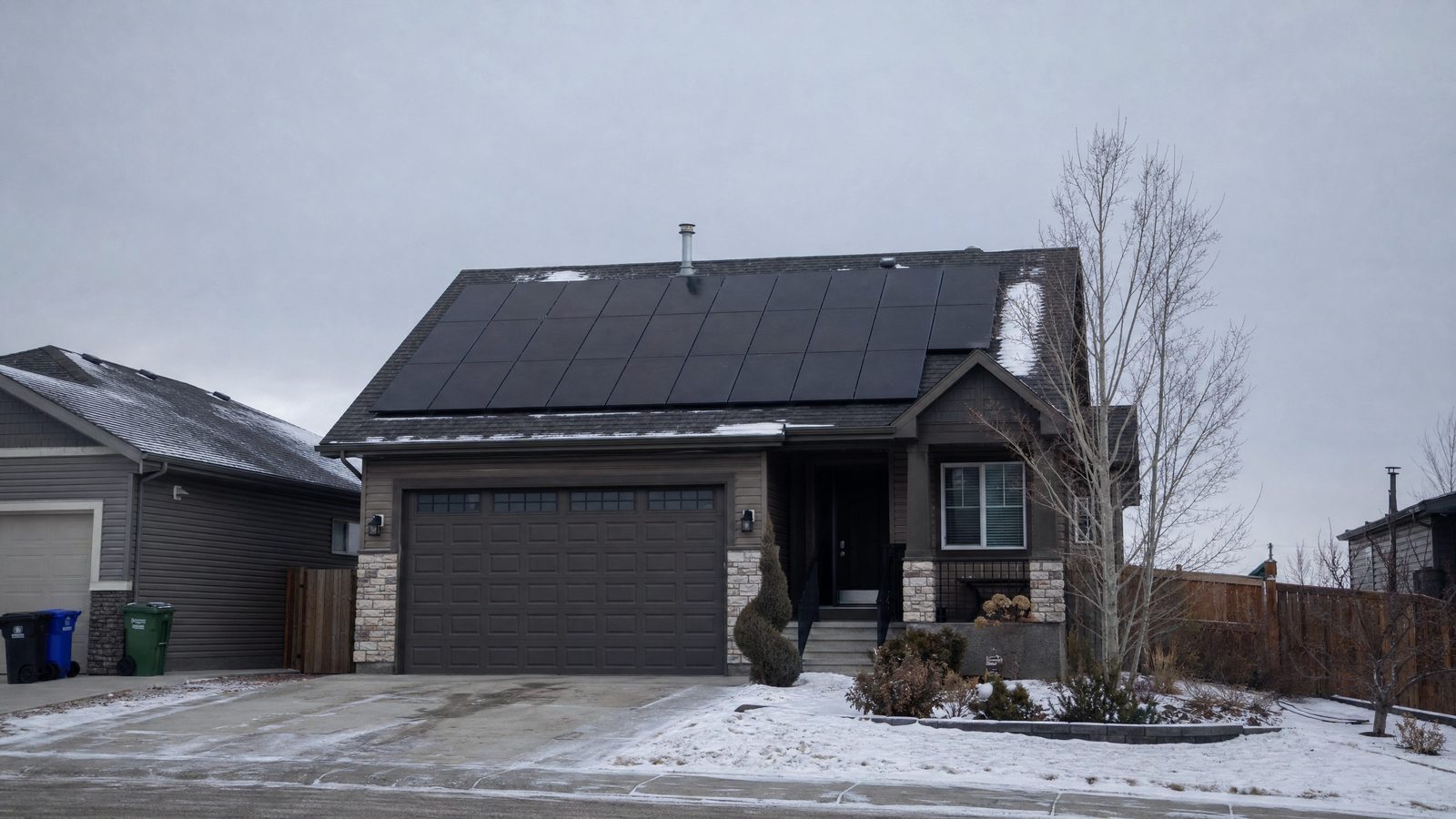
Every Alberta homeowner with solar panels is a micro power plant. That is not a metaphor. It is provincial law. The Micro-Generation Regulation lets you generate your own electricity, use what you need, and export the rest back to the grid for credits.
Your power company sends you a bill every month. With microgeneration, that bill gets smaller. For a lot of our customers, it hits zero.
What Microgeneration Actually Is
Microgeneration is a provincial regulation that allows Alberta property owners to generate their own electricity — up to 5 MW — and connect to the grid. In practice, most residential and farm systems are 5 to 30 kW. Way under the limit.
When your panels produce more electricity than your property uses at any given moment, the surplus flows back through your meter to the grid. Your wire service provider tracks that export and gives you a credit on your bill. When your panels produce less than you use — at night, on cloudy days — you pull from the grid as normal.
End of the month, the credits and the consumption net out. If you produced more than you used, those credits roll forward. They do not expire within the year.
How the Credits Work
This is the part that confuses people. It is simpler than it sounds.
- —Your panels produce electricity during daylight hours
- —Whatever your property does not use gets exported to the grid
- —Your wire service provider credits you for every kilowatt-hour exported
- —The credit rate is based on the pool price of electricity at the time of export
- —Credits offset your consumption charges on your monthly bill
- —Excess credits roll forward month to month
In summer, most systems produce far more than the home or farm uses. Credits stack up. In winter, production drops but consumption rises. You draw those credits back down. The goal is a near-zero annual electricity bill. Most of our customers hit it.
How Solar Club Maximizes Your Credits
Here is where most people get the math wrong. Your utility bill is not just one number. It includes consumption, transmission, distribution, administration, and local access. Some of those charges are fixed. But the transmission and distribution charges also have variable components — they go down when you use less power from the grid. So solar offsets more of your bill than most people realize.
The real weapon is Solar Club. During the high-production months — spring, summer, and early fall — your system is cranking out way more than you use. With Solar Club, you get reimbursed at the 30 to 33 cent rate for that surplus. That builds up a serious credit balance.
Those credits are what carry you through winter. When production drops and your consumption rises, that nest egg covers the gap. The bigger the surplus you build in summer, the more of your total annual bill gets wiped out.
This is why system size matters. If your system is sized at 80 or 90 percent of your consumption, you will not generate enough credits during those high-rate Solar Club months to build a big enough reserve for winter. That is why Range Road Solar focuses on installing the biggest system we can get approved under the microgeneration limit. More panels. More summer credits. More of your bill erased over the full year.
The goal is to offset your entire bill — not just the consumption line. With the right system size and Solar Club used correctly, most of our customers get there.
Who Qualifies
Any Alberta property owner connected to the grid. That covers most homes, acreages, and farms in the province. The system must be under 5 MW. Your wire service provider — FortisAlberta, ATCO Electric, ENMAX, or whoever serves your area — handles the interconnection paperwork.
We handle all of this for you. Permits, utility applications, electrical inspections. You do not have to call anyone. We submit the micro-generation application to your wire service provider as part of every install.
How Long Until It Pays Back
Most residential systems in Alberta pay back in about 10 years. Farm corporations with the Investment Tax Credit — which gives you 30 percent back in year one — pay back in 5 to 7 years.
After payback, you are generating free electricity for the remaining 15 to 20 years of the system's life. Ten years sounds long until you realize the panels last 25. Your mortgage does not do that.
Full cost breakdown on our Alberta solar cost page.
Grid-Tied vs Off-Grid
Microgeneration is a grid-tied system. You stay connected to the grid. You use it as a battery. When you overproduce, the grid absorbs the surplus. When you underproduce, the grid fills the gap.
Off-grid systems require battery banks, charge controllers, and backup generators. They cost significantly more and make sense only for remote properties with no grid access. If you are connected to the grid, microgeneration is the better deal. It is not even close.
Why Alberta Is Uniquely Good for This
Alberta has a deregulated electricity market. That means prices fluctuate. When pool prices spike — and they spike a lot — your export credits are worth more. You are selling high and buying low. The system rewards you for producing during peak demand.
Alberta also gets over 300 sunny days a year. Cold winters make panels more efficient. The combination of high sunshine hours and volatile electricity prices makes Alberta one of the best places in Canada for solar microgeneration.
218 Installs and Counting
Range Road Solar handles acreages, farms, homes, and shops across rural and central Alberta. We handle every step — site assessment, system design, permits, utility paperwork, install, and inspection. You sign one contract and we do the rest.
Free site assessment. We come to you. No pressure. Just a straight number for your property.
Ready to start generating your own power?
Free site assessment. Honest quote. We handle the entire microgeneration application for you.
Our microgeneration installs cover Airdrie solar installer, solar in Cochrane, and Strathmore solar across the FortisAlberta footprint. Same meter swap, same paperwork process.
Range Road Solar Team
Rural Alberta Solar Installers
Our team has been installing solar across rural and central Alberta since 2019. Over 218 installs on farms, acreages, shops, and homes. We write about what we have actually seen in the field — not what the brochures say.