Solar Education · April 17, 2026 · 9 min read
How Solar Works in Alberta: From Sun to Panel to Power Bill
How does solar actually work in Alberta? Panels, microinverters, the grid, and Solar Club. A plain English guide to the system that cuts your power bill.
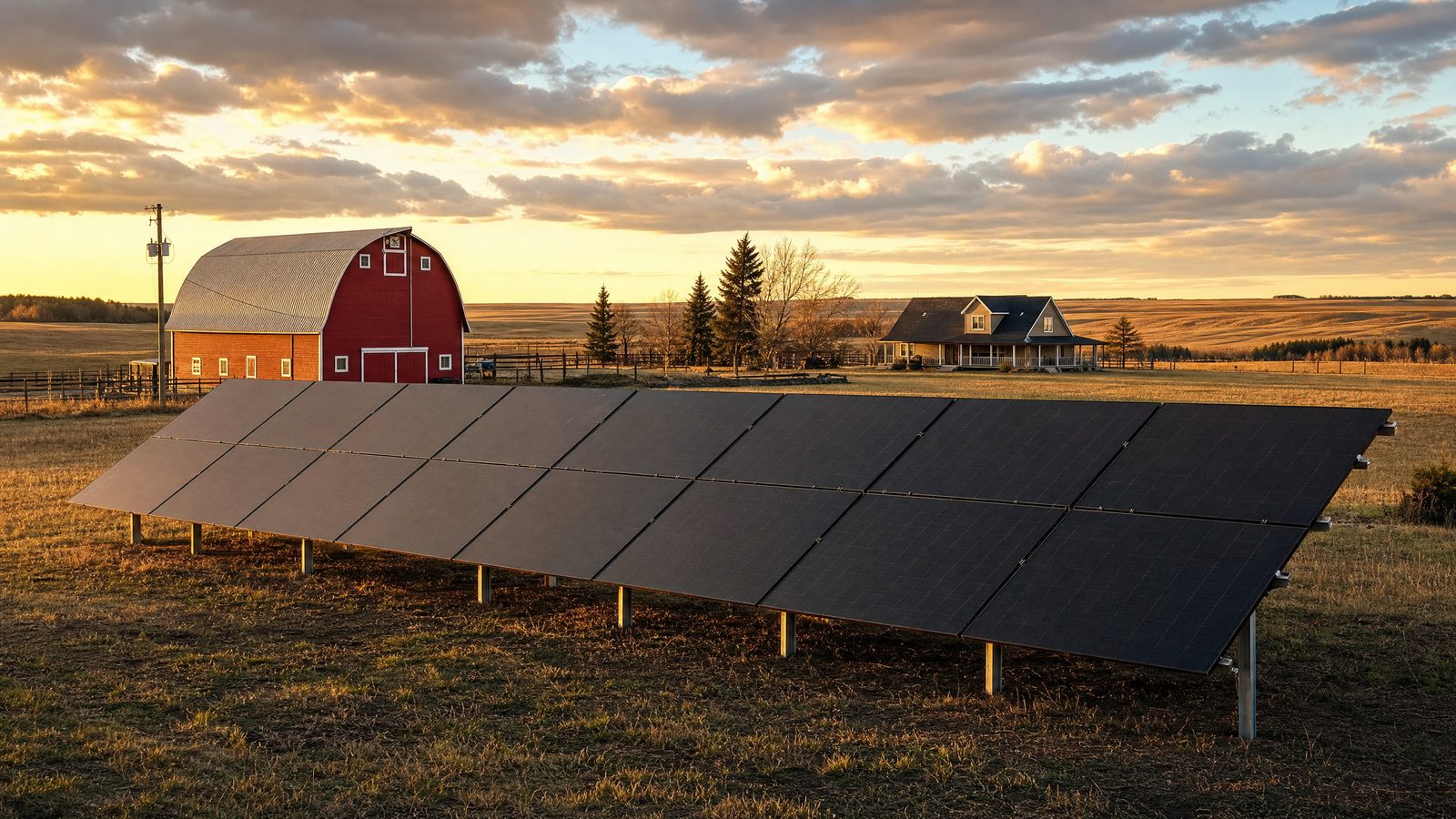
People ask how solar works like it is some kind of mystery. It is not. Sun hits panel. Panel makes power. Power goes to your house first, then to the grid. The grid sends you a credit. Your power bill drops. That is the whole show.
The interesting part is what Alberta does with that credit. So let me walk you through it like you are standing in the yard with me.
Step One: The Panel
A solar panel is a sheet of silicon cells under tempered glass in an aluminum frame. We install LONGi 450W modules, backed by a 25-year product and performance warranty. When sunlight hits the silicon, electrons get knocked loose. That movement is direct current, DC power. No moving parts. Nothing to maintain. Nothing to break. It is built to keep making electricity every time the sun is out for the full length of that warranty.
Cold does not hurt them. Cold actually helps. LONGi's panels are rated to perform better in cold than in heat, so a panel that loses efficiency on a 30-degree July afternoon gets it back on a crisp minus-20 January day with clear sky. Snow can block production for a day or two after a storm, then it slides off the angled surface and the array is back to full output. Alberta gets around 300 sunny days a year. Cold climate, lots of sun: that combination is exactly what this equipment is designed for.
Step Two: The Microinverter
DC power is no good to your house. Your fridge, your lights, your well pump, they all run on alternating current. AC. Something has to convert it. That is the inverter's job.
For most residential and acreage jobs we use APsystems microinverters. They sit underneath the panels on the racking. Each microinverter handles two panels, and every pair operates independently from the rest of the array. That independence matters more in Alberta than it would somewhere without real winters. Picture a roof after a windy snowfall: snow drifts unevenly, so two panels on the north edge might stay covered for a few extra days while the rest of the roof clears off in the sun. With a microinverter on every pair, those two shaded panels simply produce less for those days. The other ten, twelve, or twenty panels on the roof keep producing at full output because they are not wired in series with the shaded ones. A single string inverter covering the whole roof does not offer that; one shaded or faulted panel can drag down the output of everything wired behind it on that string.
For larger farm and commercial arrays, where the array is bigger and typically ground-mounted in open sections rather than split across roof planes, we size the job with Solis string inverters instead. At that scale, with fewer shading obstacles and a simpler single open field of panels, a string inverter is the more cost-effective way to convert DC to AC without losing the output protection that matters on a complex roof.
We install all major inverter brands. We match the equipment to the site, not the other way around, after years of seeing what actually holds up through an Alberta winter and what does not.
Step Three: Your House Uses It First
The AC power flows from the inverters into your main electrical panel. Your house uses it in real time. Fridge. Furnace fan. Hot water tank. The lights you are reading this under. All of it pulls from your panels first before pulling from the grid.
This is the part most people miss. Solar is not stored in your house. It is consumed instantly. Whatever you are not using right that second has to go somewhere. That somewhere is the grid.
Step Four: The Grid Becomes Your Battery
Your bi-directional meter measures power going both directions. When your panels make more than your house needs, the surplus flows out to the grid through your wire service provider, whether that is FortisAlberta, ATCO, ENMAX, or EPCOR depending on where you live. They credit you for every kilowatt-hour you send back.
This is what Alberta's microgeneration regulation allows. You become a small generator. The grid is your battery. No $15,000 battery bank in the garage. No charge controller. No replacement cycle every 10 years. The grid is the cheapest and most reliable battery ever invented.
Step Five: Solar Club Does the Math
Here is where it gets good. Sign up for a Solar Club retailer plan and the credits you build in spring, summer, and early fall pay out at 30 to 33 cents per kilowatt-hour. That is roughly double what you pay for grid power. Your summer surplus is worth more than your winter consumption.
You bank a pile of credits during the long Alberta days. Those credits carry you through winter, when production drops and your furnace fan is running. Sized properly, the system covers the whole year. Bill goes to zero, or close to it.
This is why we always push for the biggest system that fits inside the microgeneration limit. At 80 percent offset, you do not generate enough summer credit to ride out the winter. The math only works at the top end. Half-measures lose money.
The Microgeneration Limit
Alberta caps a microgeneration system at the size that produces, on average, no more than your historic annual consumption. That is the rule. Your wire service provider looks at your last 12 months of usage and approves a system sized to match.
A few practical points:
- —If your bills are bigger, you can install a bigger system. Acreages, shops, and farms tend to qualify for serious capacity.
- —If you are buying a new property or building, we work off a design load instead. Easy paperwork once you know how it goes.
- —Your retailer choice matters as much as your system size. Solar Club rates are not automatic, you have to pick a retailer that offers them.
We handle every page of the microgeneration application. Permit, single-line drawing, utility submission, inspection. You sign once and we run it.
What Actually Happens During the 2 to 6 Week Utility Review
Once we submit your microgeneration application, it does not just sit in a queue waiting for a signature. Your wire service provider, whether that is FortisAlberta, ATCO, ENMAX, or EPCOR, checks that the transformer and line feeding your property can handle the extra capacity you are about to add. They review the single-line drawing against your actual equipment: panel count, inverter model, breaker sizing, disconnect location. If something does not match or the paperwork is incomplete, it bounces back for a revision before it moves forward. That back-and-forth is most of why the review window runs 2 to 6 weeks rather than a flat number. A straightforward residential application on a well-documented line can clear in two weeks. A property with an older service or a utility running behind on volume can take closer to six.
The physical install does not have to wait for every piece of that approval. We often get the racking, panels, and wiring done while the paperwork is still moving, so the system is ready to energize the day permission comes through. Residential roof-mount installs typically take 1 to 2 days on-site once the crew arrives. Farm-scale ground mounts take longer, since footings have to go in below the frost line and a bigger array means more racking and wiring runs, but it is still measured in days, not weeks. Once the utility signs off, an inspector checks the work, your meter gets swapped for a bi-directional one if it was not already, and you are cleared to operate. That is the moment your system starts banking Solar Club credits instead of just sitting there finished and idle.
What It Costs and What You Get Back
Installed solar pricing in Alberta runs on a per-watt basis, and the honest answer is always a range, not a single number, because roof complexity, racking choice, and equipment selection all move the final price. Roof-mount systems typically land between $2.25 and $2.85 per watt installed. Ground-mount systems, with their footings, posts, and extra racking, run $2.50 to $3.50 per watt. A 6 to 8 kW roof system, the size that suits a lot of Alberta bungalows and smaller acreage homes, runs roughly $13,500 to $22,800 installed depending on the roof and the equipment chosen.
Ballpark pricing before incentives, using those same per-watt ranges:
- —Small home or cabin, 5 to 8 kW roof mount: $11,250 to $22,800 installed
- —Acreage home, 10 to 15 kW roof mount: $22,500 to $42,750 installed
- —Farm, shop, or commercial, 15 to 30 kW ground mount: $37,500 to $105,000 installed
No federal or provincial rebate applies to a personal residence right now. The federal homeowner grant program that used to help with solar has ended, and Alberta does not run a provincial residential solar rebate. If your operation is incorporated, the federal Clean Technology Investment Tax Credit gives an incorporated farm or business 30 percent back in year one, which can drop payback on a farm system from roughly 10 years down to 5 to 7. That credit applies to the business, not to a personal home, so your accountant will want a heads up either way. Full breakdown is on our Alberta solar cost page.
After payback, the panels keep making power for another 15 to 20 years on top of that. That is electricity your property keeps generating with the debt already paid off. Your mortgage does not do that.
What Kind of Property Suits Solar
Almost all of them. We do acreages, farms, shops, homes, and ground mounts in fields across rural and central Alberta. 218 installs and counting.
Ground mounts beat rooftops on most acreage properties. Flat prairie, point south, set the tilt for Alberta latitude, walk away. No roof penetration. Easier to service. Easier to expand later. The vast majority of our jobs end up grid-tied, not off-grid. The grid is right there. Use it.
Common Questions About How This Actually Works
Do I need a battery for this to work?
No. Under Alberta's Micro-Generation Regulation, the grid takes over that job. Surplus production rolls forward as a bill credit instead of getting stored on-site, so a $15,000 battery bank with a charge controller and a replacement cycle every 10 years is not part of a standard grid-tied install. The economics work without one. A battery is a separate add-on for anyone who specifically wants backup power during an outage, not something the system needs to function.
What happens on a cloudy day?
Production drops, it does not stop. Panels still generate on an overcast day, just less than on a clear one. Your house pulls whatever the panels are not covering from the grid automatically, the same way it always has. Because each APsystems microinverter pair responds to the light hitting its own two panels, a patch of cloud sitting over one corner of the roof does not drag down what the rest of the array is producing in better light.
What happens if the power goes out?
A standard grid-tied system shuts itself off. That is a safety requirement, not a malfunction: your system has to disconnect so it does not backfeed power onto lines that a utility crew might be working on to restore service. Without a battery, your panels will not run your house during an outage even if the sun is out that day. If backup power during outages matters to you, that is a battery conversation we can scope separately, but it sits outside a standard Alberta grid-tied install.
Is there a rebate for putting solar on my house?
Not currently. The federal homeowner grant program that used to help with solar has ended, and Alberta does not run a provincial residential solar rebate. The 30 percent federal Clean Technology Investment Tax Credit exists, but it applies to incorporated farms and businesses, not personal residences. For a home, the return comes from Solar Club credits and a lower power bill, not an upfront rebate cheque.
Free Site Assessment
I come out to your property. I look at your roof or your land, check your electrical panel, and read your most recent power bill. Then I give you a real number within 48 hours. Sized to maximize your Solar Club credits. Nothing inflated. No two-hour kitchen-table pitch. No financing trick.
I will give you the number. You think about it. If it makes sense, you call me. If it does not, no hard feelings. I have got enough work.
Ready to get a real number for your property?
Free site assessment. Honest quote. No obligation. We handle the entire microgeneration application for you.
If you are in central Alberta: Lacombe solar installer, out in solar in Ponoka, or on an acreage in Red Deer County solar. The process works the same way.
Range Road Solar Team
Rural Alberta Solar Installers
Our team has been installing solar across rural and central Alberta since 2019. Over 218 installs on farms, acreages, shops, and homes. We write about what we have actually seen in the field — not what the brochures say.