Education · June 10, 2026
Solar Panels for Rocky View County Acreages
Thinking about solar for your Rocky View County acreage? Here are the real numbers, FortisAlberta rules, and what to expect from installation.
Solar on a Rocky View County Acreage: What You Actually Need to Know
You are not in the city. Your power bills are bigger than your cousin's condo bill. Your roof is bigger too, or you have a shop or a barn that sits in full sun all day. You use electricity for pumps, heat tape, outbuildings, maybe a heated shop. Somewhere between 12,000 and 18,000 kilowatt-hours a year is a normal range for an acreage in Rocky View County. At current rates, that is a real number every month on your FortisAlberta bill. Solar does not fix everything, but it puts a significant dent in that number. This post gives you the actual math, the actual utility rules, and a clear picture of what working with Range Road Solar looks like from first call to final inspection.
You are also not alone in asking. Rocky View County's population climbed from 39,407 at the 2016 census to 41,028 in 2021, exurban growth clustered around anchors like CrossIron Mills and the Balzac Industrial Area along the county's Calgary-facing edge. More acreages, more shops, more outbuildings, and more property owners running the same numbers you are.
What Solar Actually Does for an Acreage Owner
Solar panels on your property generate electricity from sunlight. That electricity runs your house or shop first. Whatever you do not use goes back to the grid. Your utility tracks what you send back and what you pull from the grid and bills you on the difference. That is the short version of microgeneration in Alberta.
Here is what solar does not do without extra equipment: it does not keep your lights on during a power outage. A grid-tied system shuts down when the grid goes down for safety reasons. If backup power matters to you, that is a battery conversation for a separate post.
What solar does reliably: it reduces the kilowatt-hours you buy from the grid every month. In Rocky View County, the sun shines enough to make a 10 to 16 kilowatt system produce 8,500 to 14,000 kilowatt-hours per year. Alberta is sunnier than most Canadians think. The Calgary International Airport weather station, the long-term climate record closest to the county, logs about 2,396 hours of bright sunshine a year, and Natural Resources Canada puts the specific yield for a well-sited system here at roughly 1,292 kilowatt-hours per kilowatt of installed capacity annually under ideal orientation. Real-world output on a given roof or ground mount runs somewhat under that ideal number once tilt, orientation, and shading are accounted for, which is why our production estimates are always site-specific. Either way, that is competitive with many parts of the United States.
For an acreage owner, the appeal is straightforward. You have space. You have a big bill. You own the property long-term. Solar pays back over time through reduced purchases from the grid. The bigger your bill, the shorter your payback.
FortisAlberta Microgeneration: The Rules That Apply to You
Rocky View County is, for the large majority of properties, FortisAlberta territory. Not ENMAX. Not EPCOR. But the county is large and its service areas are not perfectly uniform, so we confirm your exact wires provider and rate class at the site assessment rather than assume it from the municipal boundary alone. For almost every acreage we work on here, FortisAlberta is the wires company, and their microgeneration program is what governs how your solar system connects to the grid and how you get credited for excess power.
Under the Alberta Microgeneration Regulation, FortisAlberta is required to offer net metering to eligible customers. Here is how the credit structure works. When your system produces more than you use in a given hour, the surplus flows to the grid. FortisAlberta credits you at the current regulated rate for that export. The export credit rate under microgeneration is around $0.35 per kilowatt-hour. That is a strong rate and it makes oversizing your system a reasonable option if your usage supports it.
Credits accumulate monthly and roll forward. At the end of a 12-month period, unused credits are settled. The program applies to systems up to 5 megawatts, so residential and farm-scale systems are well within scope.
The interconnection application goes through FortisAlberta and requires a permit from Rocky View County. Range Road Solar handles both. You do not need to call the utility yourself or figure out the paperwork. That is part of what the install includes.
The Real Math: What a Typical Rocky View County Solar System Saves
Here is a worked example based on realistic numbers for a mid-sized acreage in Rocky View County.
Property usage: 16,000 kilowatt-hours per year. Blended rate including distribution, transmission, and energy charges: $0.20 per kilowatt-hour. Annual power cost before solar: $3,200.
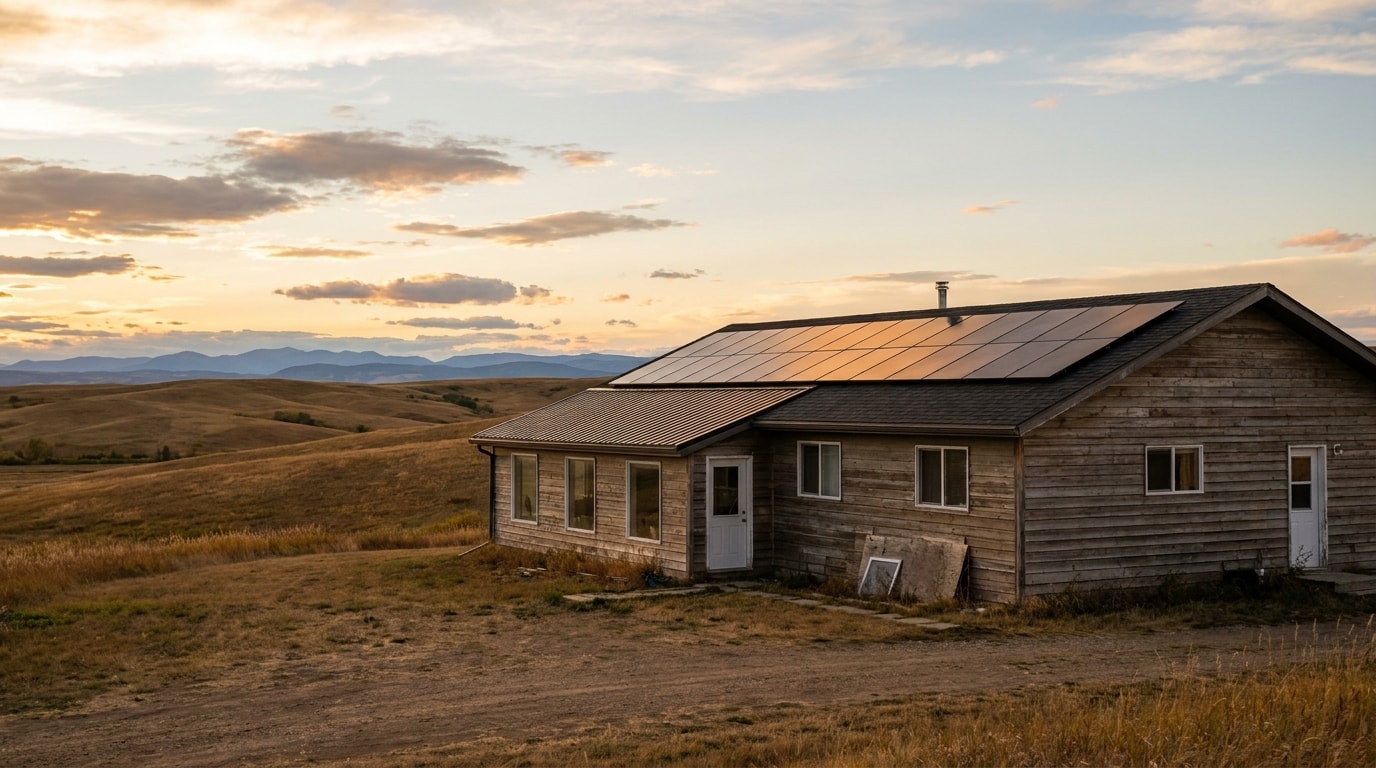
System size: 14 kilowatts installed on a south-facing shop roof. Estimated annual production in Rocky View County: approximately 12,000 kilowatt-hours. That covers 75 percent of total consumption.
Remaining grid purchases: 4,000 kilowatt-hours at $0.20 equals $800 per year. Annual savings: $2,400 compared to pre-solar bill.
Installed cost for a 14 kilowatt roof-mount array at current Alberta pricing runs about $2.25 to $2.85 per watt, or roughly $31,500 to $39,900 installed, before any provincial programs. Many acreage owners in the county put the same capacity on a ground-mount array instead, on a shop field or open yard with better orientation than the roof offers. Ground-mount systems run higher, about $2.50 to $3.50 per watt, or roughly $35,000 to $49,000 for 14 kilowatts, since racking, trenching, and site prep add cost a roof doesn't. Using the roof-mount numbers for this example, simple payback is $31,500 to $39,900 divided by $2,400 in annual savings, or roughly 13 to 17 years.
Now factor in rate escalation. FortisAlberta rates have not stayed flat historically. If your blended rate increases by even two percent per year, that payback range shortens. At three percent annual rate increase, even the higher end of that range moves down toward 13 to 14 years. A quality solar system carries a 25-year panel warranty. The math works over the life of the system.
If your usage is higher, say 18,000 kilowatt-hours per year, or you have a heated shop running year-round, the savings per year go up and the payback comes down. Your specific numbers will vary. That is why we look at the 12-month usage history on your most recent bill before designing anything.
Frequently Asked Questions from Rocky View County Acreage Owners
Does solar work in Alberta winters?
Yes. Cold temperatures actually improve panel efficiency. The challenge in winter is shorter days and lower sun angles, which reduce daily production. A system that produces 40 kilowatt-hours on a July day might produce 10 to 15 kilowatt-hours on a clear February day. Annual production estimates already account for this seasonal variation. Your solar production will be front-loaded in spring, summer, and fall, and the credits you build up during those months offset your higher winter grid use. That is how the FortisAlberta annual true-up process works in your favor.
What about my shop or outbuildings?
If your shop is on the same meter as your house, the system can offset consumption for both. If your shop runs on a separate meter, that is a separate system and a separate interconnection application. Many acreage owners in Rocky View County run a large system on the shop roof because it has better orientation, more space, and less shading than the house. We assess both during the site evaluation.
Can I add battery storage to go off-grid?
You can add battery storage to a grid-tied system for backup power during outages. True off-grid is a different system design entirely and typically requires a much larger battery bank plus a generator for extended low-sun periods. For most Rocky View County properties that already have FortisAlberta service, a grid-tied system with optional battery backup gives you the best combination of economics and reliability. Full off-grid rarely pencils out better than grid-tied when you already have utility access.
How does Rocky View County handle solar permits?
Rocky View County requires a building permit for roof-mounted and ground-mounted solar installations. The permit application includes structural and electrical drawings. Range Road Solar prepares and submits the permit package. Permit timelines vary but typically run two to four weeks. Once the permit clears, installation can proceed. FortisAlberta also requires an interconnection application before the system can be turned on. That application is submitted in parallel with the permit process where possible to keep the overall timeline efficient.
What size system do I actually need?
System size depends on your annual consumption, your available roof or ground space, your budget, and whether you want to offset 50 percent or 100 percent of your usage. For most acreages in Rocky View County using 12,000 to 18,000 kilowatt-hours per year, a 10 to 16 kilowatt system is the right range. Larger systems make sense if you are adding an electric vehicle, planning to expand a heated shop, or want to maximize export credits. We size based on your actual bills, not a guess.
What Working With Range Road Solar Looks Like
The process is straightforward. Here is the order of operations.
Step one: you share your most recent power bill. We need to see your actual consumption pattern, not an estimate. Bills tell us your monthly usage, your rate structure, and your peak months.
Step two: we design the system. That includes panel layout, inverter selection, mounting method, and production estimates specific to your property location and roof orientation.
Step three: we submit the building permit to Rocky View County and the interconnection application to FortisAlberta. Both go in together. We handle the paperwork.
Step four: once permits clear, installation is scheduled. The install itself takes one to three days depending on system size and complexity. From permit approval to install complete, the timeline is two to six weeks.
Step five: FortisAlberta does a final inspection and approves the system for grid connection. Once that approval comes through, your system is live and your meter starts tracking production and export.
No mystery. No surprises.
Ready to See Your Numbers?
If you own an acreage in Rocky View County and your FortisAlberta bill is a number you think about, it is worth running the math on solar. Not because of anything other than whether it saves you money. Sometimes it does. Sometimes the timing or the roof situation does not make sense yet. We will tell you either way.
Call Range Road Solar at 587-330-7502 or visit rangeroadsolar.com/book to get started. Bring your most recent power bill and we will build you a real number, not a brochure estimate.
Ready to get a real number for your property?
Send us your most recent power bill. We'll review your consumption and give you an honest design and cost estimate. No obligation.