Local Solar Guides · May 17, 2026
Solar in Stettler: What Farms and Acreages in Central Alberta Actually Pay Back
Solar panels for Stettler County farms and acreages. ATCO Electric rates, federal ITC, honest payback math, and free site assessments from Range Road Solar.
The Stettler Rate Reality
If your property runs on rural power around Stettler, you already know the bill is not what city people pay. Stettler and the surrounding county sit in ATCO Electric distribution territory, and rural distribution costs real money. Wires run long distances to serve a small number of meters, and those costs land on your monthly statement. By the time energy, distribution, transmission, and riders get added up, most rural accounts in the Stettler area carry an all-in blended rate well above what an Edmonton or Calgary homeowner sees.
That gap is exactly why solar math works so well out here. Every kilowatt-hour your panels produce is a kilowatt-hour you are not buying at the full blended rate. The higher the rate you displace, the faster the system pays for itself, and central Alberta rates give solar plenty to displace.
What Solar Costs in the Stettler Area Right Now
There is no mystery to the numbers. Residential-scale solar in Alberta installs for roughly $3.00 to $3.80 per watt, with larger farm systems coming in lower per watt because fixed costs spread across more panels. A 10 kW home or acreage system lands in the $34,000 to $38,000 range installed. A 25 kW farm shop system typically runs $65,000 to $80,000. Those are complete numbers covering panels, racking, inverters, electrical work, permits, and the ATCO Electric interconnection application. Nothing hidden, nothing added later.
Prices have come down a long way over the past decade, but the biggest cost driver today is not the panels. It is site conditions: trenching distance for a ground mount, the state of your electrical service, and how much structural work a roof needs. That is why a real quote starts with a site visit rather than a postal code.
ATCO Electric Microgeneration for Stettler Properties
ATCO Electric is the wire service provider for Stettler and the surrounding rural area, and it participates in Alberta's microgeneration framework like every distribution utility in the province. When your system produces more than you are using, the surplus flows to the grid and your retailer credits your bill for it. For the full mechanics, see our Alberta microgeneration guide.
Credits bank through the strong production months from April through October and get spent through the winter, when the panels produce less and the yard lights run longer. Accounts settle annually, and leftover credits at settlement pay out at a lower rate than retail. That is why the goal is to size a system to your annual consumption rather than to the biggest number that fits on the roof.
ATCO Electric supplies the bi-directional meter that tracks power in both directions and installs it as part of interconnection approval. The process is an application, a technical review, and a meter swap after the install passes inspection. We handle the paperwork end to end.
Central Alberta Sun: The Hours Are There
Stettler sits at roughly 52 degrees north, and central Alberta is one of the sunniest regions in Canada. Peak sun hours average around 4.5 per day across the year, which is more than Germany gets, and Germany built one of the largest solar fleets on earth. Summer days are long and productive. Winter days are short, but cold, clear prairie air is good for panel efficiency, and snow slides off a properly tilted array faster than most people expect.
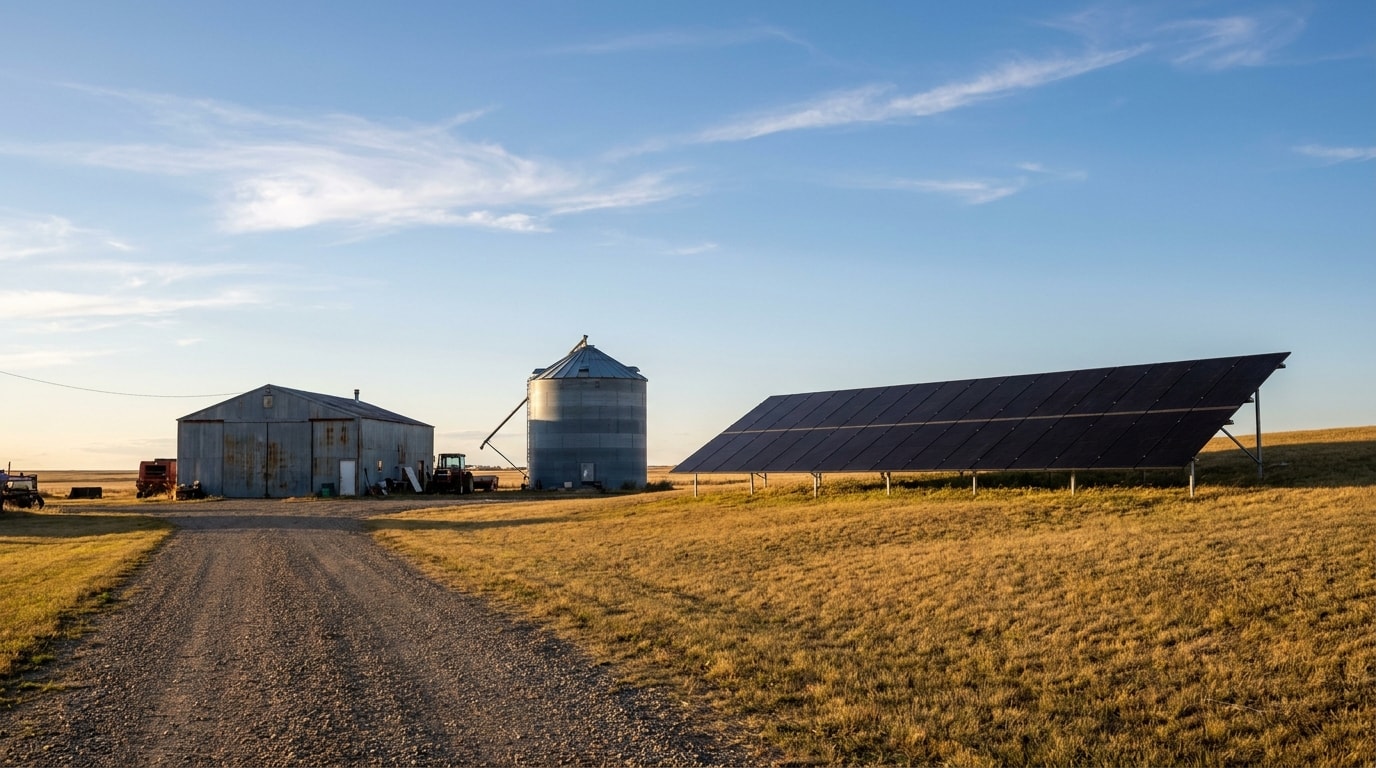
Ground-mounted systems are common around Stettler because land is rarely the constraint. Flat, open acreage lets you set the tilt for maximum annual production, usually 35 to 40 degrees at this latitude, and face the array dead south without compromise.
A Worked Example: 10 kW Near Stettler
Here is what the honest math looks like at a common residential size. A 10 kW system on a south-facing roof or a simple ground mount costs about $36,000 installed. In central Alberta sun, that system produces roughly 11,000 kWh per year. At a blended rate of about 23 cents per kilowatt-hour on a rural ATCO Electric account, the production is worth approximately $2,500 per year in avoided charges and microgeneration credits.
Simple payback is $36,000 divided by $2,500, which comes out around 14 years. That assumes rates never rise again, which has not been Alberta's experience. Apply even three percent annual rate escalation and the effective payback tightens toward 12 years. Panels carry 25-year production warranties and inverters typically run 10 to 12 years, so the system spends well over a decade producing power you no longer pay for.
Farms change the math further. An incorporated operation can claim the federal Clean Technology Investment Tax Credit at 30 percent of capital cost, which drops that $36,000 system to a net $25,200 and pulls simple payback down near 10 years, before depreciation enters the picture. Talk to your accountant before you sign, because for incorporated farms this is the largest solar incentive in the country and most rural operations are not using it.
Ground Mount vs. Roof Mount in Stettler County
Most farms out here go ground-mounted, and the reasons are practical.
- —Older shop roofs often have unclear load ratings, and a structural review adds cost
- —Ground mounts let you set tilt and orientation exactly where production peaks
- —No roof penetrations and no warranty questions on aging steel roofing
- —Expanding the array later is straightforward when the racking sits on open ground
- —Snow clearing and inspection access are simpler at ground level
Homes in town usually go roof-mounted when the roofline is clean and faces south. Either way, production numbers come out close when the tilt is right, and we model both options during the assessment so you can compare real numbers instead of guesses.
Common Questions from Stettler Area Homeowners
Is Stettler served by ATCO Electric or ATCO?
Stettler and the surrounding county are ATCO Electric distribution territory. ATCO serves other parts of east-central and northern Alberta, and the boundary confuses a lot of people. The delivery section of your power bill names your wire service provider, and for properties in and around Stettler that is ATCO Electric. The provincial microgeneration rules are the same either way, but the interconnection application goes to the utility named on your bill.
What happens to production in a central Alberta winter?
It drops, and the system is designed around that. A 10 kW array producing 11,000 kWh annually might generate only 400 to 600 kWh in December against 1,400 or more in July. The credits you bank from spring through fall carry you through the dark months. You still pay fixed distribution and service charges every month regardless of production. Solar attacks the energy portion of the bill, not the fixed fees.
Do I need batteries to make solar work?
No. A grid-tied system uses the ATCO Electric grid as its battery, banking credits when you overproduce and drawing power at night and through the winter. Batteries add outage protection rather than payback, and at current prices most Stettler area installs skip them. If backup matters for a well pump or livestock operation, we can design for a battery now or leave room to add one later.
How long does the whole process take?
From a signed agreement, design and permitting usually run a few weeks depending on the county queue and ATCO Electric review times. Installation happens two to six weeks after permits clear, and the crew is on site for one to three days on most residential and small farm systems. The meter swap follows, and credits start banking the day it goes in.
Does hail wreck solar panels out here?
Central Alberta hail is real, and panels are engineered for it. Quality modules are rated for 25 millimetre stones at terminal velocity, which covers the vast majority of storms. For the rare monster cell, home and farm insurance treats panels as part of the structure once your insurer is notified. Make that call before install day and confirm coverage in writing.
Get a Real Number for Your Stettler Property
The short checklist: clear southern exposure on a roof or open ground, no heavy shading between 9 AM and 3 PM, and an annual power spend of $3,000 or more. If that sounds like your place, the math almost certainly works. If you are unsure about shading or your consumption, that is exactly what the assessment sorts out.
Send us your most recent power bill and we will build a site-specific production estimate and payback projection at no cost. Book a free assessment or call us at 587-330-7502. Straight numbers, no pressure.
Jonathan
We do installs across the Stettler area, the town itself on our Stettler solar installer page, the broader Stettler County solar rural properties, and into the solar in Lacombe corridor to the west.
Ready to get a real number for your property?
Send us your most recent power bill. We'll review your consumption and give you an honest design and cost estimate. No obligation.
Serving Stettler & Area