Solar Education · August 21, 2026
Three-Phase vs Single-Phase Power: What It Means for Your Farm Solar Project
How to tell if your Alberta farm has three-phase or single-phase power, why it matters for solar sizing, and what to do when the array outgrows the service.
Before we size a single panel on a farm solar project, we need the answer to one question: is the service three-phase or single-phase? It's not a detail. It sets the ceiling on how much inverter capacity you can practically connect, it shapes the equipment list, and in some cases it decides whether the project pencils at all. Here's how to tell what you have, why it matters for solar, and what the options look like when the array you want meets the service you've got.
How Do You Tell What You Have?
You don't need a meter or an electrician to make a good first guess. Three things usually give it away.
Look at the transformer
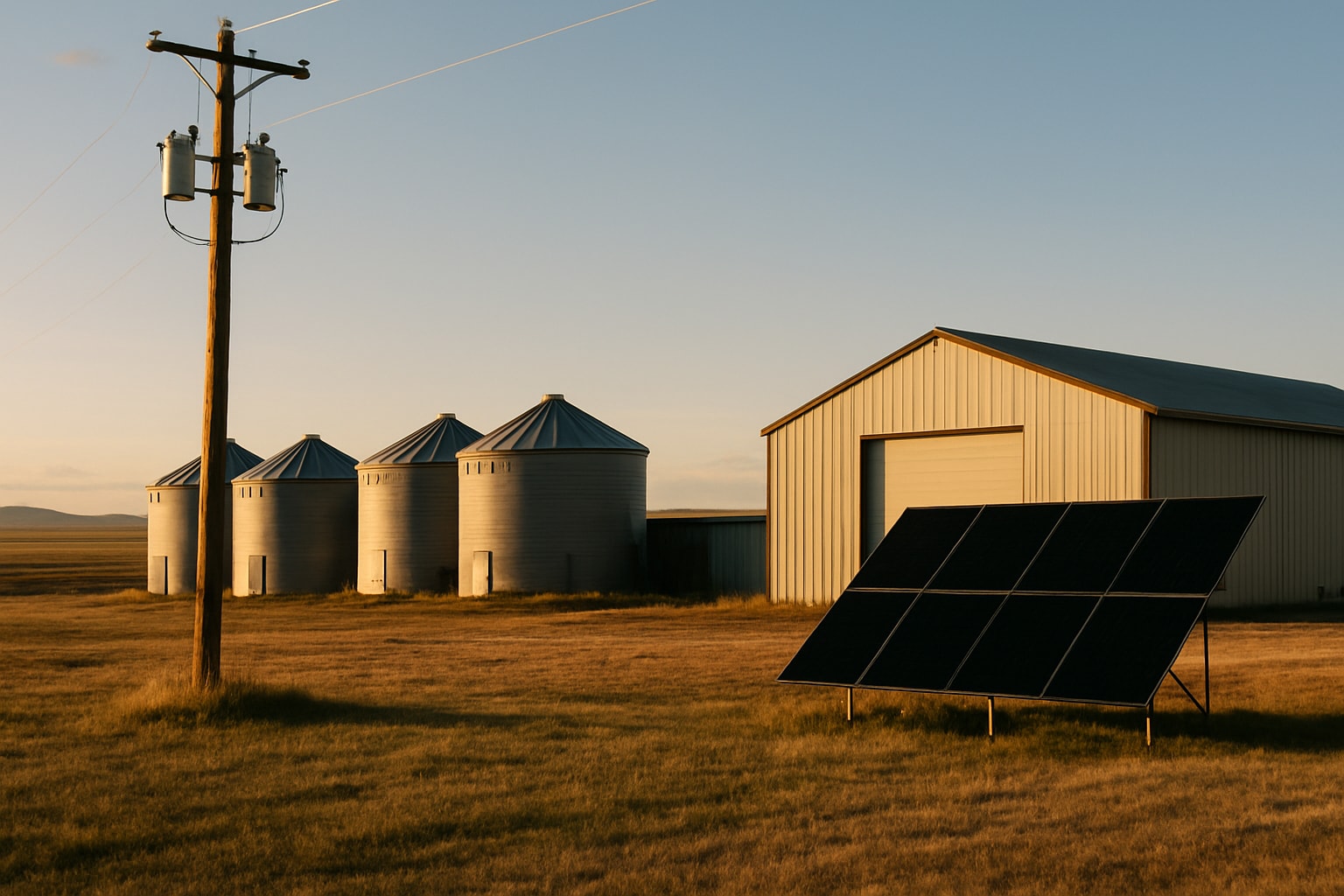
Walk out to the pole that feeds your yard. A single grey can on the pole almost always means single-phase. Three cans mounted together, or a single larger unit with three high-voltage bushings on top, means three-phase. This is the fastest tell and it's visible from the driveway.
Look at the panel
Open your main panel. A single-phase service has a two-pole main breaker, and every breaker in the panel takes up one or two slots. A three-phase panel has a three-pole main, and the larger equipment circuits run on three-pole breakers. If you see three-pole breakers feeding machinery, you have three-phase.
Look at what runs on the farm
Big motors are the giveaway. Motors above roughly 10 HP are usually three-phase, because single-phase motors get impractical beyond that size. So ask what's actually running:
- —Grain dryers and large aeration fans
- —Augers and grain-handling legs on bigger setups
- —Large irrigation pumps
- —Dairy equipment: milking systems, bulk tank compressors, vacuum pumps
- —Big air compressors or welders in a commercial shop
If equipment like that runs off your service without phase converters, you almost certainly have three-phase. If the biggest motor on the place is a well pump, a small auger, or shop tools, you're almost certainly single-phase.
If the visual checks leave you unsure, your bill helps too. The rate class and service description on your most recent power bill often indicate what you're on, and your wire service provider can confirm it in one call. We verify it as part of every site assessment anyway, so an educated guess is all you need to start the conversation.
Why Does It Matter for Solar?
Inverters connect to the service you have, and the service type sets how much inverter you can connect.
A three-phase service spreads the solar output across three conductors instead of two. That means larger inverters are available for it, and the export current divides across the phases instead of loading one path. Three-phase inverters also keep the service balanced by design, pushing equal power onto each phase. For a farm that wants a large array, a three-phase service is simply more room to work with. It also leaves headroom for the future: if the operation adds a dryer, another pump, or a bigger shop later, the same service carries the new load and the solar together.
A single-phase service caps the practical inverter size. All the export current travels on one phase pair, which means the conductors, the transformer, and the voltage on the line all see the full output at once. Push a single-phase service too hard and you run into the limits of the equipment behind it, including voltage rise on long rural runs. The cap isn't one universal number, because it depends on your service size, your transformer, and your distance from it, which is exactly what we assess at the design stage.
None of this means single-phase properties can't go solar. Most of our residential and acreage installs are single-phase and work well. It means the service defines the sandbox, and the design has to respect it.
What's the Typical Alberta Farm Reality?
Most residences and small farms in rural Alberta are single-phase. If your place is a house, a shop, a well, and some yard lights, single-phase is the overwhelming default, and there was never a reason for it to be anything else.
Three-phase shows up where the motors are. Grain-handling operations with dryers and legs, large irrigation, dairies, and commercial shops are the usual three-phase customers. If your operation grew into serious equipment at some point, someone probably brought three-phase in to run it.
That split matters because the solar ambitions often don't match the service. A grain farm with three-phase and a big dryer load is an easy match for a large array. But we also regularly meet acreage and farm owners with a single-phase service and a power bill big enough to justify more solar than that service comfortably takes. That's where the design work starts.
What If a Large Array Meets a Single-Phase Service?
There are three honest paths, and they're not equal.
Multiple smaller inverters
Instead of one large inverter the service can't take, the array runs through two or more smaller ones. This keeps each unit inside what the service handles cleanly and is often the simplest way to get more capacity onto a single-phase service. It's standard practice, not a workaround, and it's usually where we look first. Splitting the output also spreads the export across the day-to-day limits of the service, and on long rural runs it pairs naturally with the voltage-rise design work we do on every farm system, since the same service characteristics drive both questions.
Design to the service
Sometimes the right answer is an array sized to what the service supports, offsetting the bulk of the bill rather than all of it. A system that fits the service costs less, connects without drama, and still does most of the economic work. Chasing the last stretch of offset through expensive infrastructure is often where the payback math falls apart.
Upgrade the service
Bringing three-phase to a property that doesn't have it means the utility extends three-phase supply to your site, and in rural Alberta that can run tens of thousands of dollars depending on how far the nearest three-phase line is from your yard. That number belongs in the open early, because it changes the whole project. Our default is to design to the service you have. The upgrade only makes sense when the load case justifies it, meaning the farm actually needs three-phase for equipment, expansion, or an array large enough that the economics carry the line extension. Upgrading a service purely to host solar rarely pays.
Which path wins is a numbers question, not a preference. We price the options against your consumption and let the math pick.
Where Do Demand-Metered Rates Fit In?
Larger farm and commercial services are often on demand-metered rate classes, where part of the bill is driven by your peak draw rather than just the energy you use. Solar offsets the energy portion well, but demand charges behave differently, and a system sized on energy alone can overpromise savings on a demand-metered bill.
This is a separate analysis, and we run it before quoting any demand-metered property. The short version: if your bill has a demand charge on it, the sizing math changes, and we account for that up front rather than letting you find out after install.
The First Step Is Knowing What You Have
Phase type, service size, transformer, and rate class are all facts we can establish quickly, and every one of them shapes the design. If you're thinking about solar for your farm or acreage, send us your most recent power bill through our contact page or call 587-330-7502. We'll confirm what service you're on, size a system that fits it, and give you straight numbers on the options.
Range Road Solar installs across Alberta. See Airdrie solar installer for service area details.
Ready to get a real number for your property?
Send us your most recent power bill. We'll review your consumption and give you an honest design and cost estimate. No obligation.