Solar Education · August 21, 2026
What Voltage Rise Means for Rural Solar Systems in Alberta
Voltage rise explained for Alberta farms: why long rural lines and small transformers make inverters trip on sunny days, and how good design prevents it.
If your wire service provider came back on your solar application asking questions, or told you the system needs a study before they'll approve it, there's a good chance the issue behind it is voltage rise. It's one of the most common technical flags on rural microgeneration applications in Alberta, and almost nobody explains it in plain language. Here's what voltage rise actually is, why it shows up on farms and acreages far more than in town, what it does to your production when it's ignored, and why it should be settled on paper before anything gets installed.
What Is Voltage Rise?
Electricity flows downhill, from higher voltage to lower voltage. When your property draws power from the grid, the transformer is the high point and your panel is the low point. When your solar system exports, the flow reverses, which means the hill has to reverse too. Your inverter has to operate at a slightly higher voltage than the line it's feeding, or no current moves toward the grid.
That by itself is fine. The problem is the wire in between. Every conductor has resistance, and pushing current through resistance costs voltage. On the way out, that cost shows up as a rise at your end: the more current you export, and the more resistance between your inverter and the transformer, the higher the voltage at the inverter's terminals climbs above the grid.
So voltage rise isn't a defect in the equipment and it isn't your utility being difficult. It's physics: current through resistance. The design question is whether the rise on your specific service stays inside the band the grid and your inverter can live with on the sunniest, lightest-load afternoon of the year.
Why Is Voltage Rise a Rural Problem Specifically?
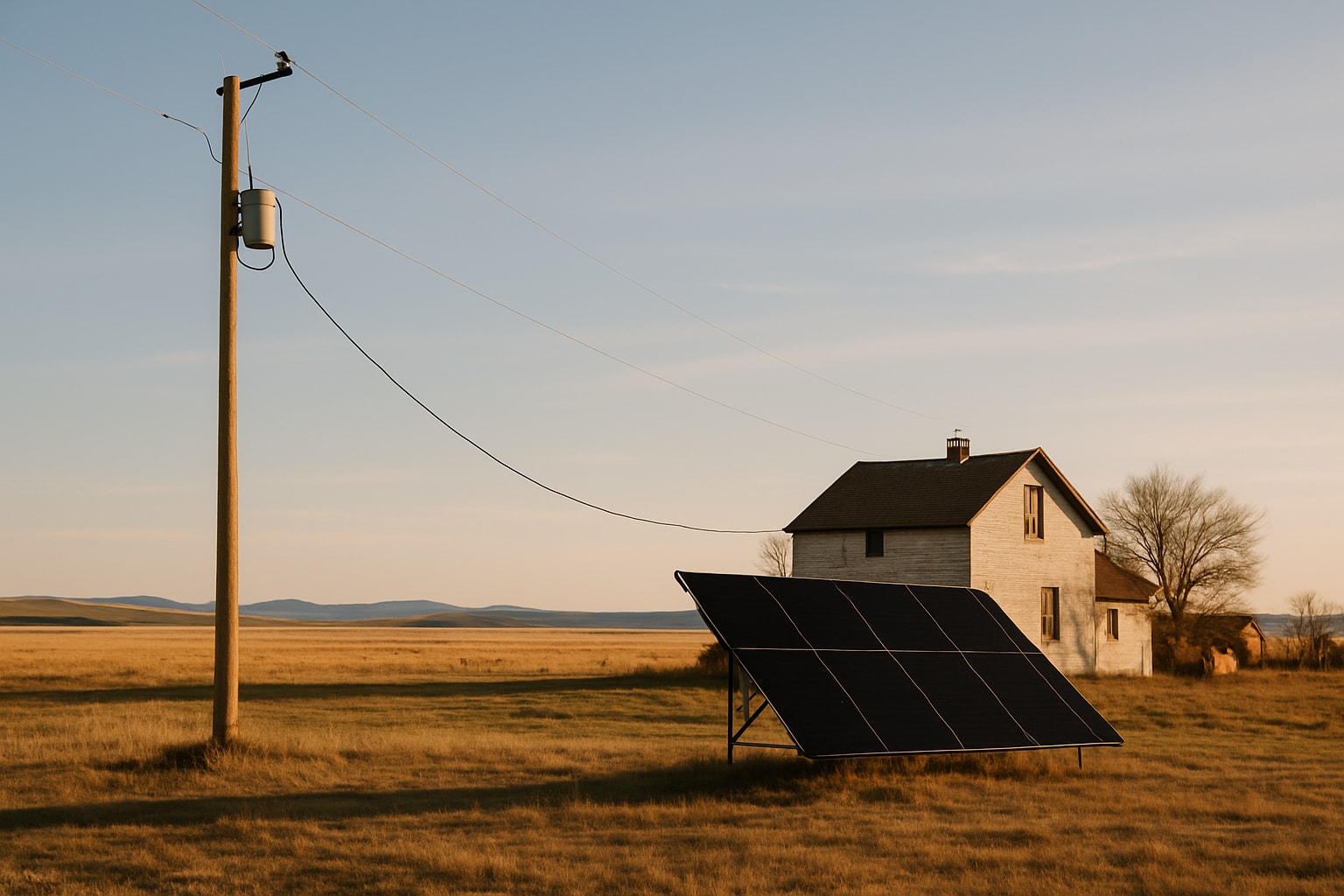
In a city subdivision, the transformer typically sits at the lot line and the run from it to the house is short. On a farm or acreage, none of that holds. Three things stack against rural services.
Distance to the transformer
Rural secondaries are long. The transformer might be at the road while the house, shop, and the best spot for the array are a long way into the yard. Every metre of conductor adds resistance, and resistance is what converts export current into voltage rise. A run that's ten times longer produces, all else equal, ten times the rise for the same current.
Small transformers
A farm service is usually fed by a transformer sized for the farm's load, not for exports. Smaller transformers have higher impedance, which means more voltage rise per amp flowing through them. The same 10 kW of export that a large urban transformer wouldn't notice can push a small farm transformer's secondary voltage up meaningfully.
Shared transformers
Plenty of rural transformers feed more than one service. If a neighbour's yard shares your transformer, their load and their solar both move the voltage you see. A shared transformer that's already running near the top of its voltage band on a light-load afternoon has very little headroom left before your exports push it over.
Put those together and you get the pattern utilities see constantly: the same system that sails through review on an urban service gets flagged on a rural one. It's not the array size in isolation. It's the array size against the service behind it.
What Does It Look Like When It Goes Wrong?
The symptom is specific: inverters shutting off on sunny afternoons, exactly when they should be earning the most.
Picture a clear, cool day in May. The array is at full output. The house load is light because nobody's running heat or much else. Almost everything the array makes is exporting, so the current on that long secondary is at its maximum, and the voltage at the inverter climbs. When it crosses the inverter's over-voltage limit, the inverter disconnects from the grid. It waits, reconnects, voltage climbs again, and it trips again. On a bad service this cycle repeats all afternoon.
That disconnect isn't a malfunction. Inverters certified for grid connection in Canada are required to shut off when the voltage at their terminals goes above prescribed limits. It's a safety behaviour that protects line workers, your neighbours' equipment, and your own, and every certified inverter does it. The inverter is doing its job. The service just can't absorb what the array is producing.
The cost is lost production, concentrated on the best days of the year. On the production graph it shows up as a flat-topped or sawtooth curve where a clean arc should be. Owners often don't notice for months, because the system still works, it just quietly gives up its strongest hours. Those hours are a real part of the payback math, and losing them means the system earns less than the design promised.
If you already have a system and want to check, pull up your monitoring for a stretch of clear spring or summer days and look at the shape of the curve. A healthy grid-tied system draws a smooth arc from sunrise to sunset. Repeated mid-day dropouts to zero, or a curve that keeps hitting the same ceiling and collapsing, are the signature of over-voltage tripping, and they're worth a phone call.
What Do the Fixes Look Like?
Voltage rise has a toolbox, and which tool applies depends on where the rise is coming from:
- —Larger conductor. Upsizing the wire between the array and the service cuts resistance, which cuts rise directly. Cheap insurance at design time, expensive to redo after the trench is closed.
- —Shorter runs. Array placement is a voltage decision, not just a sunlight decision. Moving the array closer to the service entrance or the transformer shortens the path the export current has to climb.
- —Transformer upgrade. If the transformer itself is the bottleneck, the utility can replace it with a larger unit. That's the utility's call and its cost varies by situation, which is one reason this conversation belongs before the install, not after.
- —Inverter grid-support settings. Modern inverters can be configured to absorb reactive power as voltage climbs, which holds the voltage down without throwing away real production. Whether these settings are used, and how, is coordinated with the wire service provider.
- —Sizing the array to the service. Sometimes the honest answer is a system sized to what the service can actually export. A slightly smaller array that runs clean beats a bigger one that trips off every sunny afternoon.
Usually the answer is a combination: a sensible array location, conductor sized with export in mind, and inverter settings agreed with the utility. The transformer upgrade is the last resort, not the first, because it's the one piece you don't control.
Why We Model This Before Install, Not After
Everything you need to predict voltage rise is knowable at the design stage. The run length from the array to the service. The conductor size. The transformer serving the property and who shares it. The inverter's rated output. With those numbers, calculating worst-case rise is straightforward engineering, and it's part of how Range Road Solar designs every rural system.
Done at design time, voltage rise costs a conversation and maybe a wire gauge. Done after install, it costs re-trenching, change orders, a curtailed inverter, or a system that underperforms its quote indefinitely. There is no version of this problem that gets cheaper by waiting.
It also changes how the utility application goes. A microgeneration application that already accounts for rise, with the run lengths and conductor sizes shown, gets fewer follow-up questions than one that leaves the utility to discover the problem in review. If you've been told your system needs a study, that's not a rejection. It's the utility asking the design question that should have been answered in the first place.
What If You've Already Been Flagged?
If your application came back with questions, or you have an existing system whose production drops out on clear afternoons, the path is the same: get the actual numbers for your service and model it. That means the distance to your transformer, the conductor in the ground, and what else shares the transformer. From there the fix is usually one of the items above, and often the cheapest one available.
If you're planning solar on a farm or acreage and you want the voltage question answered before it becomes a surprise, send us your most recent power bill through our contact page or call 587-330-7502. We'll look at your service, your load, and your site, and design a system that runs clean on the sunniest day of the year.
Range Road Solar installs across Alberta. See Airdrie solar installer for service area details.
Ready to get a real number for your property?
Send us your most recent power bill. We'll review your consumption and give you an honest design and cost estimate. No obligation.