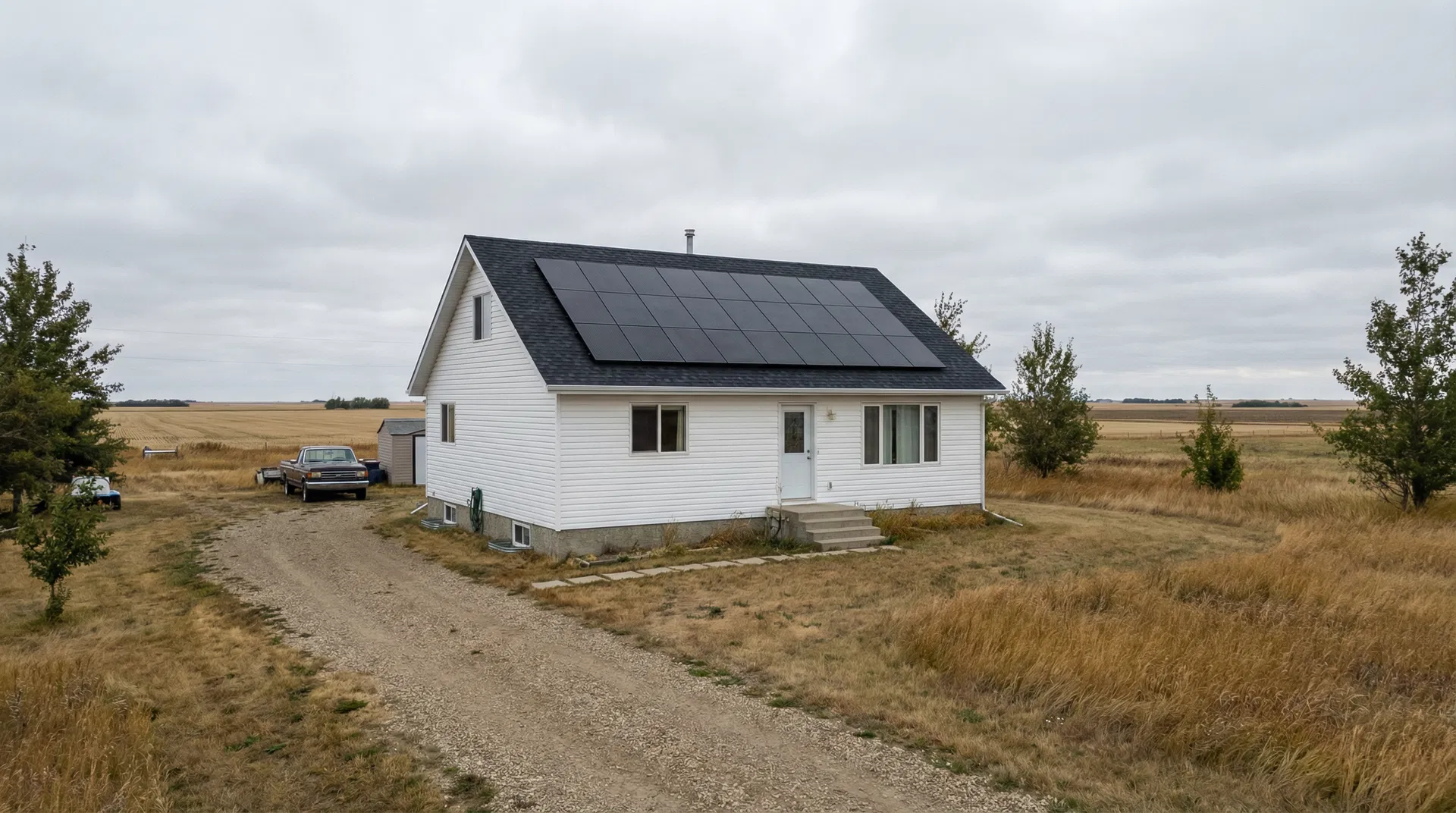
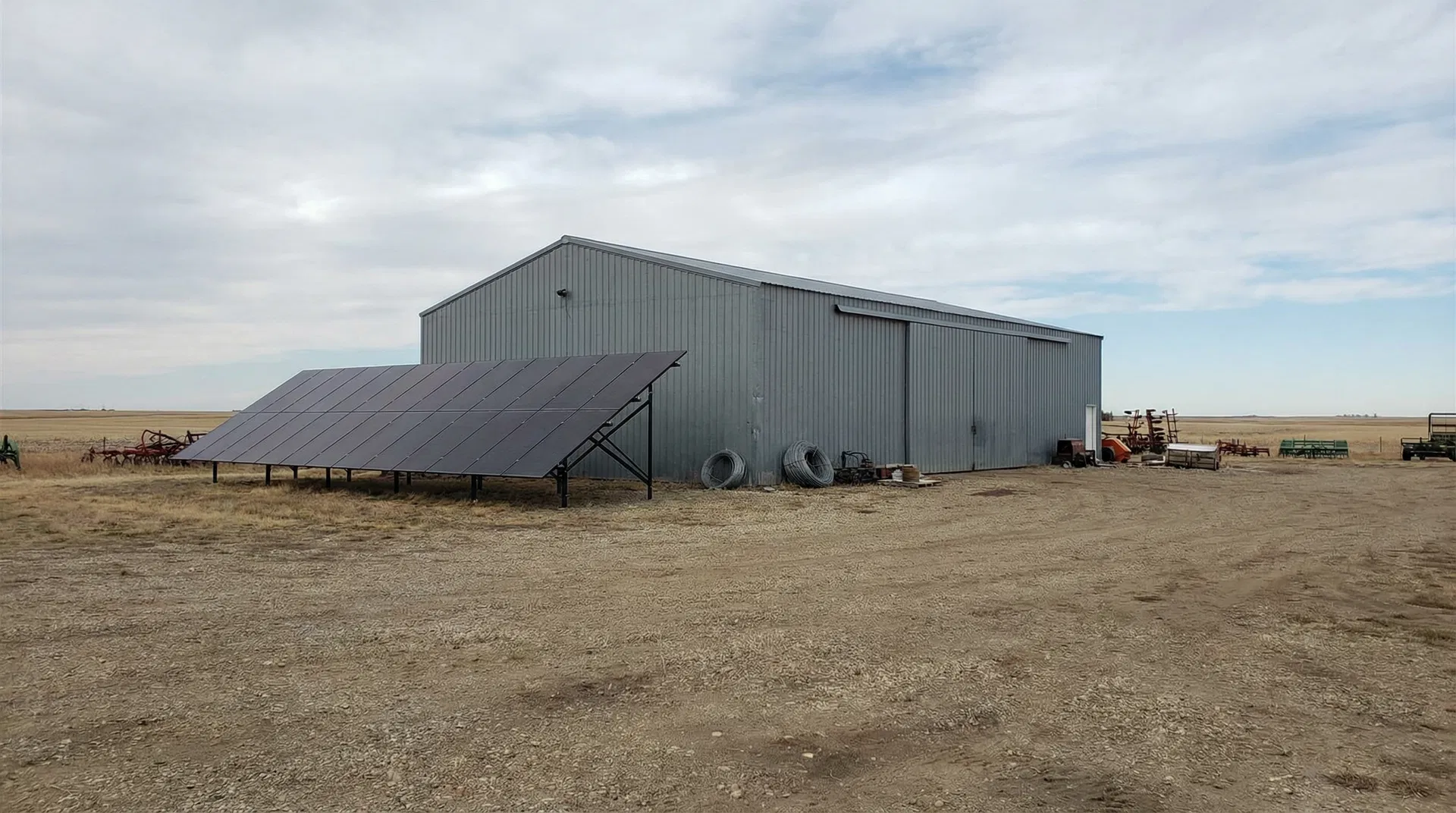
Farm solar for Three Hills operations starts with the yard, not the roof. Most of the systems we quote here run in the 20 to 50 kW range, with 25 kW being a common landing point once we've added up the house, a heated shop, a grain dryer or auger circuit, and maybe a well pump. We default to LONGi panels paired with APsystems microinverters, and for farm-scale arrays we generally recommend ground-mount racking over rooftop. A ground-mount array lets us orient panels for the best angle regardless of which way the house or shop happens to face, and it keeps wiring and maintenance access at ground level instead of up on a metal roof in January. Rooftop still makes sense on some properties, especially where there's a south-facing shop roof with no shading and the ground around the yard is already crowded with bins, machinery, or a shelterbelt. We walk every site before recommending one over the other. For acreages and quarter-sections with grain handling or livestock infrastructure, we also look at whether the array needs to be split across multiple inverters to match separate panel feeds or three-phase equipment. Every farm system we design gets sized from your actual electrical layout and your most recent power bill, not a generic per-acre estimate.
Solar Planning for Three Hills Properties
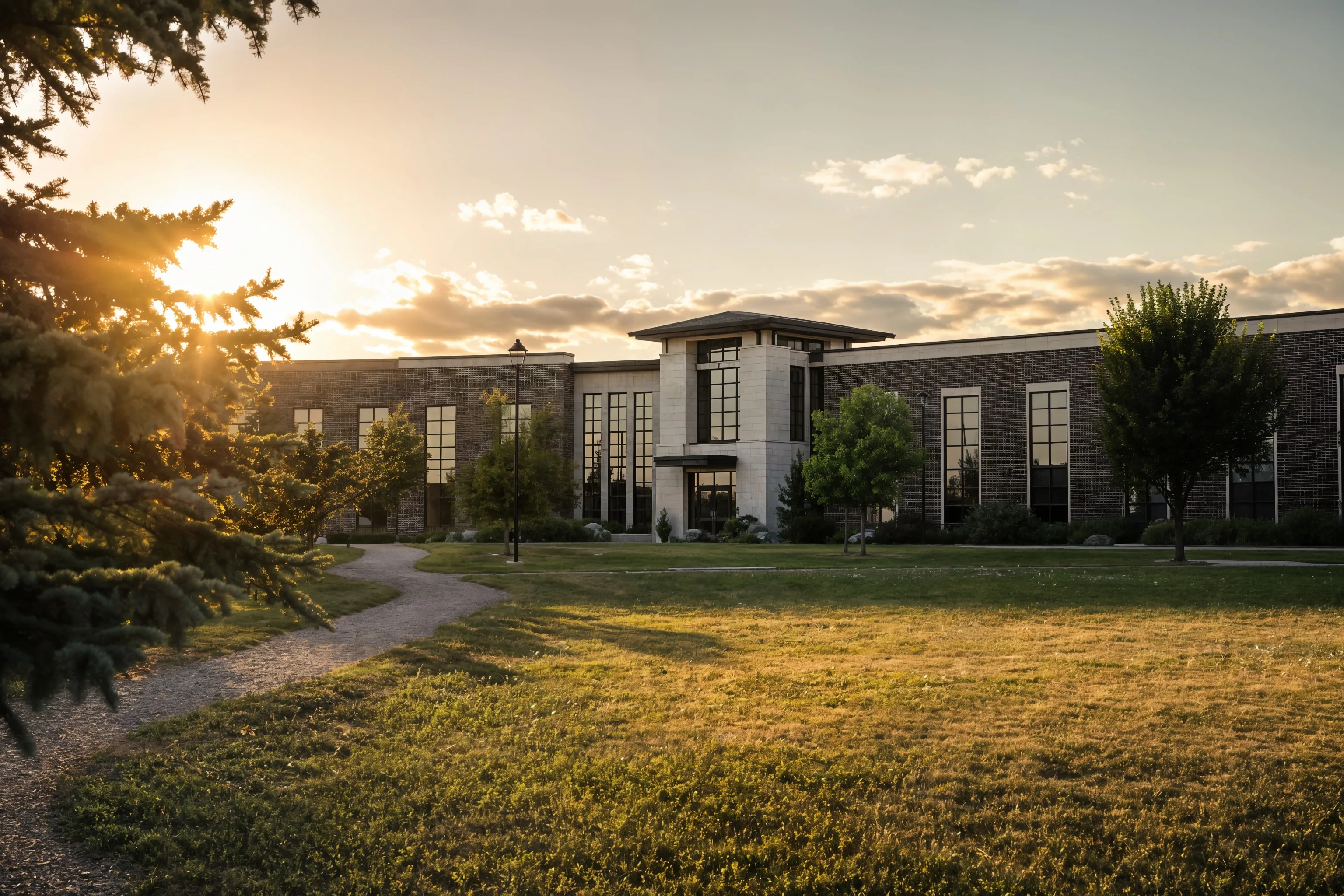
Three Hills sits within Kneehill County, and most of the farms and acreages we work with here run on ATCO Electric service. That matters before any panel goes up: ATCO's interconnection process, metering requirements, and application paperwork differ from what you'd deal with under a different wire service, and we build the design package around ATCO's rules from the first site visit. The town itself was incorporated as a village on June 14, 1912, and as a town on January 1, 1929, and agriculture has stayed the backbone of the local economy since. Prairie College, formerly known as Prairie Bible Institute, is still one of the area's largest anchors, and a lot of the farm properties we quote sit within a short drive of it. According to Environment Canada's annual bright sunshine normals (Calgary International Airport station), the region sees 2,396.3 hours of bright sunshine a year, and Natural Resources Canada's photovoltaic potential maps put the specific yield for this area at 1,276 kWh per kWp. We use figures like these only as a general reference point, not a promise. Actual production for your property depends on roof or ground-mount orientation, shading from bins, shelterbelts, or outbuildings, and the load your operation actually carries, so we confirm real numbers through a site design and your most recent power bill before we size anything.
Electrical Site Review for Three Hills Properties
Voltage Rise
Voltage rise happens when power travels a long distance down a rural distribution line before it reaches your property, and the voltage at your service can run higher than it would closer to the substation. That matters for solar because an inverter that senses voltage too far above normal will clip its output or shut down to protect itself. We check line conditions at your site before sizing an inverter so it's rated to perform where the voltage actually sits, not just on paper.
Single-Phase vs Three-Phase
Rural Alberta properties can have either single-phase or three-phase electrical service, and which one you have changes what inverter equipment fits. Three-phase service, common on larger farm operations with bigger motors or grain handling equipment, can support higher system capacity and different inverter configurations than single-phase. We confirm which service type is on your property before we spec equipment, since the wrong assumption here means ordering the wrong gear.
Panel Infrastructure
A lot of farm properties in this area still have older electrical panels that weren't built with solar interconnection in mind. Before we finalize a design, we check the panel's age, its total breaker capacity, and whether there's room for the backfeed breaker a solar system needs. If the existing panel can't support it, an upgrade means a new panel or a service upgrade sized to handle both your existing loads and the new solar circuit.
Service Entrance Review
We also review the service entrance and meter base, since that's the point ATCO Electric cares about most when reviewing a micro-generation application. An aging or undersized meter base can hold up an approval even if the rest of the system is ready to go. When an upgrade is needed, we identify it during the site visit so it's part of the project plan from the start, not a surprise partway through installation.
Right-Sizing Solar for Three Hills Properties
Farm and acreage properties in rural Alberta usually carry more electrical load than a house in town. There's the home itself, plus a heated shop, maybe a grain dryer, an auger or conveyor circuit, a well pump, or livestock equipment running on its own panel. That's why farm systems here tend to land in the 20 to 50 kW range instead of the smaller systems you'd see on a residential bungalow, and it's also why we don't size off a single rule-of-thumb number. Roof versus ground-mount comes down to the specific yard. If there's a shop roof with good south exposure and no shading from trees or grain bins, rooftop can work fine and keeps the array off usable land. If the roof is shaded, poorly pitched, or there's open yard space with room to orient panels for the best angle, ground-mount is usually the better call, and it's what we recommend for most larger farm arrays. Either way, we size the system from the 12-month usage graph on your most recent power bill, which shows exactly how your load moves through the year: seeding season, harvest, grain drying, winter heating, all of it. That graph tells us more than a generic per-acre estimate ever could.
Typical Load Profiles We Design For Near Three Hills
Home + Heated Shop
This profile covers a farmhouse plus a heated shop used for equipment storage and winter repair work. Shop heat, along with any block heaters or welders, usually pushes this load well past what a house alone would need. We size the array and inverter count from the combined load shown on your most recent power bill, not the house and shop separately.
Grain Handling and Drying
This profile applies to yards running an auger, conveyor, or grain dryer during harvest, where electrical demand spikes hard for a few weeks a year rather than staying steady. A system sized only for average monthly use would undersize for that harvest spike, so we look at the peak periods on your most recent power bill's usage graph as well as the annual total. Three-phase service is common on these setups and often changes which inverters fit.
Livestock and Irrigation
This profile covers properties with well pumps, livestock waterers, or irrigation equipment running on their own circuits, often with load that's more constant through the year than seasonal grain operations. These loads tend to be smaller individually but steady, which changes the production curve we're designing against. We confirm actual draw from your power bill rather than assuming based on herd size or acreage.
ATCO Electric Interconnection in Three Hills
In this area, properties are served by ATCO Electric, and that's the utility whose rules govern how a farm solar system gets connected to the grid here. ATCO reviews every micro-generation application before a system is allowed to operate in parallel with their lines, and the application has to match your actual equipment: panel count, inverter model, and system capacity all need to line up with what gets installed. Range Road Solar handles that application and the supporting design package on your behalf, from the single-line diagram to the equipment specifications ATCO asks for. We coordinate directly with ATCO so you're not the one tracking down forms or chasing an approval. What we don't do is promise a specific approval timeline, a credit carryover rule, or a payout rate, because those terms are set by ATCO and your electricity retailer, and they can change. We confirm whatever applies to your situation during the design review, using your current account details and the rules in place at the time you apply.
Project Economics and Design Review
| System Size | Annual Production | Year 1 Savings | Payback Period |
|---|---|---|---|
| 20-50 kW range, 25 kW typical |
Production, savings, and payback figures require a property-specific design and your most recent power bill before we can quote them.
How We Work in Three Hills
Bill and Load Review
We review your power bill to understand your energy use in Three Hills and size the system to your actual consumption, not a generic estimate.
Site Assessment
We assess your roof or ground area, south-facing exposure, electrical service, and utility interconnection requirements specific to your property.
Design and Utility Application
We produce a system layout, production estimate, and cost summary, then submit your micro-generation application to your utility on your behalf.
Installation and Commissioning
Our crew installs racking, panels, inverter, and electrical connections. All work is performed by licensed electricians. We commission and test before handoff.
Current Program and Interconnection Review
Utility connection review
ATCO Electric reviews every micro-generation grid connection application before a farm solar system can operate alongside their lines. Range Road Solar prepares the design package, single-line diagram, and equipment specs that application requires. We submit and track it on your behalf so you're not the one navigating ATCO's paperwork.
Current program review
Residential, farm, and commercial solar installations are each reviewed against whatever program and eligibility rules are current at the time of your design, since rules and rates can change. We check what applies to your specific property and use case during the design review rather than assuming last year's terms still apply. If something changes between quote and installation, we flag it before you sign off.
Frequently Asked Questions
Get a Solar Assessment for Three Hills
Submit a recent power bill and we will review your consumption and provide an honest assessment for your Three Hills property. No obligation.
(587) 330-7502 Book a CallRelated Resources
More Solar Services in Three Hills