
Who Calls Us From Andrew
Andrew inquiries usually come from two kinds of property owners: villagers on standard in-town lots looking to knock down a power bill that has crept up every year, and acreage owners on the outskirts running a shop, a well pump, or grain-handling equipment that pulls a lot more than a typical house. Andrew is a small village, 366 people as of the 2021 census, down from 425 in 2016, and most of the housing stock here is older and established. That matters for solar: a homeowner with no mortgage and a fixed income has a very different payback calculus than someone financing a new build, and we design around that.
The village sits in Lamont County, about an hour northeast of Edmonton near the junction of Highways 855 and 45. Most of what we install here is straightforward rooftop residential, plus a handful of acreage systems just outside the village boundary where FortisAlberta's rural distribution grid also runs instead of ATCO's. We do not oversell Andrew. It is a small market. But the physics of solar do not care about population size, and the math works the same here as anywhere else in central Alberta.
Why Solar Works in Andrew
Andrew sits at roughly 53.88 degrees north, 112.33 degrees west. There is no Environment Canada sunshine sensor in the village itself, but the nearest station that records bright sunshine duration, Edmonton International Airport, about 104 km southwest, logs an annual average of 2,310 bright sunshine hours under the 1981 to 2010 climate normals. That is a duration measurement, not the "peak sun hours" figure solar calculators use, but it tells you this part of Alberta gets a lot of clear sky, concentrated hard into the April-through-August stretch when a grid-tied system does most of its annual production. NRCan's own municipal solar potential dataset lists Andrew specifically at 1,247 kWh per kW of installed capacity per year for a south-facing, latitude-tilt array, in line with neighbouring Vegreville at 1,264 and Two Hills at 1,255.
In the village of Andrew, ATCO Electric owns the distribution wires, confirmed directly through the Village's own utility contact page, which tells residents to set up their power account through ATCO's Vegreville office. Properties just outside the village limits, out in Lamont County's rural sections, can fall into FortisAlberta territory instead, so the first thing we do on any acreage job is confirm which company actually owns the poles and transformer feeding that yard. A grid-tied system has to go through that distributor's micro-generation application: they review the design, verify the breaker panel and conductor sizing can handle the backfeed, and swap in a bi-directional meter, typically a two-to-four-week process. We handle that application as part of every install.
A Village Known for Its Duck
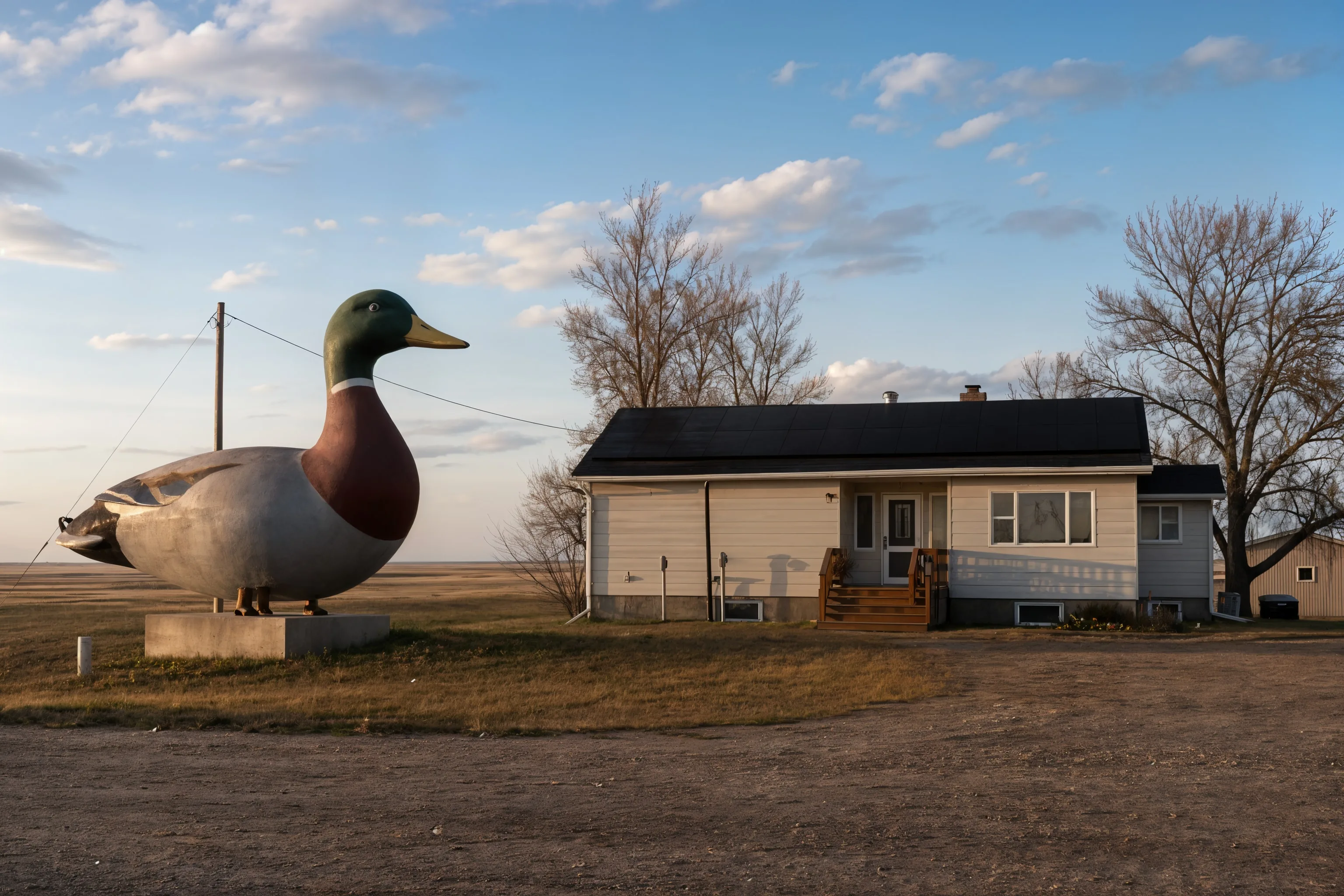
Andrew was incorporated as a village on June 24, 1930, though the post office here dates back to 1902. Its best-known landmark is the World's Largest Mallard Duck, a "Giants of the Prairies" roadside attraction built in 1992 by the Andrew Lions Club: a one-tonne, seven-metre wingspan duck marking the wetlands and lakes around the village. It is the kind of small-town landmark that makes Andrew memorable to anyone who has driven Highway 855.
The land around Andrew is flat, open Lamont County farm country with minimal tree cover, which means shading is almost never a factor in a solar design here. Properties range from village homes on standard lots to quarter-section farms on the rural edges, and the openness that makes this land good for grain also makes it good for solar exposure from sunrise to sunset.
What a System Looks Like on an Andrew Property
Village Home on a Standard Lot
Most homes in Andrew are older bungalows or split-levels on standard village lots, with monthly bills in the $150 to $220 range depending on the season. A 6 to 8 kW rooftop system, installed roughly $13,500 to $22,800 depending on the roof and equipment (roof-mount pricing runs $2.25 to $2.85 a watt), covers the bulk of a typical household's annual draw.
Village Home Plus Detached Garage or Shop
A house plus a detached garage or small shop for a trade or hobby equipment usually pushes bills into the $220 to $320 monthly range. An 8 to 10 kW system, roughly $18,000 to $28,500 installed, spread across the house and garage roof if orientation allows, is the typical fit.
Acreage Just Outside the Village
Rural Lamont County properties running well pumps, block heaters, and shop heat see bills that swing seasonally, often $300 to $500 a month in winter. These sites frequently sit on FortisAlberta's rural grid rather than ATCO's village service, which we confirm before designing. A 10 to 13 kW system, roughly $22,500 to $37,050 installed, is typical, sized to actual annual consumption.
Snow Load and Frost Depth
Andrew sits in the same general snow-load band as the rest of east-central Alberta. The nearest town with a published National Building Code ground snow load figure is Vegreville, at roughly 1.9 kPa, which we treat as the working design number for Andrew absent a site-specific value. For ground-mount systems, the Edmonton-region standard is a minimum footing depth of 1.2 metres per code, though local geotechnical practice around here commonly runs footings to 5 feet or deeper for anything expected to hold steady through freeze-thaw cycles over 25-plus years. Every ground-mount post gets sized to the racking manufacturer's engineering spec for our actual frost and snow conditions, not a generic southern-Alberta number.
Andrew Solar System Sizing and Savings Estimates
Based on $2.25 to $2.85 a watt installed for roof-mount systems, NRCan's Andrew-specific yield of 1,247 kWh per kWp per year, and a blended Alberta residential rate of roughly 23 cents/kWh.
| System Size | Annual Production | Year 1 Savings | Simple Payback |
|---|---|---|---|
| 6 kW | 7,482 kWh | ~$1,721 | ~7.8 to 9.9 yrs |
| 10 kW | 12,470 kWh | ~$2,868 | ~7.8 to 9.9 yrs |
| 13 kW | 16,211 kWh | ~$3,729 | ~7.8 to 9.9 yrs |
Payback shortens for incorporated farm or business operations that qualify for the 30 percent federal Investment Tax Credit on capital equipment. There is currently no Alberta residential solar rebate.
What We Put on Andrew Properties
LONGi panels, no exceptions. LONGi is the largest solar panel manufacturer globally, and their equipment is built for harsh climates. Alberta qualifies: the panels handle temperature swings from minus 40 to plus 35 without degradation, backed by a 25-year product warranty. Residential systems get APsystems microinverters, where every pair of panels operates independently, so one panel covered in snow does not reduce the output of the others. For farm-scale systems near Andrew, we use Solis inverters built for higher-capacity installations.
How We Work with Andrew Properties
Power Bill Review
Share your most recent power bill. We analyze your consumption to determine the right system size and calculate projected savings specific to your property.
Site Visit to Andrew
We drive to your property and assess the roof, electrical infrastructure, shading, and ground conditions. No charge, no obligation.
Custom Design
A detailed system design with panel layout, production estimate, cost breakdown, incentive eligibility, and payback timeline specific to your property.
Permitting
We handle building permits, electrical permits, and the ATCO or FortisAlberta micro-generation interconnection application. You sign once, we follow up on everything.
Installation
Licensed electricians install racking, panels, inverters, and all electrical connections. One to two days for residential, two to three for farm-scale.
Grid Connection
Final inspection, commissioning, and grid connection. Your system starts producing power and you start seeing the savings on your bill.
Andrew Solar, Frequently Asked Questions
218+ installations. Zero shortcuts.
Read what Alberta property owners say about our work.
Free Solar Assessment for Andrew Properties
Village home, acreage, or farm, we will come to you and give you an honest number.
Also Serving Near Andrew
Get a Solar Quote for Your Andrew Property
Tell us your address and a recent power bill, and we will tell you whether you are on ATCO or FortisAlberta wires, what system size actually fits your usage, and what it costs installed. No generic estimate, no inflated range.
Also Serving Nearby Communities