
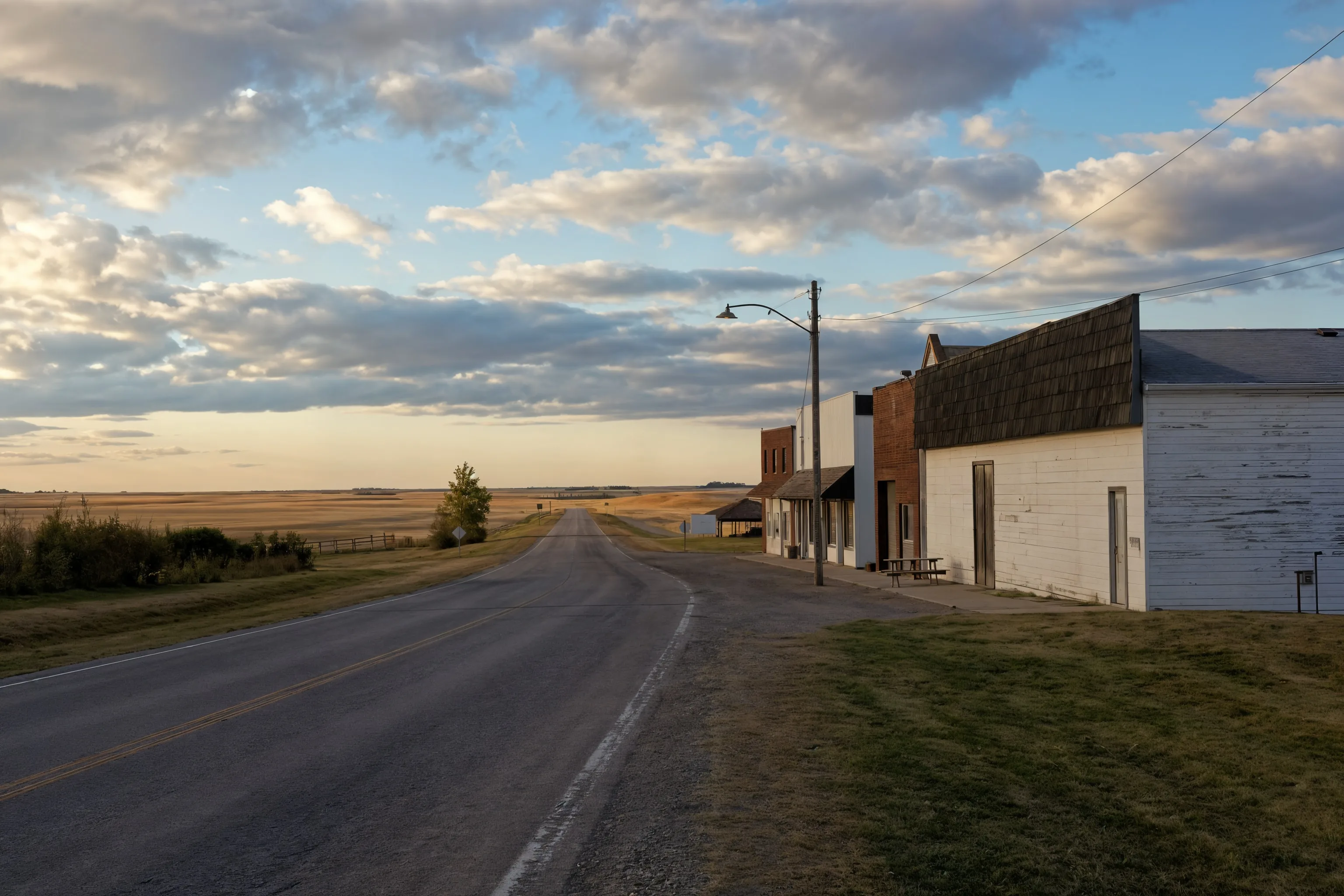
Who Calls Us From Two Hills
Two Hills counted 1,416 residents in the 2021 census, a small town by any measure, but the calls we get here reflect an economy much bigger than that number suggests. Homeowners on standard lots near Main Street want to bring down a power bill that climbs every winter. Grain and cattle operators on the quarter sections surrounding town are running dryers, augers, and stock waterers through harvest and calving season, loads a town lot never sees. And owners of the shops, restaurants, and service businesses along Main Street want to offset refrigeration, HVAC, and lighting that runs from open to close.
A Main Street bungalow, a ground-mount array on a working farm, and a commercial roof over a Main Street storefront don't share a formula in Two Hills, only a starting point: your actual 12 months of usage and your actual roof or yard. From there the design work looks completely different for each.
The Numbers Behind Solar in Two Hills
Two Hills sits at about 53.72 degrees north, 111.75 degrees west, at an elevation of 603 metres in the aspen parkland belt of east-central Alberta. No Environment Canada station tracks bright sunshine duration inside the town, and we could not confirm a closer verified figure this session, so the working regional number we use comes from Bashaw, a station in our own dataset over 100 km to the southwest: 2,340 annual bright sunshine hours and a recorded 9,670 kWh a year from a 7.6 kW array, about 1,272 kWh per installed kilowatt. We treat that as the honest regional estimate rather than manufacturing a Two Hills specific figure that has never actually been measured.
ATCO Electric, not FortisAlberta, owns the distribution wires across this part of the province, part of ATCO's published north and east-central Alberta territory that also covers St. Paul County, Lamont County, Smoky Lake County, and County of Two Hills No. 21 itself. That is worth stating plainly because a good number of the towns closer to our home base run on FortisAlberta lines, and the two utilities file micro-generation paperwork differently. We handle the interconnection application on your behalf regardless of which distributor serves your meter, and approval typically takes two to six weeks once a complete application is submitted.
A Grain Town Built on Ukrainian Settlement Roots
Two Hills got its post office in 1914, incorporated as a village in 1929, and reached town status in 1955, growing up at the junction of Highway 45 and Highway 36 as a service point for the farms around it. The area sits inside the historic Edna-Star block settlement, one of the largest concentrations of Ukrainian pioneers in Canada, and that history is still visible downtown at Pioneer Park, where a bronze statue of Mr. and Mrs. Dowhaniuk, unveiled in 1992 and donated by Two Hills-raised businessman Wally Dowhaniuk, depicts a pioneer couple stepping off the train with a Bible and a loaf of kolach bread. More recently, Mennonite families who relocated from Mexico have put their own mark on the town's shops and restaurants, a newer layer on top of the older Ukrainian one.
County of Two Hills No. 21 surrounds the town on every side, 2,600 square kilometres of grain and cattle land with its own Reeve and council, even though the county's administration office physically sits inside town limits. A lot of the farm and ranch systems we quote nearby are for people who bank, fuel up, and ship grain through Two Hills even though their land falls under the county's building permits rather than the town's. If that describes your property, our page on County of Two Hills No. 21 covers that jurisdiction on its own terms.
What a System Looks Like on a Two Hills Property
Town Home Near Main Street
A bungalow or two-storey on a standard Two Hills lot typically runs $150 to $220 a month depending on the season. A 6 to 8 kW rooftop array, installed for roughly $13,500 to $22,800 at roof-mount pricing of $2.25 to $2.85 a watt, covers most of a household's annual draw.
Grain and Cattle Operation Outside Town
Farms running grain dryers, augers, heated shops, and stock waterers see bills that swing hard by season, commonly $300 to $600 a month through harvest and calving. A 15 to 25 kW ground-mount system, roughly $37,500 to $87,500 installed at $2.50 to $3.50 a watt for ground-mount, is a common fit, and an incorporated operation can apply the 30 percent federal Investment Tax Credit against the cost.
Small Commercial Building on Main Street
A shop, restaurant, or service business downtown, carrying refrigeration, HVAC, and daytime lighting, often carries a $400 to $900 monthly bill. A 12 to 20 kW rooftop system, roughly $27,000 to $57,000 installed, is typical, sized from the building's actual 12-month usage rather than square footage alone.
Two Hills' Borrowed Snow and Wind Numbers
There is no National Building Code climatic listing specific to Two Hills, so we design to the nearest town that does have published figures: Vegreville, about 31 km to the southwest, with a ground snow load of 1.9 kPa, an additional 0.1 kPa allowed for rain-on-snow, and a 1 in 50 year design wind pressure of 0.36 kPa. Ground-mount racking on the farms around Two Hills gets engineered to those numbers, with piles driven below the local frost line, and rooftop mounting hardware in town is rated to the same wind pressure rather than a generic manufacturer default. On open grain-belt land with nothing to break the wind for miles, that engineering margin is not optional.
Two Hills Solar System Sizing and Savings Estimates
Based on $2.25 to $2.85 a watt installed for roof-mount systems, the regional yield of roughly 1,272 kWh per kWp a year drawn from Bashaw's measured output, and a blended Alberta residential rate of about 24 cents/kWh.
| System Size | Annual Production | Year 1 Savings | Simple Payback |
|---|---|---|---|
| 7 kW | 8,904 kWh | ~$2,137 | ~7.4 to 9.3 yrs |
| 15 kW | 19,080 kWh | ~$4,579 | ~7.4 to 9.3 yrs |
| 25 kW | 31,800 kWh | ~$7,632 | ~7.4 to 9.3 yrs |
Ground-mount farm systems run $2.50 to $3.50 a watt rather than the roof-mount pricing used above, and payback shortens for incorporated farm or business operations that qualify for the 30 percent federal Investment Tax Credit. There is currently no Alberta residential solar rebate.
Equipment We Install on Two Hills Properties
LONGi is the panel we install on Two Hills roofs and ground mounts, the largest module manufacturer in the world by shipped volume, with a 25-year warranty rated for the swing between a hard January on the open grain belt and a dry, hot August. Town homes and small Main Street commercial buildings wire through APsystems microinverters, so a shaded or snow-covered panel never pulls down the rest of the array. Grain and cattle operations building larger ground-mount systems step up to Solis string inverters, sized for the higher continuous throughput a working farm needs.
How a Two Hills Project Moves Forward
Send a Recent Power Bill
Your 12-month usage history tells us far more about the right system size than acreage or a rough estimate ever could.
Site Visit
We drive up and walk the roof or ground site, checking orientation, shading, the electrical service, and, for farm properties, how the grain dryers and augers are actually wired.
Design and Fixed Price
You get a panel layout, a production estimate built on real regional yield data, and one locked installed price, not a range that grows later.
Permits and Interconnection
We pull the Town of Two Hills or County of Two Hills No. 21 building permit as applicable, arrange the electrical permit, and file the micro-generation application with ATCO Electric.
Installation
Licensed electricians handle racking, panels, inverters, and wiring, usually one to two days for a home or small commercial roof, longer for a larger farm system.
Commissioning
Final inspection, utility sign-off, and the bi-directional meter goes in. From there the system runs itself and we monitor it remotely.
Two Hills Solar, Frequently Asked Questions
218+ installations. Zero shortcuts.
Read what Alberta property owners say about our work.
Free Solar Assessment for Two Hills Properties
Town home, farm operation, or Main Street business, we will come to you and give you an honest number.
Also Serving Near Two Hills
Get a Solar Quote for Your Two Hills Property
Tell us your address and send a recent power bill, and we will tell you what size system your actual usage supports, whether you fall under the town or the county for permitting, and what it costs installed. No inflated range, no generic small-town number.
Also Serving Nearby Communities