
Who Calls Us From St. Paul
St. Paul counted 5,863 residents in the 2021 census, with another 6,306 people living in the surrounding County of St. Paul No. 19. That split shows up directly in the calls we get. Homeowners on a standard town lot want to bring down a bill that climbs every winter. Owners of shop bays and small commercial buildings in town, several tied to the oilfield services trade that serves the Cold Lake heavy oil region nearby, want to offset compressor, refrigeration, and daytime lighting loads. And grain and cattle operators out in the county are dealing with shop heat, grain augers, and stock waterers that a house in town never has to carry.
A town-lot bungalow, a shop bay on Main Street, and a quarter section out in the county each need a different answer to the same two questions: how much roof or yard space is actually available, and what the meter shows for actual draw. We price from those two things, not a flat per-address rule that treats a St. Paul rooftop the same as a St. Paul ground-mount.
The Numbers Behind Solar in St. Paul
St. Paul sits at roughly 53.99 degrees north, 111.30 degrees west, on the edge of the aspen parkland belt in northeast Alberta. Natural Resources Canada's official photovoltaic potential database, which calculates a location-specific figure for St. Paul rather than borrowing a neighbouring town's number, puts a south-facing rooftop array at latitude tilt at 1,244 kWh of production per installed kilowatt each year. There is no Environment Canada bright sunshine sensor in St. Paul itself; the nearest station with published Climate Normals is Cold Lake, about 115 km northeast by road, logging 2,156 annual bright sunshine hours over the 1981 to 2010 normal period. We size systems off St. Paul's own NRCan yield figure and treat the Cold Lake sunshine data as regional context only.
ATCO Electric owns the distribution wires inside St. Paul town limits, confirmed against the Town of St. Paul's own published business directory listing. Step outside town into the County of St. Paul No. 19 and the picture changes: Lakeland Power Co-op, a rural electrification association, serves rural sites across the county along with six neighbouring counties, including Two Hills, Smoky Lake, and Minburn. A property a few kilometres apart, one inside town and one out on a quarter section, can land on two entirely different distributors, so we confirm the actual wires owner for your address before filing any interconnection paperwork. Approval typically takes two to six weeks once a complete micro-generation application is in, regardless of which utility is involved.
A Town With a Genuinely Unusual History
St. Paul began in 1895 as St. Paul des Métis, an agricultural settlement organized by the Roman Catholic Church after missionary Father Albert Lacombe lobbied the federal government for land, four townships leased for 99 years at a dollar a year, so Métis families could shift from a hunting and trading economy to settled farming. Each family that joined received 80 acres, livestock, and equipment. Funding problems and a fire that destroyed the school eventually ended the colony's original purpose, and the land opened to general settlement in 1909, when roughly 450 people registered as homesteaders under Father Joseph-Adeodat Thérien over two days. The community incorporated as the Village of St. Paul des Métis in 1912 and became the Town of St. Paul in 1936, a French and Métis settlement history that is still visible in the town's street names and churches today.
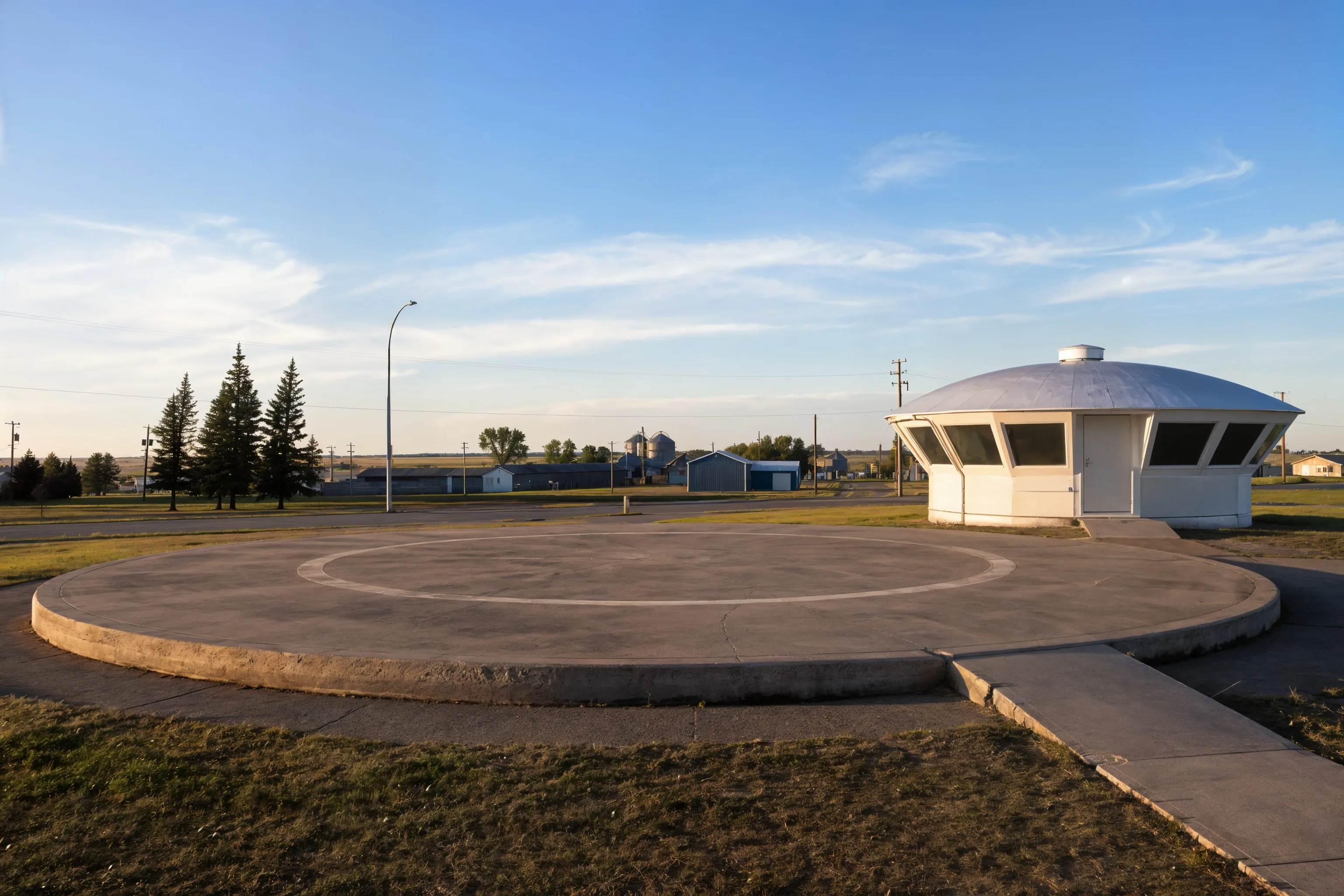
St. Paul is also, more famously, home to the world's first UFO landing pad, a 1967 Canadian Centennial project that put the town on the map in a way its grain elevators never quite did. The roughly 130 tonne circular concrete pad, attached to a spaceship-shaped building that now houses the Chamber of Commerce, opened on June 3, 1967, the same day St. Paul was declared the Centennial Capital of Canada, and contains a time capsule set to open in 2067. A saucer-shaped visitor centre added in the 1990s houses a small UFO memorabilia museum and still draws steady tourist traffic through the summer season. It is a genuinely odd, genuinely real piece of local color, one line in a longer story about a town built by Métis homesteaders and now anchored by grain, cattle, and oilfield service work.
St. Paul functions as the retail and services hub for a ring of smaller hamlets around it, Ashmont, Mallaig, and Saddle Lake among them, and for farms scattered across the County of St. Paul No. 19. The St. Paul Healthcare Centre serves the wider region, and the town's current economy runs on that same three-part mix its residents describe to us on site visits: grain and cattle operations, oilfield service work tied to the Cold Lake heavy oil area, and the steady trickle of tourism traffic the landing pad still pulls in every summer. That mix is part of why load profiles here vary so much property to property, and why we do not quote a St. Paul job off a single template.
What a System Looks Like on a St. Paul Area Property
Home on a Standard Town Lot
A typical St. Paul bungalow or two-storey runs $150 to $220 a month depending on the season. A 6 to 9 kW rooftop array, installed for roughly $13,500 to $25,650 at roof-mount pricing of $2.25 to $2.85 a watt, covers most of a household's annual draw.
Grain and Cattle Operation in the County
Farms out in the County of St. Paul No. 19 running shop heat, grain augers, and stock waterers see bills that swing hard by season, commonly $350 to $600 in the coldest months. A 12 to 20 kW ground-mount or rooftop system, roughly $30,000 to $70,000 installed at $2.50 to $3.50 a watt for ground-mount, is a common fit, sized to the operation's actual 12-month usage rather than acreage alone.
Shop or Small Commercial Building in Town
A shop bay, retail storefront, or oilfield services building in town, running compressors, refrigeration, and daytime lighting, often carries a $450 to $900 monthly bill. A 15 to 25 kW rooftop system, roughly $33,750 to $71,250 installed, is a common fit, and an incorporated business here can apply the 30 percent federal Investment Tax Credit against the cost.
Snow and Wind Numbers, Honestly Sourced
St. Paul does not have its own published National Building Code climatic data the way some larger Alberta cities do. The nearest town carrying standard NBCC climatic data is Vermilion, about 97 km south by road: a ground snow load of 1.7 kPa, an additional 0.1 kPa allowed for rain-on-snow, and a 1 in 50 year design wind pressure of 0.36 kPa. We treat that as the honest working baseline for St. Paul and the surrounding county rather than inventing a town-specific figure that has never actually been measured. Ground-mount racking gets footings set below the local frost line and engineered to that baseline, adjusted upward for site-specific exposure on an open quarter section versus a sheltered town lot, and rooftop hardware is rated to the same wind pressure rather than a generic manufacturer default.
St. Paul Solar System Sizing and Savings Estimates
Based on $2.25 to $2.85 a watt installed for roof-mount systems, St. Paul's own NRCan yield of 1,244 kWh per kWp a year, and a blended Alberta residential rate of about 23 cents/kWh.
| System Size | Annual Production | Year 1 Savings | Simple Payback |
|---|---|---|---|
| 7 kW | 8,708 kWh | ~$2,003 | ~7.9 to 10.0 yrs |
| 12 kW | 14,928 kWh | ~$3,433 | ~7.9 to 10.0 yrs |
| 20 kW | 24,880 kWh | ~$5,722 | ~7.9 to 10.0 yrs |
Payback shortens for incorporated farm or business operations that qualify for the 30 percent federal Investment Tax Credit on capital equipment. There is currently no Alberta residential solar rebate. Ground-mount pricing of $2.50 to $3.50 a watt runs a longer payback than the roof-mount figures above.
Equipment We Install on St. Paul Properties
LONGi supplies the panels on every St. Paul job, the largest module producer in the world by shipped volume, picked for a 25-year warranty that has to survive a swing from minus 35 in January to plus 30 in July. Town homes and small shop bays wire through APsystems microinverters, so a shaded or snow-covered panel in one corner of the array never pulls down output from the rest. Grain and cattle operations out in the county, running bigger ground-mount arrays, move up to Solis string inverters built for that higher continuous throughput.
How a St. Paul Project Moves Forward
Send a Recent Power Bill
Your 12-month usage history tells us far more about the right system size than lot size or a rough estimate ever could.
Site Visit
We drive up and walk the roof or ground site, checking orientation, shading, the electrical service, and, for county properties, which utility's poles actually feed the yard.
Design and Fixed Price
You get a panel layout, a production estimate built on St. Paul's own NRCan yield data, and one locked installed price, not a range that grows later.
Permits and Interconnection
We pull the Town of St. Paul or County of St. Paul No. 19 building permit as applicable, arrange the electrical permit, and file the micro-generation application with ATCO Electric or Lakeland Power Co-op, whichever actually owns the wires at your address.
Installation
Licensed electricians handle racking, panels, inverters, and wiring, usually one to two days for a home or small commercial roof, longer for larger farm systems. St. Paul jobs are scheduled as a dedicated trip or bundled with other northeast Alberta work given the distance from our base.
Commissioning
Final inspection, utility sign-off, and the bi-directional meter goes in. From there the system runs itself and we monitor it remotely.
St. Paul Solar, Frequently Asked Questions
218+ installations. Zero shortcuts.
Read what Alberta property owners say about our work.
Free Solar Assessment for St. Paul Properties
Town home, shop, or county farm, we will come to you and give you an honest number.
Also Serving Near St. Paul
Get a Solar Quote for Your St. Paul Property
Tell us your address and send a recent power bill, and we will tell you whether you are on ATCO Electric or Lakeland Power Co-op, what size system your actual usage supports, and what it costs installed. No inflated range, no generic town-wide number.
Also Serving Nearby Communities