
About Bonnyville
The area's recorded history starts with the fur trade: North West Company trader Angus Shaw reached Moose Lake, just north of today's townsite, in 1789 and built a trading post on its northwest shore. Permanent agricultural settlement came much later, in 1907, when Fathers Joseph Adéodat Thérien and J.A. Ouellette encouraged French-Canadian colonizers to the area; eight settlers arrived that spring to start clearing land. The community took its current name in 1910, after Rev. Father Francis Bonny, its first resident priest.
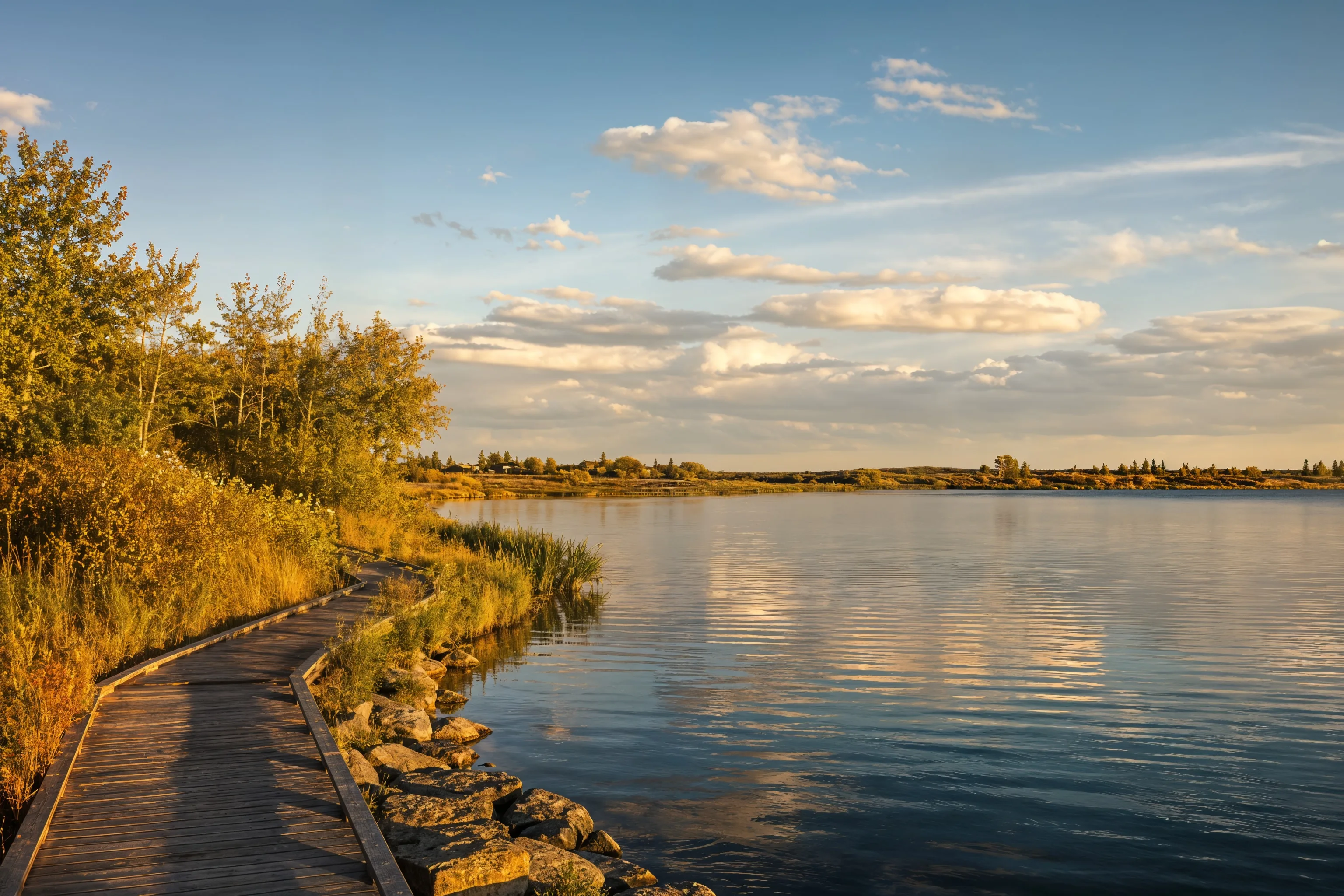
Today Bonnyville is the service centre for a large, lake-studded stretch of northeast Alberta. Jessie Lake forms the town's own southern edge, with a shoreline walking loop popular with birdwatchers, while Moose Lake and Muriel Lake nearby carry a mix of cottages and year-round acreages. The MD of Bonnyville No. 87 countryside is also within commuting distance of the Cold Lake oil sands in-situ projects, which gives the local economy a second leg beyond the grain and cattle farming that still covers most of the surrounding land.
Solar Potential in Bonnyville
Bonnyville, at roughly 54.27 degrees north, has no Environment Canada bright sunshine sensor of its own, so we design around the closest real reading: Cold Lake A, about 30 km northwest, which logs 2,155.5 hours of bright sunshine a year in the published 1991-2020 climate normals. That works out to a specific yield near 1,150 kWh per installed kilowatt. Run that on a 7.6 kW reference array and you land near 8,700 kWh a year; a 10 kW system climbs toward 11,500 kWh.
| Property type | Typical system | Installed cost range | Est. annual production |
|---|---|---|---|
| In-town Bonnyville home | 6-8 kW roof-mount | $13,500 - $22,800 | ~6,900 - 9,200 kWh |
| Oilfield-adjacent shop or yard | 8-12 kW roof-mount | $18,000 - $34,200 | ~9,200 - 13,800 kWh |
| Lake-country acreage or farm | 10-15 kW ground-mount | $25,000 - $52,500 | ~11,500 - 17,250 kWh |
These are ranges, not quotes, because the roof's condition, the panel count, and the electrical scope all shift the final total. The site visit is what turns a range into an actual number.
Snow Load, Wind, and the Local Build
Bonnyville has no National Building Code climatic reading of its own, so we design to the published Cold Lake figures, 30 km away: a 1-in-50-year ground snow load of 1.7 kPa, an additional 0.1 kPa rain-on-snow allowance, and a 1-in-50-year hourly wind pressure of 0.38 kPa. Those load figures are moderate by Alberta standards, but the cold is not, this corner of the province has recorded lows past minus 40, so ground-mount footings go in below the local frost line regardless of what the load table alone would suggest is needed.
Most in-town Bonnyville homes are well served by rooftop arrays, while the larger acreage and lake-country properties around Jessie, Moose, and Muriel lakes often make more sense as ground-mount, where tree cover near a shoreline can rule out a roof that would otherwise work fine.
Grid Connection and Net Metering
ATCO Electric owns the distribution system here, so our office prepares and submits the micro-generation application under your name as soon as the design is locked. ATCO reviews the filing, confirms your service can accept the export, and only then authorizes the bi-directional meter swap. Until that meter is physically in, the array can be fully installed and inspected, it simply is not credited for anything it sends back yet.
Once that meter is live, Alberta's micro-generation regulation does the accounting for you on a rolling basis: production you do not use in a given billing cycle becomes a kilowatt-hour credit rather than vanishing, and it carries forward against future bills. Given how long the daylight stretches around Bonnyville in June and July, most of the properties we serve here build a sizeable credit bank through summer that gets drawn down through the short, dark stretch of December and January.
Six Steps From Power Bill to Power Producer
Share Your Usage History
Twelve months of billing data shows us the real seasonal swing in your household or shop draw, the number an honest system size actually comes from.
Site Visit on the Lake or in Town
Our crew checks roof pitch or ground conditions in person, flags any shoreline tree shading, and confirms what the service panel can handle before anything is quoted.
Fixed-Price Design
A layout, a projected output figure, and one price that does not move once a crew is standing on your property.
Permit and ATCO Filing
We pull the building and electrical permits and submit the ATCO Electric micro-generation application in parallel, so neither step waits on the other.
Build Day
Licensed electricians handle racking, panels, inverters, and wiring on site, typically wrapping up within one to two days for a residential job.
Inspection and Energizing
A final inspection clears the install, ATCO completes the meter swap, and the system starts counting as generation rather than just a line item on the bill.
Solar in Bonnyville, Common Questions
Nearby Communities We Serve
Our clients speak for themselves
Read what Alberta homeowners and farmers say about Range Road Solar.
Free Solar Assessment for Bonnyville
Rooftop or ground-mount. In town or on the lake. We will tell you what works best.
From Jessie Lake to the Oilfield Shops, We Know Bonnyville
Send over a power bill and we will put real numbers in front of you for your Bonnyville property, not a ballpark guess.
Also Serving Nearby Communities