
A Town Built Around Its Railway, Its Farms, and Buffalo Lake
Bashaw sits in a shallow valley in Camrose County, about ten minutes from the campgrounds and golf courses that ring Buffalo Lake. The town began as a village on August 18, 1911, first named Forster, before it was renamed for Eugene Bashaw, the early townsite owner who brought the railway through and gave the place both its name and its reason to exist. It became a town on May 1, 1964, and the 2021 Census counted 848 residents, up from 830 in 2016, a slow and steady community in a valley that has always run on agriculture.
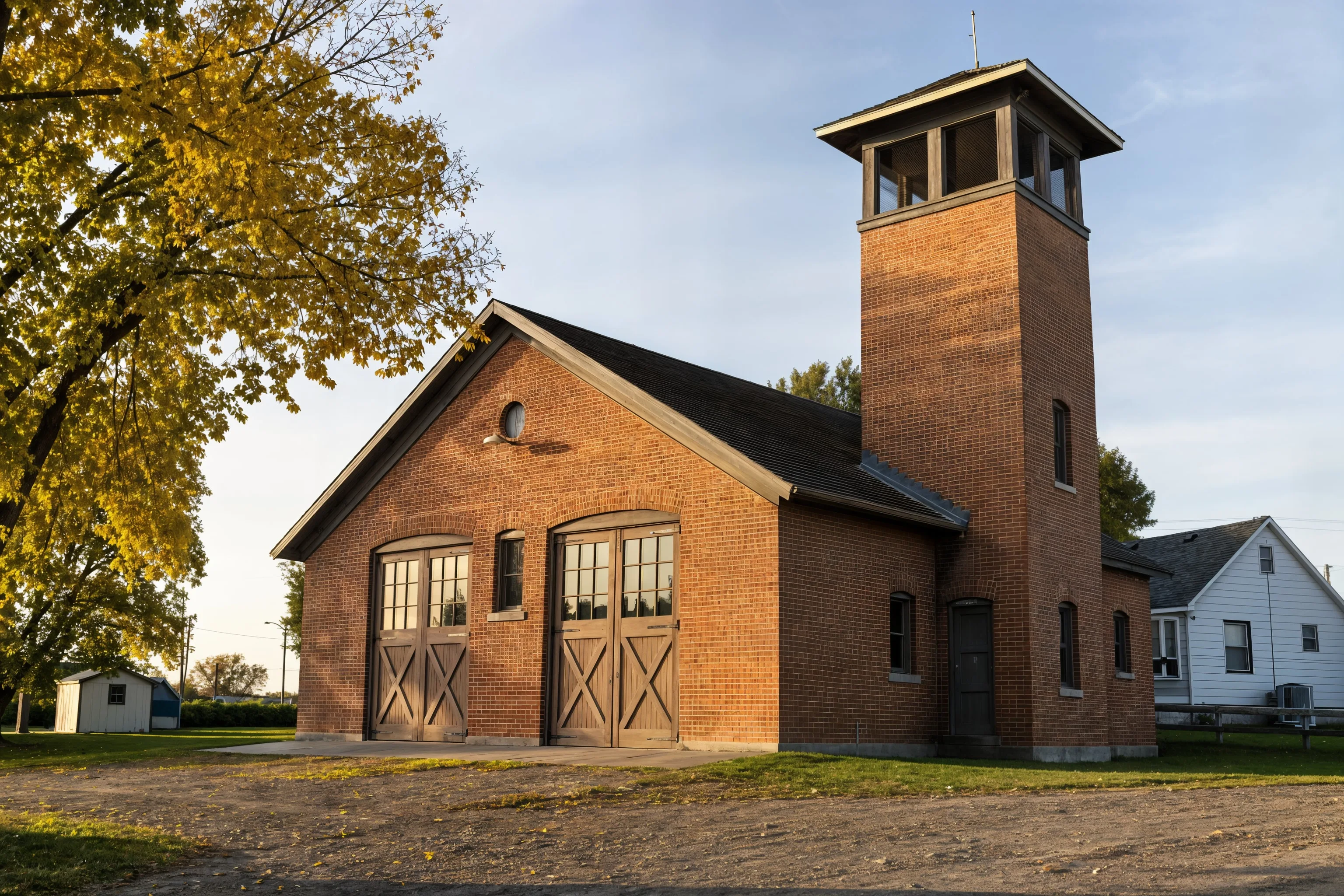
The Bashaw Fire Hall Museum tells a lot of that history in one building. It occupies the town's original 1914 fire hall and jailhouse, a structure that once held Robert Raymond Cook, the last man hanged in Alberta, a somber piece of the province's legal history that the museum treats with the seriousness it deserves rather than as a curiosity. Down the street, the Majestic Theatre is still part of local life. Outside town, the economy is straightforward: productive cropland and a diverse mix of livestock operations, the kind of properties where a power bill reflects real, year-round work rather than a single-family household pattern.
That combination, a farm-driven local economy and a valley setting close to Buffalo Lake's recreation draw, is exactly the kind of property mix we design for: in-town homes on modest lots, acreages with a shop, and working farms with grain handling and livestock infrastructure that never really stops drawing power.
FortisAlberta Wires Bashaw, and We Speak Their Process
Bashaw is confirmed FortisAlberta territory, per the Town of Bashaw's own utilities page, which points residents to FortisAlberta's line locate and service line at 310-WIRE. That single fact drives a lot of the paperwork on a solar project: your micro-generation interconnection application, any service upgrade request, and your bidirectional meter installation all route through FortisAlberta as the distribution service operator, not a municipal utility or a co-op.
Under Alberta's Micro-Generation Regulation, systems up to 150 kilowatts can connect to the grid and earn credit for the surplus power they send back. Your bill breaks into distribution charges, transmission charges, and an energy charge from your retailer, and a solar system offsets the energy you would otherwise be buying at the meter. Approval on a FortisAlberta micro-generation application typically takes two to six weeks once the application is complete and correct.
We prepare and submit that FortisAlberta application, along with the electrical permits and inspection paperwork, as part of every Bashaw install. You sign what needs your signature. We handle the rest, including the follow-up if FortisAlberta comes back with questions.
Three Bashaw Load Profiles We See on Bills
Camrose County's farm economy shapes what a Bashaw power bill looks like more than the town's small population does. Grain handling, livestock waterers, and shop heat run year-round on the properties outside town, while the in-town homes look more like anywhere else in Alberta. The ranges below are honest estimates from bills we see across the region. Your own 12-month usage history is what we actually size a system to.
The in-town home. A bungalow or older two-storey on one of Bashaw's residential streets, gas or electric heat, an average household draw. Bills typically run $150 to $300 a month. A 6 to 7 kilowatt roof system covers a solid share of that load across the year.
The acreage with a heated shop. Common on the edges of town and out into the county: a heated shop, a pressure system for the house, sometimes a stock waterer for a few head. Bills of $400 to $650 a month are typical, and a 9 to 12 kilowatt system, roof or ground, makes a real dent.
The working farm. Grain augers and drying fans at harvest, livestock waterers running through winter, a yard full of lights and a shop that never really cools down. Bills of $550 to $950 a month during the working season are common, and a 12 kilowatt or larger ground-mount system, sited on open south-facing yard, is usually where the payback case is strongest.
Open Farmland Means Snow and Wind Both Matter
Bashaw sits in a moderate-to-higher snow load and wind design zone typical of open Camrose County farmland. There is not much standing between a Bashaw yard and a stiff prairie wind, so racking and anchoring get engineered for that exposure specifically, not borrowed from a calmer, more sheltered site further south. Roof mounts tie into the trusses with flashed attachments, and we check the roof structure before quoting, since a farmhouse roof, a newer build, and a shop roof all carry load differently.
Hail is a real consideration on open cropland, and it is one reason we install LONGi panels, which are hail-rated to withstand 35mm stones at 97 km/h. Frost runs deep in this part of Alberta, so ground-mount piles and conduit are set well below the frost line as a rule of thumb, keeping freeze-thaw cycles from working anything loose over the years.
Snow cuts production on the days it sits on the glass, but a steeper tilt sheds it fast once the sun is back, and clear cold days push output per watt higher than a mild summer afternoon. We have installed well over 200 systems across Alberta, plenty of them on exposed farmland like this, and we spec equipment accordingly: LONGi panels, APsystems or Solis inverters, and racking rated for the load an engineer stamps.
What Solar Costs in Bashaw
Roof-mounted solar runs $2.25 to $2.85 per watt installed. A 6 to 8 kilowatt in-town system runs roughly $13,500 to $22,800 installed depending on the roof and equipment. Ground mounts run $2.50 to $3.50 per watt, reflecting trenching, piles, and racking, and they are usually the right call on farms and acreages with open, south-facing yard.
| Property profile | System size | Installed cost range | Est. first-year production |
|---|---|---|---|
| In-town home | 6-8 kW roof | $13,500 to $22,800 | About 7,700 to 10,200 kWh |
| Larger home or acreage home | 10-12 kW roof | $22,500 to $34,200 | About 12,800 to 15,300 kWh |
| Working farm with shop | 12-16 kW ground | $30,000 to $56,000 | About 15,300 to 20,400 kWh |
Production estimates use the NRCan modelled yield for Bashaw of 1,278 kilowatt-hours per kilowatt per year on a south-facing, latitude-tilt system, a solid figure for this part of central Alberta. FortisAlberta interconnection and permitting are included in the installed price, and travel from our Airdrie shop is grouped into scheduled Bashaw trip windows rather than billed as a solo run.
Payback depends on your usage and your retailer's rate, but for the load profiles above, a typical honest range runs roughly 9 to 13 years, against 25 to 30 years of panel life behind it. Farm and shop properties with the heaviest year-round draw tend to pay back fastest, since every kilowatt-hour the system generates is one that would otherwise be bought at full retail.
The Process, From a Bill to a Spinning Meter
Send Your FortisAlberta Bill
We start with the 12-month usage graph on your bill. It tells us your real consumption, your highs and lows, and the system size that actually fits your property.
Site Assessment in Bashaw
We walk the roof or the yard, check shading, panel or ground space, and your electrical service, and talk through roof-mount versus ground-mount options on site.
Design, Quote, and Interconnection
You get an itemized quote with a production estimate built on the local yield figure. We file the FortisAlberta micro-generation application and the electrical permits.
Install and Commission
Our crew installs racking, panels, inverter, and tie-in over one to three days. Inspection and the meter swap follow, and then the meter starts running back on sunny days.
The Drive Reality: Airdrie to Bashaw
Our shop is in Airdrie, just north of Calgary. Bashaw is roughly 165 kilometres away, about 145 minutes on the road. That is too far to send a crew for one small job, so we do not book Bashaw work that way.
Site assessments and installs are grouped into scheduled Bashaw trip windows. Several properties in the area get seen on the same run, materials are staged before we roll, and your install day gets booked around that plan. From signed quote to a commissioned, grid-connected system, the full process typically runs two to six weeks, with most of that time spent in permitting and the FortisAlberta interconnection queue rather than labour on your roof or yard.
Whether you are in town, out toward Buffalo Lake, or further into Camrose County farmland, we run it the same way: one visit, one plan, one crew that knows this snow zone and FortisAlberta's paperwork.
Frequently Asked Questions
Get a Solar Design for Your Bashaw Property
Send a recent FortisAlberta bill and we will come back with an honest assessment: system size, cost range, and what solar can realistically do for your property. No pressure, no brochure numbers.
Also Serving Nearby Communities