
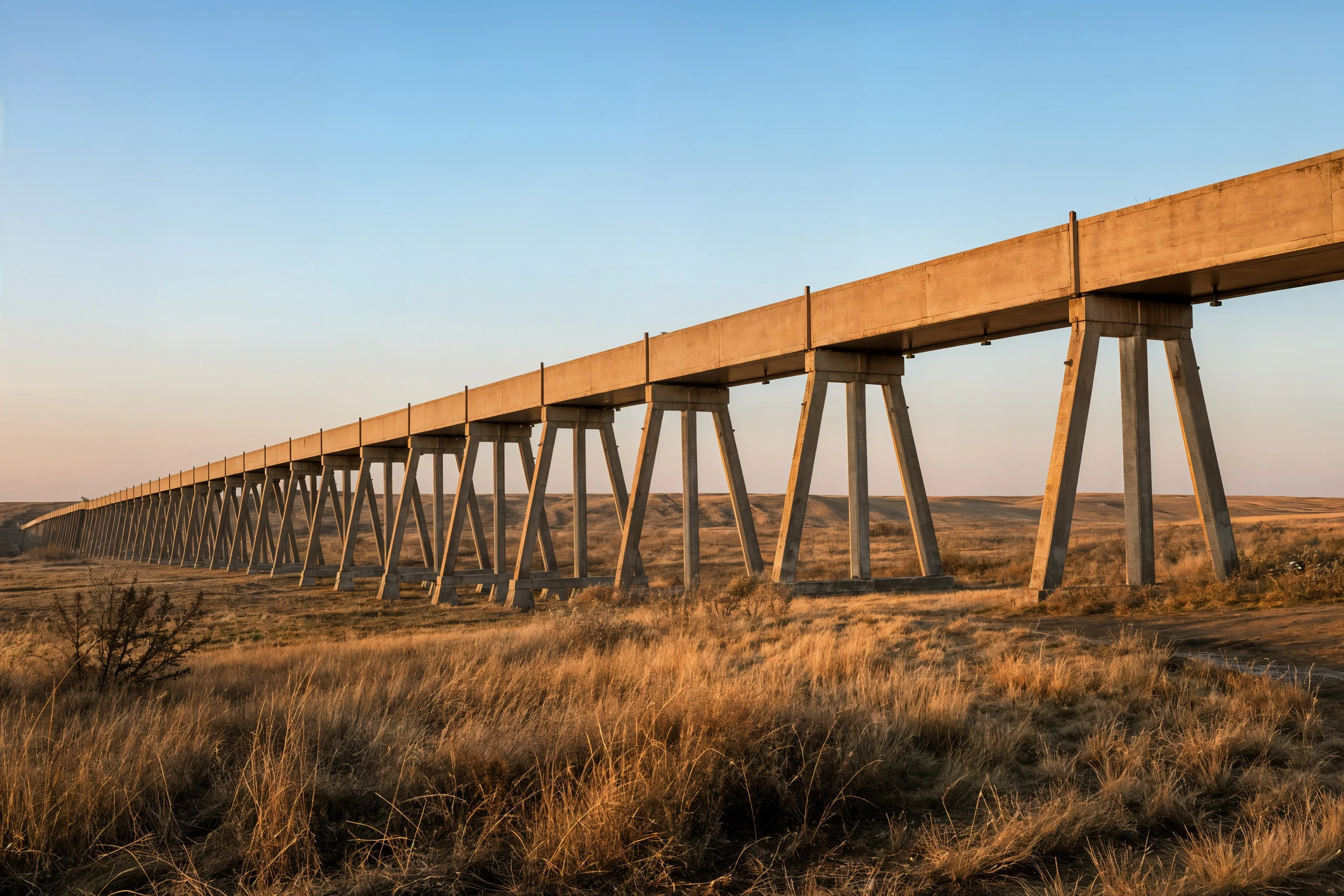
The Aqueduct, the Beef Plant, and Brooks' Solar Numbers
Southeast of town, a 3.2 kilometre reinforced-concrete flume rises about 20 metres above the open prairie, a structure the Canadian Pacific Railway built between 1912 and 1915 to carry irrigation water across the valley. The Brooks Aqueduct was once the largest concrete structure of its kind in the world, and it is now a National and Provincial Historic Site, a reminder that this stretch of southeastern Alberta has been engineered for water and sun longer than almost anywhere else in the province.
Brooks itself grew up around that irrigation push: incorporated as a village on July 14, 1910, a town by September 8, 1911, and a city on September 1, 2005. It remains its own municipality, geographically surrounded by but separate from the County of Newell; a 2019 proposal to study amalgamating Brooks with the Town of Bassano and the county was reviewed and then withdrawn by the County of Newell that September, and the three have stayed independent since. The 2021 Census counted 14,924 people, up from 14,451 in 2016, a city still growing on the strength of irrigated agriculture and the JBS Foods Canada beef plant, Canada's second-largest beef processing facility, which employs more than 2,000 people just outside town.
None of that history changes the physics, and the physics favour Brooks. At 50.564 degrees north, this is meaningfully further south than most Alberta towns we serve, and the Brooks weather station itself, not a proxy station hours away, measured about 2,329 hours of bright sunshine a year in its long-run normals. Natural Resources Canada's modeled yield for a south-facing roof here is 1,352 kilowatt-hours per kilowatt of panels annually, genuinely one of the strongest solar resources in the province.
FortisAlberta Wires Brooks, and We Handle Their Process
Brooks being an independent city sometimes leads people to assume it runs its own power utility the way a couple of other Alberta cities do. It does not. FortisAlberta holds the electricity distribution franchise agreement with the City of Brooks, confirmed in a January 2026 AUC franchise fee filing, and the same company wires the acreages and irrigated farmland across the County of Newell around it. One utility, one process, whether your property sits inside city limits or out past the Eastern Irrigation District canals.
Under Alberta's Micro-Generation Regulation, systems up to 150 kilowatts can connect to the grid and export surplus power for credit through the meter. Your FortisAlberta bill separates distribution, transmission, and the energy charge from your retailer; solar offsets the energy portion first; and the micro-generation application, typically approved in two to six weeks, is what makes the export credit possible in the first place.
We file that application, the electrical permit, and the inspection paperwork on every Brooks project. You sign a handful of forms, we handle the rest, and once the bidirectional meter goes in, sunny prairie days start working in your favour.
Three Brooks Load Profiles We See on Bills
Brooks bills tend to run one of a few directions, and irrigation-district agriculture and the beef plant's shift schedules both leave a mark on local usage. The ranges below are honest estimates; your 12-month FortisAlberta history is what actually sizes a system.
The in-town family home. A bungalow or two-storey near downtown or the newer subdivisions, central air running through hot prairie summers, typical bills of $180 to $350 a month. A 6 to 8 kilowatt roof system, producing roughly 8,100 to 10,800 kilowatt-hours a year at Brooks' yield, covers most of that.
The acreage near the irrigation district. Properties out toward Lake Newell or along the canals often carry a heated shop, a pressure system, and sometimes stock water. Bills of $400 to $700 a month are common, and a 10 to 14 kilowatt system, roof or ground, makes a serious dent in that.
The grain and hay operation. Wheat and alfalfa have been grown here since the district's irrigation infrastructure went in, and grain augers, yard lights, and irrigation pumps add up. Bills of $600 to $1,000 a month during the growing season are not unusual, and a 15-kilowatt-plus ground mount is often where the payback math is strongest.
Wind, Snow, and What Holds the Panels Up
Brooks sits on open southern Alberta prairie with very little to break the wind, so racking here is engineered for a higher wind load than we would spec in a sheltered valley. That is a bigger design factor around Brooks than snow: winters bring a moderate snow load compared to the foothills or the mountains, and what does accumulate tends to clear quickly once the wind and the strong Brooks sun get at it.
Hail is the other prairie reality worth planning for, and it is one reason we install LONGi panels rated to withstand 35 millimetre hailstones at 97 kilometres an hour, backed by a 25-year product warranty. Cold, clear days actually raise panel output per watt, so winter is not the write-off people assume.
We spec APsystems microinverters, carrying a 25-year warranty, for most homes and acreages, and Solis inverters for larger farm and shop strings, matched to racking rated for the wind and snow load an engineer stamps for the site.
What Solar Costs in Brooks
Roof-mounted solar runs $2.25 to $2.85 per watt installed. A 6 to 8 kilowatt in-town system runs roughly $13,500 to $22,800 installed depending on the roof and equipment. Ground mounts, common on acreages and farmsteads around Brooks, run $2.50 to $3.50 per watt to cover trenching, piles, and heavier racking.
| Property profile | System size | Installed cost range | Est. first-year production |
|---|---|---|---|
| In-town bungalow or family home | 6-8 kW roof | $13,500 to $22,800 | About 8,100 to 10,800 kWh |
| Larger home or acreage home | 10-12 kW roof | $22,500 to $34,200 | About 13,500 to 16,200 kWh |
| Acreage or farm operation with shop | 12-16 kW ground | $30,000 to $56,000 | About 16,200 to 21,600 kWh |
Production estimates use Natural Resources Canada's 1,352 kilowatt-hour per kilowatt per year modeled yield for Brooks, among the strongest solar resources we quote anywhere in Alberta. FortisAlberta interconnection and permitting are included in the installed price, and travel from Airdrie is grouped into scheduled Brooks trip windows rather than billed as a solo run.
Payback depends on your usage and your retailer's rate, but across the profiles above, a typical honest range runs roughly 8 to 12 years, on the faster side of what we see province-wide because Brooks' sun numbers are simply stronger, with 25 to 30 years of panel life behind that.
The Process, From a Bill to a Spinning Meter
Send Your FortisAlberta Bill
We start with the 12-month usage graph on your bill. It tells us your real consumption and the system size that actually fits.
Site Assessment in Brooks
We walk the roof or the yard, check shading, wind exposure, and your service, and talk through roof-mount versus ground-mount on site.
Design, Quote, and Interconnection
You get an itemized quote with a production estimate built on Brooks' own sun numbers. We file the FortisAlberta micro-generation application and electrical permits.
Install and Commission
Our crew installs racking rated for the local wind load, panels, inverter, and tie-in over one to three days. Inspection and meter swap follow, and the meter starts running backward.
The Drive Reality: Airdrie to Brooks
Our shop is in Airdrie, just north of Calgary. Brooks is roughly 210 kilometres away, about a two hour forty-five minute drive. It is far enough that we do not send a truck out for a single service call.
Site assessments and installs around Brooks are grouped into scheduled trip windows. Several properties get seen on the same run, materials are staged before we roll, and your install day is booked around that plan. From deposit to commissioning, the full process typically runs two to six weeks, most of it permitting and the FortisAlberta queue rather than labour on your roof.
Whether you are in town, out toward Lake Newell and Kinbrook Island, or farming irrigation-district land in the county around it, we cover the area the same way: one visit, one plan, a crew that already knows Brooks' wind, sun, and FortisAlberta paperwork.
Frequently Asked Questions
Get a Solar Design for Your Brooks Property
Send a recent FortisAlberta bill and we will come back with an honest assessment: system size, cost range, and what Brooks' strong sun numbers can realistically do for your property. No pressure, no brochure numbers.
Also Serving Nearby Communities