
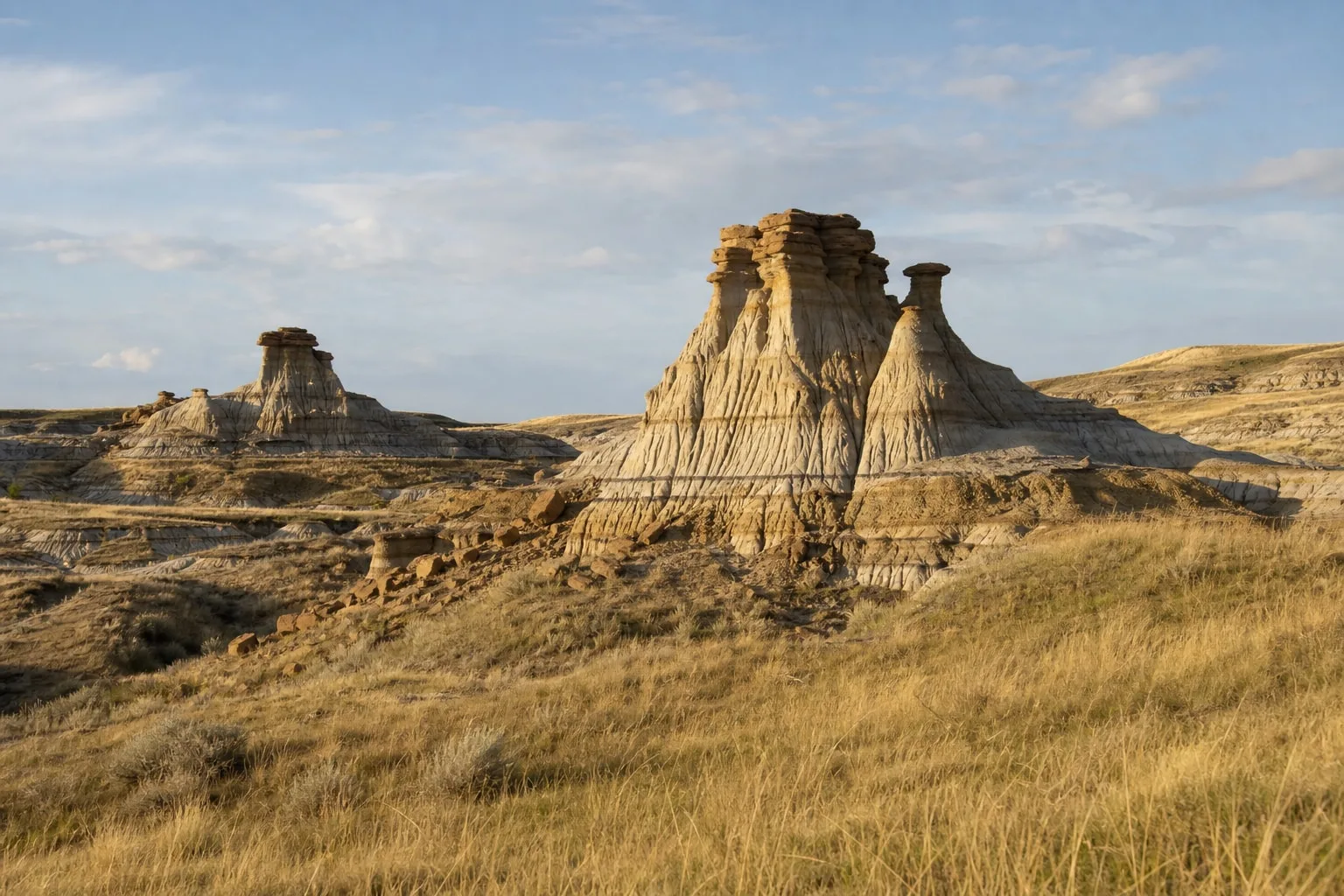
One of the Sunniest Corners of Alberta
Brooks sits at roughly 50.56 degrees north latitude on the dry mixed grass prairie of Palliser's Triangle. It is one of the most reliable solar locations in the province. Environment Canada's climate normals for Brooks record about 2,329 hours of bright sunshine per year, with July averaging over 330 hours. That sunshine series comes from the Environment Canada Brooks station normals; note that bright sunshine is no longer published in the newest 1991 to 2020 normals, so the long-record station reading remains the honest figure to use.
The semi-arid climate cuts both ways in your favour. Annual precipitation averages around 300 millimetres, and annual snowfall near Brooks is roughly 95 centimetres according to Environment Canada 1991 to 2020 normals, far less than central or northern Alberta. Less cloud cover means more production per panel. Less snow on tilted panels means fewer snow-covered mornings. A fixed-tilt array near Brooks will typically produce on the order of 1,300 to 1,400 kilowatt-hours per installed kilowatt per year, which is at the top of the range we see anywhere in our service territory.
Wind is the other half of the local climate. The county sits in open prairie with few windbreaks, so every racking system and rooftop attachment we install is engineered to the Alberta Building Code wind loads for the specific site, not a generic southern Alberta number.
FortisAlberta Wires, Straightforward Interconnection
Every property we serve in the County of Newell, from Brooks and Bassano to Duchess, Rosemary, Tilley, Rolling Hills, Scandia, and Patricia, is on FortisAlberta distribution service. That is a useful fact for your project. Alberta's Micro-generation Regulation lets any FortisAlberta customer connect a solar system up to their service capacity, export surplus power, and receive a credit on the wire-owner's bill. You do not need your retailer's permission, and you do not need to switch contracts.
What you do need is a complete application: a single-line diagram, equipment specs, site sketch, and a Certificate of Recognition from the installer. We prepare and submit all of it. FortisAlberta reviews the application, approves the interconnection, and swaps your meter for a bi-directional unit. From a complete application, the approval window typically runs two to six weeks, which runs in parallel with the county development permit and the electrical permit.
One local wrinkle worth knowing: rural FortisAlberta bills carry meaningful delivery charges and riders alongside the energy charge, and the credit you earn for exported power does not offset all of those line items dollar for dollar. That is why we size county systems around self-consumption first, using your actual 12-month billing history, rather than chasing maximum export.
An Economy Built on Irrigated Power
The County of Newell runs on water moved uphill by willpower and engineering. The Eastern Irrigation District, headquartered in Brooks and farmer-owned since 1935, delivers water to roughly 300,000 irrigated acres. Its infrastructure reads like a list of local landmarks: the Bassano Dam on the Bow River, the Lake Newell reservoir, and the Brooks Aqueduct, built by the Canadian Pacific Railway between 1912 and 1914. When it opened, the aqueduct was the largest structure of its kind in the world, a concrete flume carried on more than a thousand columns across a 3.2 kilometre valley. It was retired in 1979 and is now a National Historic Site overlooking Kinbrook Island Provincial Park on Lake Newell.
That irrigation backbone shapes the electrical load in the county. Centre-pivot pumps run on three-phase power and spike hard from June through August. Feedlots and the JBS Canada beef processing plant in Brooks anchor a livestock sector with constant ventilation, heating, and refrigeration demand. Add acreages with wells, shops, and outbuildings, plus a town of nearly 15,000 in Brooks, and you get one of the most electrically diverse rural service areas in southern Alberta.
Diversity is good for solar, but only if the system matches the load. A pivot-heavy farm, a feedlot, and a town bungalow in Brooks need three different designs, three different sizes, and three different payback conversations. That is exactly how we quote them.
Local Load Profiles We Design Around
Irrigation Farm
Centre-pivot pumps, shop welder, yard loads. Typical FortisAlberta farm bills run roughly $1,500 to $4,000 per month in peak irrigation months, based on our estimates for electric pumping setups. Solar shines here because production peaks exactly when the pivots run. Systems of 25 to 60 kW on the shop roof or as a ground mount are common, sized to daytime loads rather than maximum export.
Feedlot or Livestock Barn
Ventilation fans, heated waterers, feed processing, and lighting run around the clock. Monthly bills of roughly $800 to $2,500 are typical estimates for mid-size operations. Solar offsets the daytime slice directly, and a battery-ready hybrid inverter can keep critical fans and waterers running through outages. Systems from 20 to 50 kW are the usual range.
Acreage Home and Shop
A rural home with a well, septic lift, freezer, and a heated shop typically draws enough to justify 8 to 15 kW. Bills in the $250 to $600 per month range are our estimate depending on heating fuel and shop use. These systems are usually ground mounts aimed due south, or rooftop arrays on newer homes with sound trusses.
Town Bungalow in Brooks
City-serviced homes with gas heat often land between $120 and $280 per month. A 6 to 8 kW rooftop system covers most of that usage through the year. Rooftop mounting at $2.25 to $2.85 per watt keeps the entry cost low, and Brooks' strong sun hours make even modest systems productive.
What It Costs in the County of Newell
Our pricing is quoted per watt, as a range, because every site differs. Rooftop systems run $2.25 to $2.85 per watt installed. Ground mounts run $2.50 to $3.50 per watt. Worked examples, spanning the range honestly: a 6 to 8 kW rooftop system on a Brooks bungalow runs roughly $13,500 to $22,800 installed depending on the roof and equipment. A 10 kW acreage system runs roughly $22,500 to $35,000 depending on roof versus ground mount. A 25 kW farm ground mount runs roughly $62,500 to $87,500 before any financing structure.
Panels carry 25-year linear output warranties, and we install LONGi 440 to 600 watt modules with APsystems DS3-series microinverters or Solis string inverters depending on the site. Inverters are the wear item in any system, with typical service lives of 10 to 15 years, and we plan for that in the quote rather than pretending otherwise.
| Property Type | Typical Size | Installed Cost Range | Est. Annual Production | Notes |
|---|---|---|---|---|
| Town bungalow, Brooks | 6 to 8 kW rooftop | $13,500 to $22,800 | Roughly 8,000 to 11,000 kWh | Best value per watt; simple permitting in the city |
| Acreage home and shop | 10 to 15 kW ground or roof | $25,000 to $50,000 | Roughly 13,000 to 20,000 kWh | County setback check for ground mounts |
| Irrigation farm | 25 to 60 kW | $62,500 to $210,000 | Roughly 33,000 to 80,000 kWh | Three-phase service and transformer review required |
Production figures are estimates for a fixed-tilt array near Brooks using the local sun hours described above. Cost ranges use our standard per-watt pricing; your quote reflects your actual site, equipment, and electrical work. No incentives are assumed in any figure on this page.
Payback Reality for FortisAlberta Customers
Under recent FortisAlberta rate conditions, a well-matched county system typically pays back in roughly 10 to 15 years, and sometimes sooner on irrigation farms where solar directly displaces peak-month pumping costs. Panels carry 25-year production warranties, so a system that pays back in year 12 still delivers a decade or more of effectively prepaid power. Those are honest ranges, not promises: the real number comes from your actual bills, your rate schedule, and how much of your production you use on site.
We build the payback model with you, line by line, before you sign anything. If the numbers do not work for your property, we will tell you that too.
From Airdrie to Your Yard: How Distance Works
Range Road Solar is based in Airdrie, about 200 kilometres from Brooks via Highway 1, roughly a two hour drive depending on conditions. We are open about that distance because it shapes how we schedule, not whether we show up. Site assessments in the County of Newell are booked in clusters, so we are in the area on set days rather than billing you for scattered solo trips.
Install crews make the same trip with materials staged in advance. The two to six week timeline from contract to commissioning already accounts for the travel, the county permit, and the FortisAlberta interconnection review running together. In practice, county installs move at the same pace as our closer work.
And the distance works in one more way: Brooks-area sun hours are among the best we serve, so every panel you install here produces more than the same panel would closer to our shop. Production, not proximity, is what you are paying for.
The Installation Process
Bill Review
Send us 12 months of FortisAlberta bills. We map your monthly usage, demand, and rate riders to see what solar can realistically displace.
Site Assessment
We visit the property: roof structure or ground conditions, shading, transformer and service capacity, and county setback rules for ground mounts.
Design and Quote
You get a system layout, an honest production estimate using Brooks-area sun data, and a fixed per-watt price with the full range explained.
Permits and Interconnection
We file the County of Newell development permit, the electrical permit, and the FortisAlberta micro-generation application together.
Installation
Crews install racking engineered for local wind, snow, and frost conditions, the panels, inverters, and electrical tie-in. Licensed electricians do the wiring.
Commissioning
Inspection, meter swap, and energizing. Your system starts earning against your bill, and we walk you through monitoring.
Where We Work in the County
We install across the whole county: the City of Brooks, the villages of Bassano, Duchess, Rosemary, and Tilley, and the hamlets of Rolling Hills, Scandia, and Patricia, plus the farm and acreage parcels between them and the Lake Newell area. Rural properties are most of what we do, and county ground-mount and farm projects are core work for our crews, not a sideline.
Range Road Solar has completed hundreds of installs across Alberta, and we bring the same engineered approach to a Bassano farmyard that we bring to any site in the province.
Frequently Asked Questions
Get a County of Newell Solar Assessment
Send your last FortisAlberta bill and we will tell you, honestly, whether solar pencils out for your farm, acreage, or Brooks home. No pressure, no inflated projections.
Also Serving Nearby Communities