
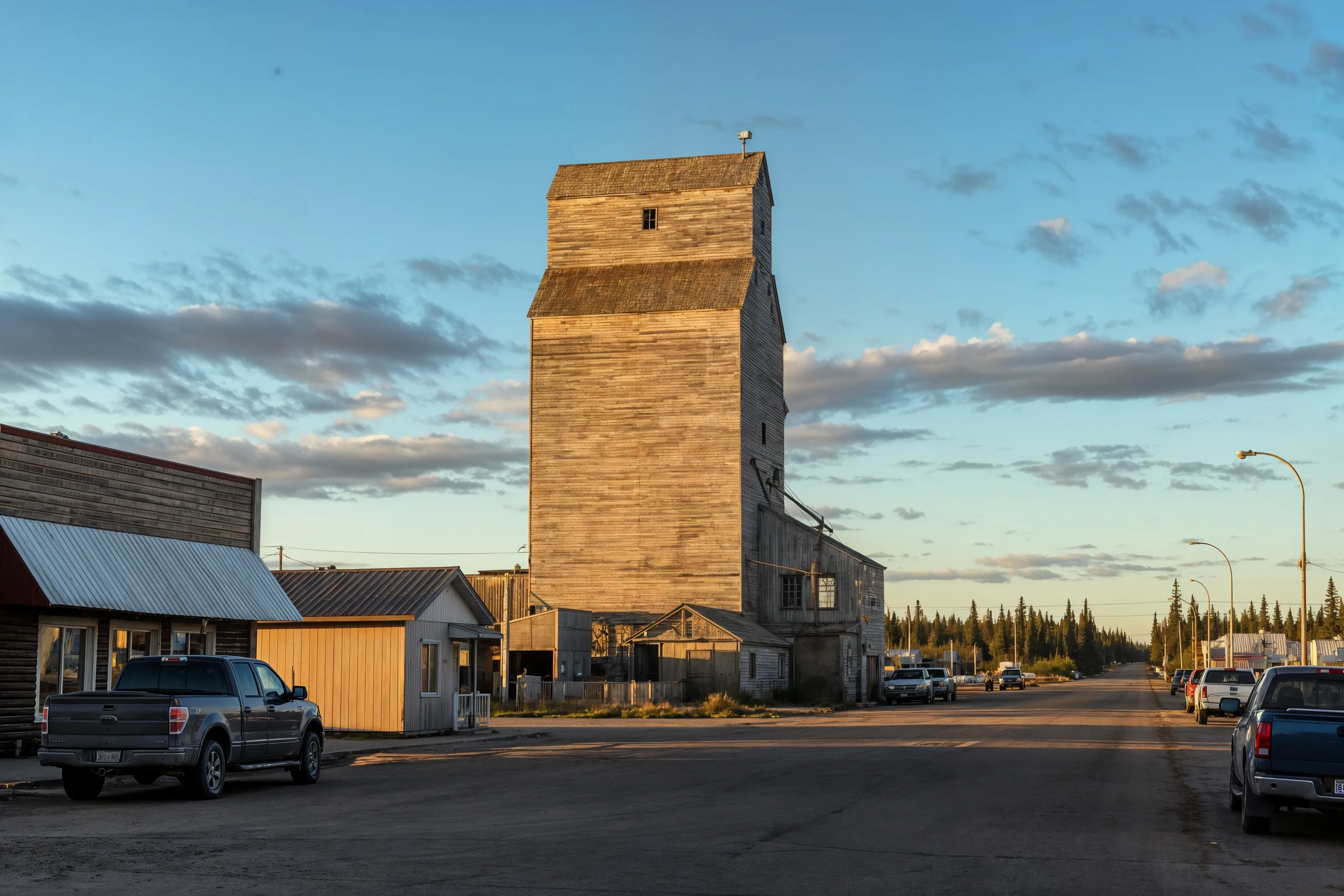
What Solar Looks Like at 58.5 North
High Level is the last real service centre on the Mackenzie Highway before the Northwest Territories, sitting where Highway 35 meets Highway 58 in Mackenzie County. The town's name comes from the height of land that separates the Peace and Hay river watersheds, and the community that grew there after 1947 now serves a trading area of roughly 20,000 people, from Rainbow Lake and Zama City oilfield crews to the grain farmers whose deliveries keep the most northerly grain elevator in Canada busy. It is also one of the fastest-growing towns in Alberta: the 2021 census counted 3,922 residents, up 24.2 percent from 3,159 in 2016.
Solar here behaves differently than it does around Calgary or Edmonton, and that difference is the whole story. At 58.5 degrees north the summer sun barely sets, and Environment Canada's climate normals for the High Level airport station show June averaging 298 hours of bright sunshine. A south-facing panel tilted at latitude keeps producing until late evening in June and July, which is why Natural Resources Canada's municipal dataset puts High Level's annual photovoltaic potential at about 1,161 kWh per kWp, a figure that surprises people who assume the north is a poor solar resource.
The other half of the equation is consumption. January at the High Level airport station averages a daily mean of minus 19.8 degrees, and properties out on acreages in Mackenzie County face heating seasons even longer than the town's. Many homes run electric plenum heaters or boilers with wood backup, and that pushes winter bills far above the Alberta average. Solar will not fix a January bill, but it turns your long, bright summer into credit on your power account that works against those deep-winter months. For grid-tied properties the economics are straightforward; for off-grid-adjacent acreages, solar paired with a generator can meaningfully cut fuel runs into town.
Bills We See Around High Level
Every property is different, but these three profiles cover most of the systems we design this far north. Ranges are hedged on purpose: fuel mixes, insulation, and thermostat habits move real numbers more than any estimate can.
Townsite home on electric heat
A 1,100 to 1,400 square foot home inside High Level with an electric plenum heater, often with a wood stove taking the edge off in January. Winter bills commonly run $350 to $550 a month from December through February, then drop to $120 to $180 in July and August. Annual usage of 18,000 to 24,000 kWh is typical, and a 10 to 12 kW system covers most of a year like that.
Mackenzie County acreage with a shop
A home and heated shop north or west of town, with block heaters, a welder, maybe a pressure washer or compressor on weekends, and electric heat as the primary source with wood backup. January and February bills of $600 to $900 are common, and we have seen them past $1,000 in a cold snap with electric backup running hard. These properties usually need 14 to 20 kW, and ground mount is almost always the better fit.
Oilfield or trucking yard on the corridor
High Level exists because of the Mackenzie Highway, and a lot of local business is servicing Rainbow Lake, Zama City, and the NWT traffic that rolls through. A yard with a heated shop, crane, office trailers, and several trucks on block heaters can pull $2,000 to $5,000 a month in the depths of winter. For these we design 25 kW and up, sized against 12 months of interval data, not a single scary bill.
Cost and Payback Honest Numbers for This Far North
Our installed pricing in High Level runs the same per-watt ranges as the rest of Alberta, plus a stated mobilization line for the distance: roof-mount systems at $2.25 to $2.85 per watt, and ground-mount systems at $2.50 to $3.50 per watt. Ground mount costs more here for a reason that matters: northern snow loads demand real engineering in the racking, and High Level averages about 154 centimetres of annual snowfall at the airport climate station, so posts, rails, and foundations are not where we cheap out.
A worked example, using the range honestly. A 10 kW ground-mount system for an acreage west of town comes in between $25,000 and $35,000 installed, mobilization included in the quote. At the NRCan figure of 1,161 kWh per kWp, that system produces roughly 11,600 kWh a year. With ATCO Electric all-in residential rates commonly landing in the mid-teens to high-teens cents per kWh depending on your retailer and riders, that production is worth about $1,800 to $2,100 a year against your bill. Simple payback lands around 13 to 18 years before any rate increases, which is longer than southern Alberta and we will tell you that on the phone rather than pretend otherwise. What shortens it is a big winter load, a high fixed portion on your bill, and every rate cycle that pushes power costs up.
| System | Installed range | Annual production | Est. annual savings | Rough payback |
|---|---|---|---|---|
| 8 kW roof-mount, town home | $18,000 to $22,800 | about 9,300 kWh | $1,450 to $1,750 | 12 to 15 years |
| 10 kW ground-mount, acreage | $25,000 to $35,000 | about 11,600 kWh | $1,800 to $2,100 | 13 to 18 years |
| 20 kW ground-mount, farm or yard | $50,000 to $70,000 | about 23,200 kWh | $3,600 to $4,300 | 12 to 17 years |
Savings assume the NRCan latitude-tilt yield for High Level and all-in rates in the 16 to 19 cent per kWh range; your bill decides the real number. Every quote we write for High Level shows the mobilization cost as its own line so you can see exactly what the distance adds and what it drops to when projects are bundled.
ATCO Electric, Not FortisAlberta: Interconnection in High Level
This is the detail most out-of-province solar websites get wrong, so we want to be explicit: High Level is ATCO Electric territory. The Town of High Level's electric distribution franchise agreement is with ATCO Electric Ltd., renewed under Alberta Utilities Commission Decision 2013-045, which granted ATCO Electric the exclusive right to distribute power in town. FortisAlberta's service area stops hundreds of kilometres south of here. Your retailer's name on the bill may vary, but the wires, the meter, and your micro-generation application all belong to ATCO Electric.
Under Alberta's Micro-Generation Regulation, systems up to 150 kW connect with a standard approval process. We prepare the application, single-line diagram, and site details, then submit to ATCO Electric on your behalf. Approval typically takes two to six weeks for a straightforward townsite connection, and can run longer where a rural feeder needs review. Once approved and inspected, your meter runs both directions: exports in June and July build the credits that carry you through a December where the sun is up for barely six hours.
How a Remote Install Actually Runs
We are based in Airdrie, and High Level is roughly 1,000 kilometres and about ten and a half hours of driving north, basically the whole length of Highway 2. That distance changes how we schedule, and we would rather tell you now than surprise you later. Remote projects here work in one of two ways: we bundle your install with other Peace Country work and drive a crew and truck up for a scheduled window, or for the right project we fly into High Level Airport, which has scheduled flights to Edmonton, and stage materials ahead of time. Either way, nothing gets committed until design, permits, and the ATCO Electric application are already moving.
Bill review by phone or email
Send a photo or PDF of a recent bill with the 12-month usage graph. From our shop near Airdrie we can size the conversation before anyone burns fuel heading north.
Site assessment
For townsite homes we can often assess by video call and satellite imagery. For acreages, farms, and yards we schedule an in-person visit, coordinated with other northern work where possible.
Design and honest quote
You get a layout, production estimate using the NRCan yield for High Level, and a cost summary with mobilization shown as its own line. What you will not get is a payment-plan pitch or pressure.
ATCO Electric application and permits
We file the micro-generation application with ATCO Electric and handle the Safety Codes permits. Approval typically takes two to six weeks.
Materials and install window
Equipment ships ahead or travels with the crew. Panels, racking engineered for northern snow, inverters, and electrical work are installed by licensed electricians in one scheduled trip.
Inspection and commissioning
The authority having jurisdiction inspects, ATCO Electric confirms connection, and your system starts banking summer credits against winter usage.
The bundling effect is real: when two or three properties in the Peace Country commit together, everyone's mobilization cost drops. Ask about other projects in the area when you call.
High Level Solar Questions, Answered Straight
See what our clients say
Real reviews from Alberta homeowners and farmers.
Get a Free Solar Assessment
We serve High Level and the Peace Country. No obligation.
Also Serving Nearby Areas
Ready to See Your Numbers?
Send a recent power bill and we will tell you plainly what a system can produce at your property near High Level, what it costs with northern mobilization included, and whether the math works. If it does not, we will say that too.