
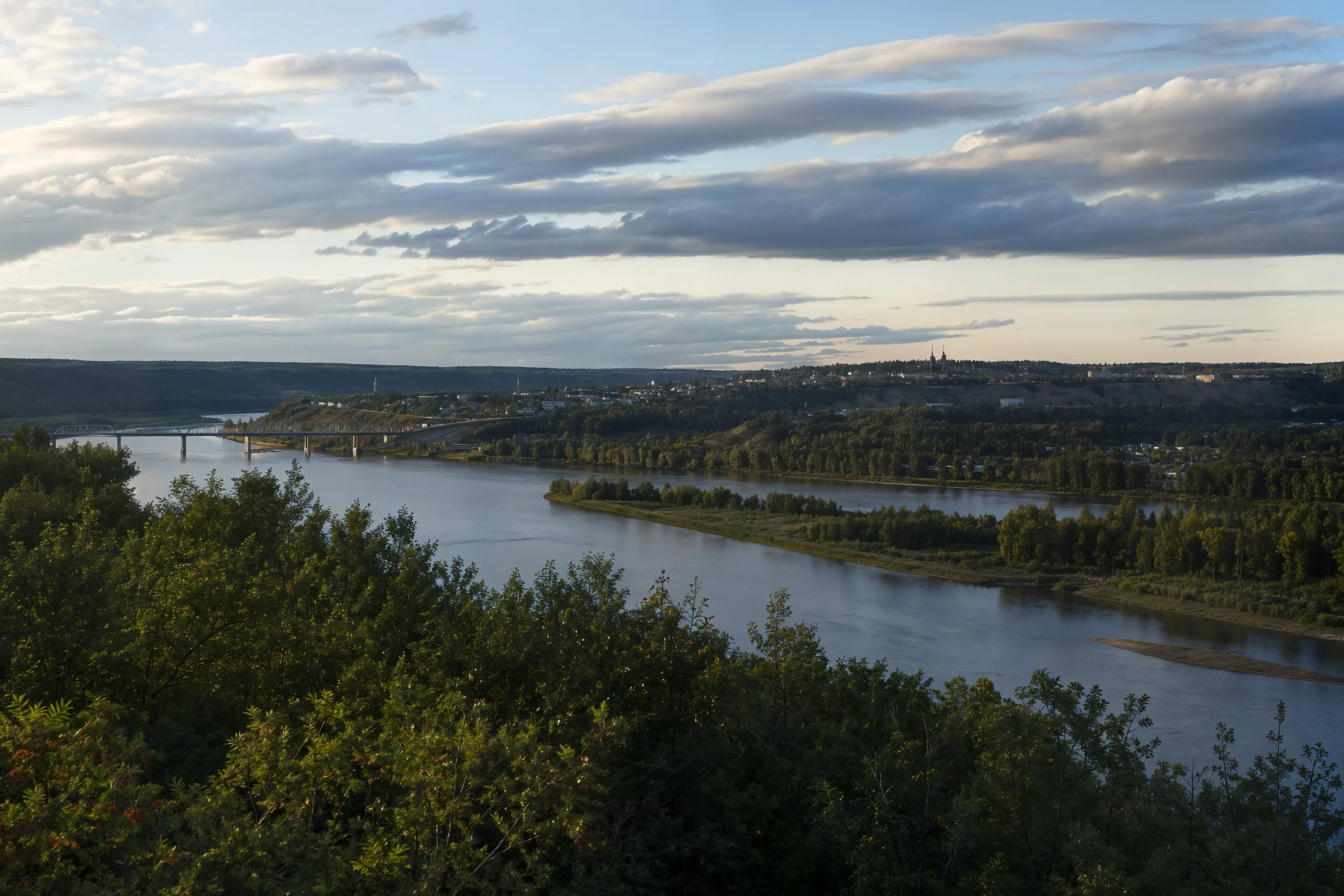
Why Solar Fits the Town at the Confluence
Peace River is one of the northernmost towns in Alberta, sitting in a deep river valley where the Smoky River and the Heart River join the Peace, roughly 486 kilometres northwest of Edmonton on Highway 2. The 2021 Census counted 6,619 residents, down modestly from 6,842 in 2016, and the town anchors a trading area of well over 15,000 people across the MD of Peace No. 135 and Northern Sunrise County. This is a working northern economy: oil and gas activity, the Peace River Pulp Mill about 25 kilometres east of town, grain and cattle operations across the Peace Country, and the services that support all of it. That mix means steady daytime power consumption, which is precisely what a grid-tied solar array offsets best.
The latitude that defines Peace River shapes its solar resource in a way most of the province does not experience. On the summer solstice the sun is above the horizon for 17 hours and 41 minutes, and Environment Canada records an average of about 2,060 hours of bright sunshine a year at the Peace River airport station. Those long, frequently clear summer days are when a solar array does its heaviest lifting, and they arrive exactly when farms are running aeration fans, shops, and yard loads. The tradeoff is real: by the winter solstice the town sees under seven hours of daylight, and December production is a small fraction of June's. Alberta's micro-generation framework was built for this shape of load, letting you bank summer surplus as credits that carry your electrically heated home through the dark months.
Winter here is not an abstract concern. National Building Code data for Peace River lists about 6,050 heating degree days a year and a January design temperature of minus 37 degrees Celsius, which is why northern homes that heat with electricity can see winter bills two or three times their summer ones. A well-sized system will not eliminate a January bill at 56 degrees north, but it converts your best sunshine months into a running credit balance and locks in a predictable cost for a quarter century of production. For the farms and acreages along the Shaftesbury Trail and west toward Grimshaw, where there is open land, big loads, and room for a properly tilted ground mount, the case is often stronger than it is in town.
Three Peace River Properties We Design For
Every design starts with the 12-month usage graph on your power bill, because at this latitude the shape of your consumption matters as much as the total. These three composite profiles cover most of what we see between town and the surrounding county; the bill ranges are realistic for ATCO Electric delivery territory but yours may sit outside them, which is exactly why we ask for the bill first.
The Valley Home with Electric Heat
A 1970s or 1980s split-level or bungalow in town, heated with baseboard electric or an electric furnace, maybe a wood stove doing part of the work. Winter bills of $250 to $450 a month are common, dropping to $90 to $140 in July and August. A 7 to 9 kW roof array sized to the summer and shoulder months will not erase January, but it routinely offsets 60 to 75 percent of the annual total and converts the expensive months into credit carry-forward months.
The Working Peace Country Farm
Grain, cattle, or mixed operation west of town along Highway 2 or out the Shaftesbury Trail, with bin aeration fans, a heated shop, yard lights, and often a separate service for the farmyard. Monthly bills of $600 to $1,200 in fan and shop season are typical, and these properties often carry three-phase service. Ground mounts of 15 to 40 kW are common here, and the design work focuses on service capacity, voltage rise on long rural lines, and interconnection details that a town install never touches.
The River Valley Acreage
A newer home on an acreage south or east of town with a well pump, septic pump, detached garage or shop, and sometimes a hot tub, EV, or both. Winter bills run $200 to $350 a month with a quieter shoulder season. These sites usually have the land for a ground mount placed clear of the treed shelterbelts, and they tend to land in the 8 to 12 kW range. Pump and shop loads run through the day, which lines up well with solar production and improves self-consumption.
What Solar Costs in Peace River
Our installed pricing for Peace River projects lands where it does for the rest of Alberta, with one honest difference: at roughly 630 kilometres from our Airdrie shop, mobilization is a real cost, and we build it into the quote plainly rather than pretending otherwise. Roof-mounted systems run $2.25 to $2.85 per watt installed. Ground-mounted systems, with racking, deeper anchors for frost, and trenching, run $2.50 to $3.50 per watt. Every quote itemizes equipment, labour, permits, interconnection, and the travel line, and we bundle northern installs together wherever scheduling allows so that travel is shared across neighbouring projects.
A worked example using the range honestly: an 8.5 kW roof system at $2.25 to $2.85 per watt costs $19,125 to $24,225 installed. At the NRCan Edmonton-area yield figure of roughly 1,180 kWh per kWp, that array produces on the order of 10,000 kWh a year. With ATCO Electric delivery included, Peace River customers typically pay 17 to 20 cents all-in per kWh, so the annual offset runs about $1,700 to $2,000. That puts simple payback in the 10 to 14 year range on panels warranted for 25 to 30 years, with no financing pitch attached: if the numbers do not stand on their own for your property, we will say so.
| System | Installed cost range | Est. annual production | Est. annual savings | Simple payback |
|---|---|---|---|---|
| 6 kW roof, town home | $13,500 to $17,100 | ~7,100 kWh | $1,200 to $1,400 | 10 to 14 years |
| 8.5 kW roof, valley home | $19,125 to $24,225 | ~10,000 kWh | $1,700 to $2,000 | 10 to 14 years |
| 12 kW ground, acreage | $30,000 to $42,000 | ~14,200 kWh | $2,400 to $2,800 | 11 to 17 years |
| 25 kW ground, farm | $62,500 to $87,500 | ~29,500 kWh | $5,000 to $5,900 | 11 to 17 years |
Production estimates use the NRCan Edmonton-area benchmark of roughly 1,180 kWh per kWp for a south-facing array at latitude tilt, disclosed as a proxy because Peace River-specific published figures are limited. Actual yield varies with shading, tilt, snow behaviour, and weather year. Savings assume 17 to 20 cents per kWh all-in including delivery; your rate depends on your retailer and consumption level.
ATCO Electric: Wire Service and Micro-Generation
Peace River is served by ATCO Electric, the wire service provider that owns the poles, transformers, and distribution lines in town and throughout the surrounding municipal district. This matters more than most homeowners expect: your retailer, whether that is Direct Energy Regulated Services on the regulated rate or a competitive provider, only sells you the electrons. Every solar interconnection application in Peace River goes to ATCO Electric under the Alberta Utilities Commission micro-generation framework, which covers systems up to 150 kW and allows your array to run the meter backward and earn credits for surplus power.
We handle that filing as part of every project. Once your design is finalized, we submit the micro-generation application with a single-line diagram and site details to ATCO Electric; approval typically takes two to six weeks. In parallel we pull the Town of Peace River building permit, or the county permit for rural properties. After installation, the electrical inspection clears the work, ATCO Electric sets the bi-directional meter, and your retailer starts settling credits on the next bill. You do not need batteries, a special rate class, or any change to who sells you power: the grid is your storage, all year, at this latitude as much as anywhere in Alberta.
How a Remote Install Actually Runs
We will be straight with you about the map. Our shop is in Airdrie, and Peace River is about 630 kilometres and seven hours of driving northwest, past Edmonton and along the full length of Highway 2 through the Peace Country. We take northern projects seriously, and we schedule them differently because of that distance. Nothing about the install is lower quality; the logistics just have to be deliberate.
Remote design from your power bill
Send us the 12-month usage graph from your bill plus photos of your service panel, meter, and the roof or intended ground area. We review consumption by month, run a satellite shading check, and hold a video call to walk through options before anyone drives north.
Site confirmation and engineering
For farms and acreages we confirm service capacity, single or three-phase supply, and frost depth requirements for the racking foundations. Racking is engineered against the 2.2 kPa Peace River ground snow load from National Building Code data, not a southern Alberta assumption.
Permits, interconnection, and materials
We file the ATCO Electric micro-generation application and the town or county permit, and stage materials ahead through Grande Prairie suppliers where it saves time. Approval typically takes two to six weeks, which we use to lock the install window.
Bundled mobilization and install
Peace River projects are scheduled together so one crew trip covers multiple properties where possible. Install days are weather-dependent at this latitude, so we build margin into the schedule and communicate plainly if Highway 2 weather moves a date.
Inspection, meter, and monitoring
After the electrical inspection and bi-directional meter set, we configure production monitoring before leaving the site. Most post-install questions are answered from production data remotely, and warranty service is handled the same way, with site visits reserved for what genuinely needs hands on hardware.
Peace River Solar Questions, Answered Honestly
See what our clients say
Real reviews from Alberta homeowners and farmers.
Get a Free Solar Assessment
We serve Peace River and surrounding areas. No obligation.
Also Serving Nearby Areas
Ready to Assess Your Property?
Submit a recent power bill and we will review your consumption and provide an honest assessment of what solar can do for your Peace River property. No obligation.
Also Serving Nearby Communities