
Who Calls Us From Grimshaw
Grimshaw inquiries come from two main groups: in-town homeowners on standard lots looking to bring down a power bill that keeps climbing, and grain and cattle operators on the land surrounding the town running dryers, augers, and heated waterers that pull a lot more than a house ever will. Grimshaw is a town of 2,601 people as of the 2021 census, down slightly from 2,718 in 2016. It sits in the Municipal District of Peace No. 135, about 25 km west of the Town of Peace River at the junction of Highway 2 and Highway 2A.
Most of what we install in Grimshaw is straightforward rooftop residential in town, plus a growing number of ground-mount systems on the farms and acreages that ring the townsite. We do not pitch Grimshaw as some special northern solar frontier, and we do not pretend the sun works differently here than it does anywhere else in Alberta. It gets less annual sunshine than the south of the province and it gets a lot more of it packed into long summer days. The math accounts for both. It is not hype, it is the actual production curve we design around.
Why Solar Works in Grimshaw
Grimshaw sits at roughly 56.19 degrees north, 117.61 degrees west, well north of most Alberta towns we serve. There is no long-running Environment Canada bright sunshine sensor in the townsite itself, but the nearest full climate station, at Peace River, about 25 km east, is the reference point for the region's sunshine duration and temperature data. What that station's numbers show, and what anyone who has lived through a Peace Country summer already knows, is a compressed but intense production season: long June and July days with the sun up close to 18 hours, followed by a shorter, lower-angle winter window. Annual bright sunshine hours in this part of the Peace Country run below the southern-Alberta towns we also serve, but the summer production surge is real and it is a meaningful part of the annual total, not a marketing exaggeration.
ATCO Electric is the distribution utility across the Peace Country, a service territory the company itself describes as covering roughly 242 communities in northern and east-central Alberta, and Grimshaw and the surrounding Municipal District of Peace No. 135 fall inside that footprint. A grid-tied system here goes through ATCO's micro-generation application: they review the design, confirm the breaker panel and conductor sizing can handle backfeed, and install a bi-directional meter, typically a two-to-four-week process once submitted. We handle every step of that application as part of the install, and we confirm the exact distributor for your specific property before finalizing any design, since rural service on the edges of the municipal district can occasionally differ from in-town connections.
Mile Zero of the Mackenzie Highway
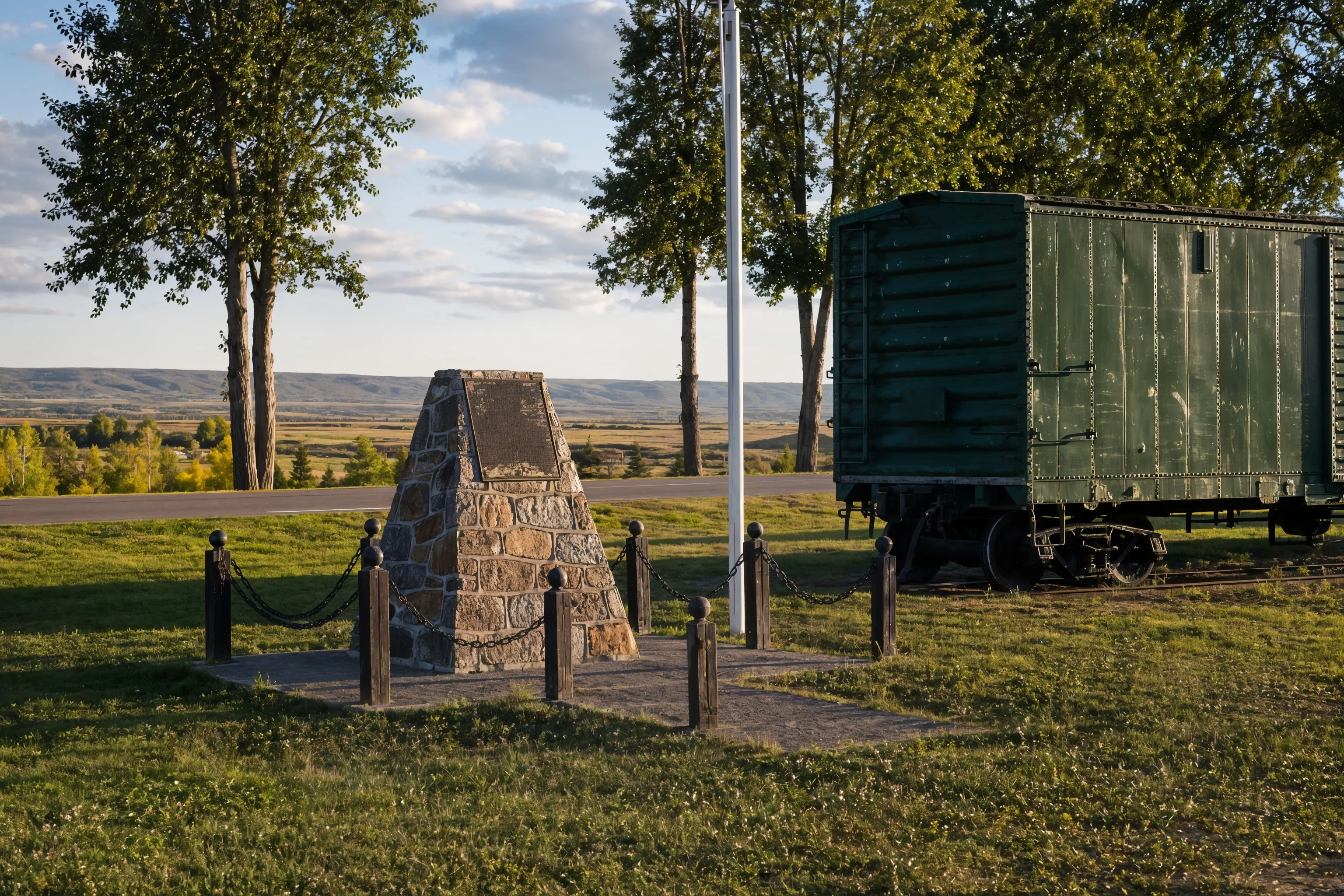
Grimshaw's townsite was selected in 1917 and surveyed in 1921, growing up around a Central Canada Railway line built through to Peace River Crossing. It reached village status in 1930 and was incorporated as a town in 1953. Its best-known landmark today is the Mile Zero Monument, marking the original starting point of Highway 35, the Mackenzie Highway, which runs north through Manning and High Level toward the Northwest Territories. The monument sits inside the Tom Baldwin Memorial Arboretum and Historic Mackenzie Highway Park just off Highway 2 through town, alongside a preserved Northern Alberta Railway car and a walking trail with plaques on the highway's construction history. It is a genuine, still-standing point of interest, not a claim we are making up for a web page.
The town grew up as a community centre for a rich mixed farming district, and that has not changed much. Grain and coarse grains, forage and seed crops, cattle, and hogs remain the backbone of the surrounding land, alongside oil and gas activity and Grimshaw's role as a supply and shipping point for the wider Peace Country. The land is flat, open farmland with minimal tree cover around the townsite, which is good news for solar. Shading is rarely a design problem out here.
What a System Looks Like on a Grimshaw Property
In-Town Home on a Standard Lot
Most Grimshaw homes sit on standard town lots, with monthly bills in the $180 to $260 range depending on the season. An 8 to 10 kW rooftop system, roughly $18,000 to $28,500 installed at $2.25 to $2.85 a watt, covers most of a typical household's annual draw.
Home Plus Detached Shop or Garage
A house with a detached shop for equipment storage or a trade pushes bills into the $260 to $380 monthly range. A 10 to 13 kW system, roughly $22,500 to $37,050 installed, split across the house and shop roof where orientation allows, is the typical fit.
Grain or Cattle Operation Outside Town
Farm properties running grain dryers, augers, bin aeration, or heated cattle waterers see bills that swing hard by season, often $400 to $700 or more a month during harvest or deep winter. A 15 to 25 kW ground-mount system, roughly $37,500 to $87,500 installed at $2.50 to $3.50 a watt, is typical here, sized to the operation's actual metered load rather than acreage.
Snow Load and Frost Depth
We do not have a Grimshaw-specific published National Building Code ground snow load figure to point to, so for design purposes we use the nearest published municipal figure for Peace River, about 25 km east, and treat Peace Country winter loading as at least as demanding as anywhere else we build in Alberta. That is the same approach we use in other small communities without their own listed value: borrow the closest verified number rather than guess. For ground-mount footings, the Alberta Building Code sets a minimum frost-protected depth, and local geotechnical practice in this region commonly runs footings to 5 feet or deeper for anything expected to hold through freeze-thaw cycles over 25-plus years. Every ground-mount post gets sized to the racking manufacturer's engineering spec for actual local frost and snow conditions, confirmed on site, not assumed from a table.
Grimshaw Solar System Sizing and Savings Estimates
Based on $2.25 to $2.85 a watt installed for roof-mount systems, an estimated production range of roughly 1,050 to 1,150 kWh per kW of installed capacity per year for this part of the Peace Country, and a blended Alberta residential rate of roughly 23 cents/kWh. Production is on the lower end of what we see in central and southern Alberta, reflecting fewer annual sunshine hours this far north.
| System Size | Estimated Annual Production | Year 1 Savings | Simple Payback |
|---|---|---|---|
| 8 kW | ~8,400 to 9,200 kWh | ~$1,932 to $2,116 | ~8.5 to 11.8 yrs |
| 13 kW | ~13,650 to 14,950 kWh | ~$3,140 to $3,439 | ~8.5 to 11.8 yrs |
| 20 kW | ~21,000 to 23,000 kWh | ~$4,830 to $5,290 | ~8.5 to 11.8 yrs |
Payback shortens for incorporated farm or business operations that qualify for the 30 percent federal Investment Tax Credit on capital equipment. There is currently no Alberta residential solar rebate.
What We Put on Grimshaw Properties
Every roof gets LONGi panels. LONGi ships more solar panels than any other manufacturer worldwide, and the hardware is rated for exactly the kind of climate the Peace Country produces: full temperature swings from minus 40 to plus 35 with no measurable degradation, backed by a 25-year product warranty. On residential roofs we pair panels with APsystems microinverters, wired so each pair works independently, so a snow-covered corner of the array does not pull down the rest. Larger grain and cattle operations near Grimshaw run on Solis inverters, built for the higher throughput a farm-scale system needs.
How We Work with Grimshaw Properties
Power Bill Review
Share your most recent power bill. We analyze your consumption to determine the right system size and calculate projected savings specific to your property.
Site Visit to Grimshaw
We drive to your property and assess the roof or ground site, electrical infrastructure, shading, and soil conditions. No charge, no obligation.
Custom Design
A detailed system design with panel layout, production estimate, cost breakdown, incentive eligibility, and payback timeline specific to your property.
Permitting
We handle building permits, electrical permits, and the ATCO Electric micro-generation interconnection application. You sign once, we follow up on everything.
Installation
Licensed electricians install racking, panels, inverters, and all electrical connections. One to two days for residential, two to four for farm-scale ground-mount.
Grid Connection
Final inspection, commissioning, and grid connection. Your system starts producing power and you start seeing the savings on your bill.
Grimshaw Solar, Frequently Asked Questions
218+ installations. Zero shortcuts.
Read what Alberta property owners say about our work.
Free Solar Assessment for Grimshaw Properties
In-town home, acreage, or farm operation, we will come to you and give you an honest number.
Also Serving the Peace Country
Get a Solar Quote for Your Grimshaw Property
Tell us your address and a recent power bill, and we will tell you what system size actually fits your usage and what it costs installed. No generic estimate, no inflated range.
Also Serving Nearby Communities