
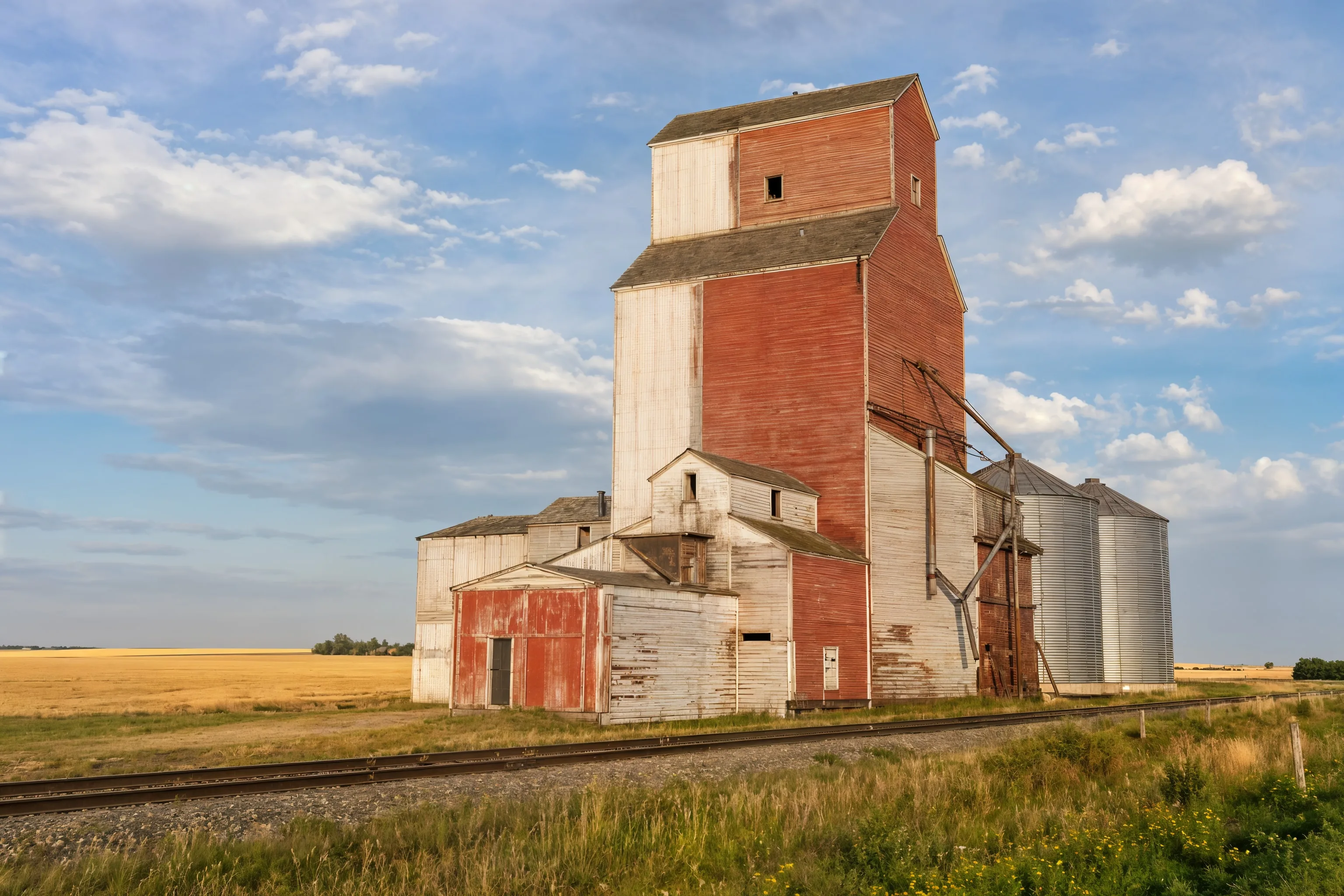
About Killam
Killam was incorporated as a town on May 1, 1965, and sits in Flagstaff County at the junction of Highway 13 and Highway 36 (Veterans Memorial Highway), east of Camrose. According to the 2021 Census of Population, Killam had 918 residents, down 7.2% from 989 in the 2016 census. The surrounding county's economy is built on grain and canola farming and cattle, with some light oil and gas service activity mixed in.
The town's most visible landmark is its grain elevator complex along the rail line: a former United Grain Growers composite elevator with an attached annex and steel storage bins, standing alongside a large concrete Viterra grain terminal on the east side of town. It is the kind of working prairie skyline that marks most Flagstaff County towns, a visible reminder that the local economy still runs on the harvest.
Solar Potential in Killam
At latitude 52.79, Killam gets an estimated 2,330 hours of bright sunshine a year, a figure in line with other central Alberta towns at a similar latitude. That works out to roughly 1,260 kWh per installed kilowatt, so a 7.6 kW system lands near 9,600 kWh annually, and sizing up to 10 kW pushes the total toward 12,600 kWh a year.
| Property type | Typical system | Installed cost range | Est. annual production |
|---|---|---|---|
| In-town Killam home | 6-8 kW roof-mount | $13,500 - $22,800 | ~7,560 - 10,080 kWh |
| Farm shop or outbuildings | 8-12 kW roof-mount | $18,000 - $34,200 | ~10,080 - 15,120 kWh |
| Grain or cattle operation | 10-15 kW ground-mount | $25,000 - $52,500 | ~12,600 - 18,900 kWh |
Pricing is a range because roof or ground condition, panel count, and electrical work all move the final number. We confirm the exact figure at the site visit, not before.
Snow Load, Wind, and the Local Build
For structural design we use an estimated snow load zone S2 and wind load zone R4, figures consistent with other open, flat stretches of east-central Alberta. Flagstaff County's prairie offers little in the way of trees or terrain breaks, which pushes wind load up the priority list here more than in sheltered towns. Every rack is built to that R4 spec rather than a generic mount, and rooftop tilt angles are chosen so snow clears within a day or two of sunshine.
Cold, clear days are a production advantage, not a drawback. Panels are semiconductors, and they output more power per watt in Alberta winter cold than in summer heat. LONGi panels paired with APsystems microinverters cover most residential and smaller farm jobs; Solis string inverters handle larger ground-mount arrays sized for grain and cattle operations.
Grid Connection and Net Metering
FortisAlberta owns and operates the distribution lines serving Killam and the rest of Flagstaff County. We prepare and submit the micro-generation interconnection application, coordinate the technical review, and schedule the bi-directional meter swap. Approval typically takes two to six weeks from a complete application. During that window your system is installed and inspected but not yet exporting power.
Once the meter is swapped, Alberta's net metering rules apply: your panels produce, your meter spins backward against your usage, and you draw from the grid when production is low. Long summer days build up credits that carry forward into shorter winter days, so the annual bill, not any single month, is what matters for a farm or home running on FortisAlberta service.
Six Steps From Power Bill to Power Producer
Bill Review
Send your most recent power bill. We calculate your annual consumption and seasonal pattern to size the system right.
Site Assessment
We visit your Killam property in person: roof or ground evaluation, electrical panel inspection, shading analysis, and interconnection scoping.
System Design and Quote
A complete system layout, production estimate, and fixed-price quote. We tell you exactly what the system will produce and what it will cost.
Permitting
We pull building and electrical permits and submit your micro-generation application to FortisAlberta.
Installation
Our licensed electricians install the racking, panels, inverters, and wiring. Residential systems typically take one to two days.
Commissioning
Inspection, meter swap with FortisAlberta, and grid connection. You are now a micro-generator.
Solar in Killam, Common Questions
Also Serving Nearby Areas
See what our clients say
Real reviews from Alberta homeowners and farmers.
Get a Free Solar Assessment
We serve Killam and surrounding Flagstaff County. No obligation.
Ready to Assess Your Property?
Submit a recent power bill and we will review your consumption and provide an honest assessment of what solar can do for your Killam property. No obligation.
Also Serving Nearby Communities