
Why Solar Fits Daysland
Daysland exists because of a bet on this exact land. In 1904, Edgerton W. Day bought twelve townships of what the Canadian Pacific Railway advertised as the Kentucky Blue Grass Region of the West, some 276,000 acres, for $750,000, one of the largest individual land deals of the prairie era. The town that took his name was incorporated on April 2, 1907, with Day as its first mayor, and the railway that reached the site in December 1905 still shapes the town grid today. More than a century later, Daysland's identity has not moved: the Town's own website describes its major industry as serving the progressive farmers of Flagstaff County, and the surrounding quarter sections grow canola, wheat, barley, and feed cattle across some of the most productive aspen parkland soil in Alberta.
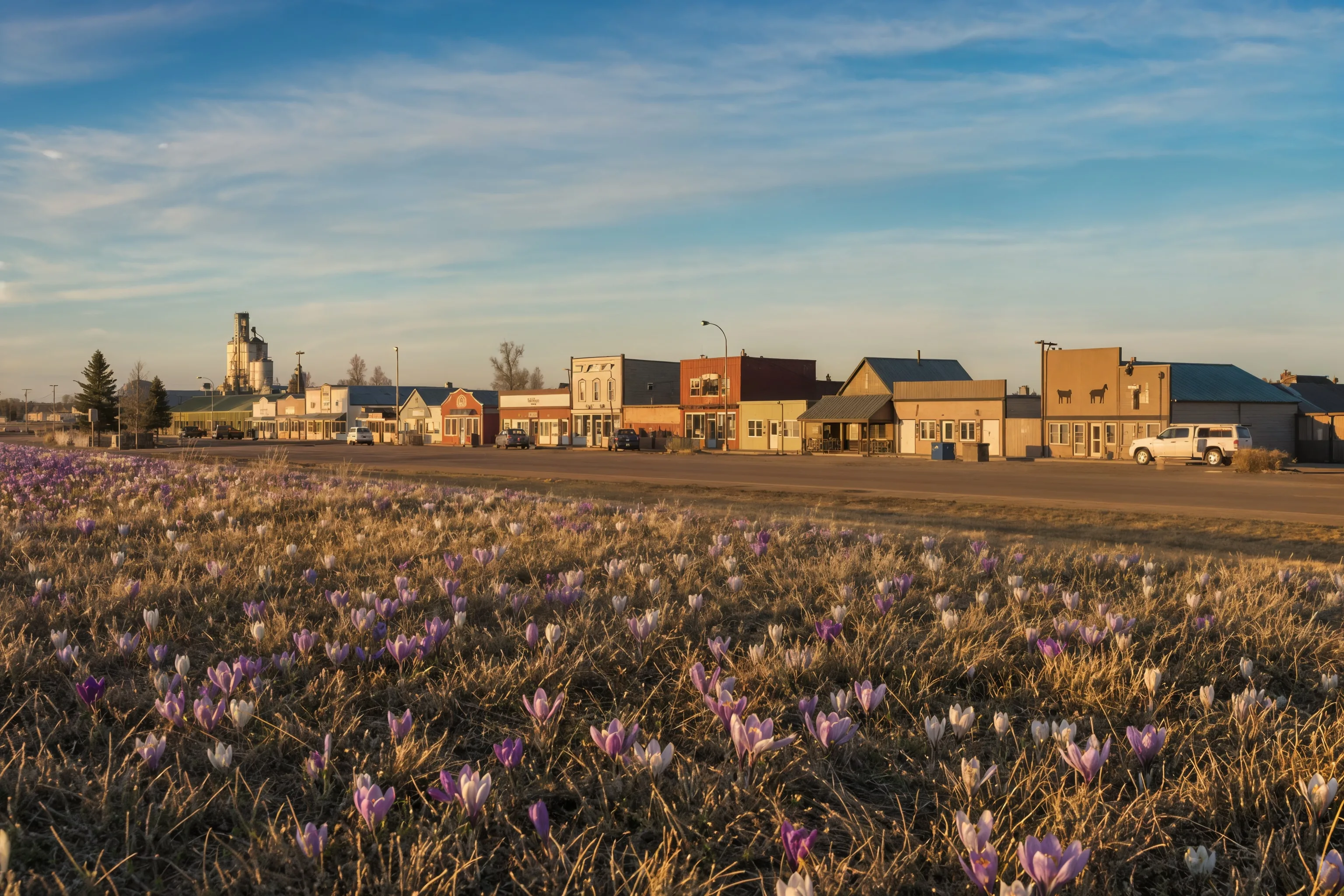
That farm-service economy is precisely why solar works here. A town whose reason for being is agriculture sits surrounded by properties with exactly the loads solar handles best: high daytime consumption from grain dryers and bin fans in the fall, heated shops and barns through the winter, stock waterers that run all year, and long rows of unobstructed sky in every direction. Daysland itself is a compact town of 789 people, down slightly from 824 in 2016, with quiet streets, stately trees, and the restored Palace Theatre still running cinema and live events downtown. Around it, the Crocus Trail walking path and the town's nine-hole golf course hint at how open the country is. There is no mountain shadow, no urban haze, and very little shading of any kind on the properties we are asked to look at.
Add the electrical facts and the case sharpens. Daysland sits at roughly 52.9 degrees north on the FortisAlberta distribution system, which means a simple grid-tied system with no batteries can offset consumption through the year under Alberta's micro-generation rules. Natural Resources Canada modelling for this area puts annual production at roughly 1,270 kWh for every kilowatt of south-facing capacity. And because Daysland is on Highway 13 between Camrose and Killam, it sits on the same corridor we already travel for Sedgewick, Forestburg, and the rest of Flagstaff County. Solar here is not a leap of faith. It is arithmetic applied to a town that has always run on productive land and open sky.
What Daysland Properties Actually Use
Every quote we build starts with the 12-month usage graph on your power bill. While no two properties match exactly, three load profiles cover most of what we see between Daysland and the surrounding Flagstaff County farmland, and each points to a different system size.
The in-town senior couple
Daysland's housing stock skews to modest post-war bungalows and mid-century two-stores on serviced lots, and many are owned by retired couples whose families have moved on to Camrose or Edmonton. A couple in a gas-heated bungalow with an electric water heater, a deep freeze, and a summer air conditioner typically uses 550 to 900 kWh a month, with bills running about $110 to $190 through the year. A 6 to 8 kW roof-mount system covers nearly all of that, and the surplus credit through the long summer days absorbs the January spike.
The acreage with the shop
Five to fifteen minutes out of town along the county grid, acreages pair a house with a shop, a well pump, and often a yard full of equipment that needs block heaters and battery maintainers all winter. Monthly use of 1,200 to 1,800 kWh translates to bills of roughly $250 to $420, higher in a cold February than in July. These properties usually land at 10 to 14 kW, and the shop roof or a ground mount beside the yard both work, which we sort out on site.
The grain farm with bin fans
The profile that defines this corner of Flagstaff County: a working grain operation with hopper bins, aeration fans, a dryer, augers, and a heated shop, drawing 20 to 35 kWh a day through the summer and then spiking past 3,000 kWh in the October drying window. Annual bills of $5,000 to $11,000 are normal, and a 15 to 25 kW ground mount sized to the farm's 12-month total is the standard answer. Incorporated operations can also apply the 30 percent federal Investment Tax Credit to the installed cost, which shortens the payback by years.
What Solar Costs in Daysland, and What It Returns
Our installed pricing is straightforward. A roof-mount system costs $2.25 to $2.85 per watt installed, and a ground mount costs $2.50 to $3.50 per watt, the higher ground-mount range reflecting racking, trenching, and post foundations. There is no financing pitch here and no monthly-payment framing, because the honest number is the payback: how many years of avoided power bills equal the system cost.
Worked honestly at both ends of the range, a 7 kW roof system for an in-town home at the low end runs 7 kW times $2.25, about $15,750, and the same system at the high end of the range runs about $19,950. A larger 10 kW roof array for a bigger home or small acreage runs from roughly $22,500 to $28,500. Step up to a 15 kW ground mount for a farm and the range is $37,500 to $52,500 before any federal tax credit an incorporated operation can claim. Production uses the NRCan-derived area figure of about 1,270 kWh per kWp a year, and savings use a blended Alberta residential rate of roughly 23 cents per kWh, the number that actually lands on Daysland bills once FortisAlberta delivery and a competitive retailer rate are combined.
| System | Installed cost | Annual production | Est. annual savings | Simple payback |
|---|---|---|---|---|
| 7 kW roof, in-town home | $15,750 to $19,950 | about 8,900 kWh | about $2,000 | 8 to 10 years |
| 10 kW roof, acreage home | $22,500 to $28,500 | about 12,700 kWh | about $2,900 | 8 to 10 years |
| 15 kW ground mount, farm | $37,500 to $52,500 | about 19,000 kWh | about $4,400 | 9 to 12 years |
Panels carry 25-year output warranties, so a system that pays for itself in nine years delivers sixteen more years of production that is already paid for. If rates rise, and FortisAlberta delivery charges have only moved one direction in the past decade, every one of those years improves. The travel distance from our Airdrie base is priced into every Daysland quote up front, not added as a surprise line later.
FortisAlberta Interconnection, Handled for You
Daysland sits on the FortisAlberta distribution system, and this is verified rather than assumed. The AUC-approved FortisAlberta Rates, Options and Riders Schedules include a Municipal Franchise Fee Riders table that lists the Town of Daysland by name and municipal code, the formal confirmation that FortisAlberta owns and operates the wires here. FortisAlberta is also the named wires owner in the neighbouring Town of Sedgewick's published franchise agreement, so the entire Flagstaff County corridor is one consistent territory.
Under Alberta's Micro-Generation Regulation, a residential system under 10 kW interconnects through a simplified approval process. We file the Customer Generation application with FortisAlberta on your behalf as part of the project, and for a standard Daysland home the approval typically comes back within one to three weeks, after which FortisAlberta schedules the bi-directional meter swap at no application fee. Larger farm systems between 10 and 150 kW can trigger a technical impact study, particularly on single-phase rural lines, and we flag that possibility in the quote rather than letting it surface mid-project. From signed quote to energized system, most Daysland projects run two to six weeks of paperwork and scheduling around the installation itself, and your existing grid connection stays in place throughout, so there is no change to your power supply until the day the system is commissioned.
One point worth understanding: the company on your power bill may not be FortisAlberta. Alberta separates the wires owner, fixed by geography, from the retailer you buy energy from, which you can change at will. Your exports are credited by your retailer at your rate, so the choice of retailer matters to your payback, and we will walk you through it at commissioning.
Working With an Airdrie Crew, 265 Kilometres Out
Range Road Solar is based just north of Calgary in Airdrie, and we will not pretend Daysland is around the corner. The run east is roughly 265 kilometres, about three hours down the QE2 and across Highway 13 through Wetaskiwin and Camrose. What makes that distance work is planning: we treat a Daysland project as a dedicated trip, schedule the site visit, installation, and commissioning together, and where possible bundle the work with other Flagstaff County jobs on the same corridor, because Killam, Sedgewick, Forestburg, and Heisler are all on the same road.
The process itself is the same disciplined sequence we run everywhere. It starts with your power bill: the 12-month usage graph tells us what size system your property actually needs. A site visit follows, where we assess roof structure or ground conditions, shading, and the electrical service entrance, since farm and acreage services around Daysland range from modern 200-amp panels to older breakered farm services that may need upgrading first. We then produce a one-page design with production estimate and cost. Once you approve, we pull the municipal and electrical permits, file the FortisAlberta interconnection application, and book the installation. Licensed electricians do the work, the authority having jurisdiction inspects it, and FortisAlberta swaps the meter. After commissioning we monitor the system remotely, so a winter checkup does not mean a three-hour drive for either of us.
Daysland Solar Questions, Answered Plainly
See what our clients say
Real reviews from Alberta homeowners and farmers.
Get a Free Solar Assessment
We serve Daysland and surrounding areas. No obligation.
Also Serving Nearby Areas
Ready to Assess Your Daysland Property?
Send a recent power bill and we will review your consumption and give you an honest answer on what solar can do for your property in Daysland or the surrounding Flagstaff County farmland. No obligation.
Also Serving Nearby Communities