
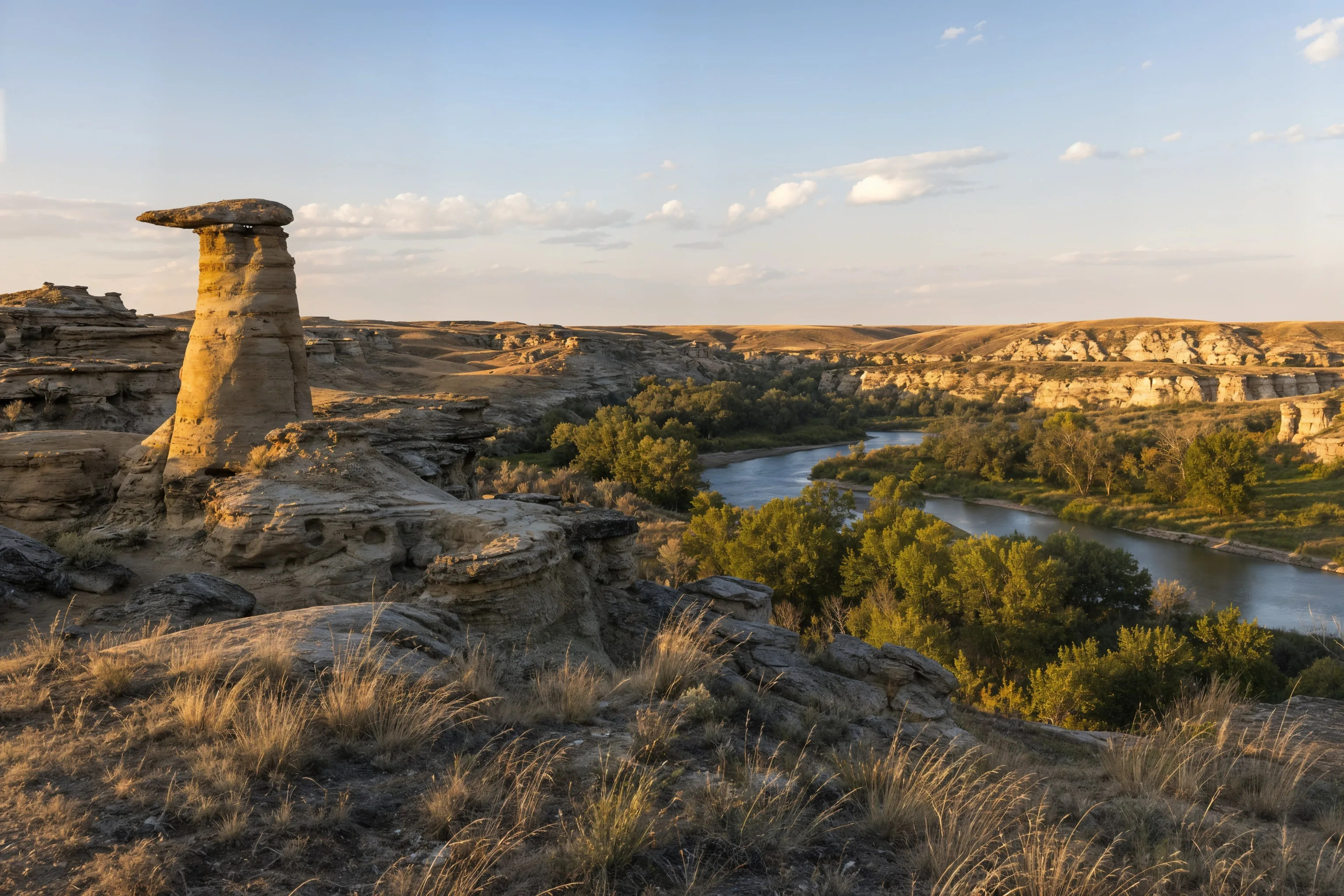
Solar Installation: Milk River, Alberta
Solar Installation in Milk River
Alberta's southernmost town sits twenty minutes from the Montana border in the sunniest farm country in the province, about 1,330 kilowatt-hours of annual production per installed kilowatt of solar. Range Road Solar designs, permits and installs grid-tied systems for Milk River homes, irrigation farms and border acreages.
Why Solar Fits Milk River Specifically
Milk River is the southernmost town in Alberta, set at 49.15 degrees north in the County of Warner No. 5, a short drive west of the Coutts border crossing into Montana. The 2021 census counted 824 residents, essentially unchanged from 827 in 2016, and the town's proud motto, Under Eight Flags, nods to the succession of nations and companies that have passed through this border country. Around town, the working landscape is almost entirely agricultural: irrigated quarter sections, dryland grain, cattle and forage running from the Milk River coulees south to the line. That geography matters for solar in a specific way. Properties here draw power from a distribution grid that stretches a long way to reach them, while sitting in one of the strongest solar resource belts in Canada.
The resource numbers back that up. The nearest full Environment Canada weather station, at Lethbridge about 80 kilometres northwest, records close to 2,500 hours of bright sunshine a year, and the Natural Resources Canada PV potential dataset puts southern Warner County at roughly 1,330 kilowatt-hours of annual production per kilowatt of installed capacity for a south-facing array tilted at local latitude, a figure we proxy from the Lethbridge municipal dataset because Milk River shares the same solar regime. That outproduces identical hardware installed around Calgary by about 3 percent and around Edmonton by about 5 percent. Cold winter air adds a small efficiency bonus, chinook winds strip snow off panels within days rather than weeks, and southern Alberta snow loads, at roughly 1 kPa on the roof, are comparatively light to engineer for.
Local load patterns line up with that resource. The town's economy runs on agriculture and on visitors bound for Writing-on-Stone / Áísínai'pi, the UNESCO World Heritage site 44 kilometres east along the Milk River, inscribed in 2019 for the largest concentration of Blackfoot rock art on the Great Plains. Farms with seasonal irrigation pumps, ranch headquarters with deep wells and cold storage, park-season businesses and ordinary in-town homes all draw their heaviest power in June, July and August, exactly when panels here produce the most. When the sunny months and the expensive months are the same months, the payback arithmetic gets noticeably better.
One more local factor rarely shows up in generic solar copy: the sheer openness of this corner of the province. Outside the town grid, most Warner County properties sit on quarter sections with no tree belts, no neighbours to the south and no roof valleys throwing afternoon shade. Arrays here are limited by economics, not by the site, which is why ground-mounts dominate our Milk River work and why production estimates for this area tend to land at the reliable end of the model's uncertainty band.
Latitude
49.15°N, the southernmost town in Alberta
Population
824 residents, 2021 census (827 in 2016)
Wire service
FortisAlberta, micro-generation up to 150 kW
NRCan PV yield
About 1,330 kWh per kWp per year, south-facing latitude tilt, proxied from the Lethbridge municipal dataset
Local anchor
Writing-on-Stone / Áísínai'pi UNESCO World Heritage Site, 44 km east
System type
Grid-tied, no batteries required
Typical Milk River Load Profiles
Three property patterns account for most of the solar work in the Milk River area. Your bill will not match these exactly, but if one of them sounds like your place, the sizing logic probably applies to you.
Irrigated farm north of town
FortisAlberta farm rate · Typical bills $350 to $800 a month through the irrigation season
A quarter section running a centre pivot or booster pumps from June through September typically sees bills spike into that range, then fall sharply once the pivots shut down. Because farm bills include demand and service charges, not just energy, the value concentrates in the summer months. A 20 to 40 kW ground-mount sized against the pumping season can cover most of it, and the array produces most exactly when the pumps run.
In-town home near Centre Street
FortisAlberta residential rate · Typical bills $120 to $240 a month across the year
A typical Milk River home with electric appliances, a pressure system on a well, or air conditioning in July lands in this band. A 7 to 10 kW roof or ground system usually covers 80 to 100 percent of annual consumption, and the town's flat, open surroundings mean little shading to design around.
Border acreage or farm shop
Farm or general service rate · Typical bills $250 to $550 a month with shop and yard loads
Acreages along Highway 4 and yard sites running grain aeration fans, welders, compressors and yard lights commonly settle in this range. These properties often have the best siting in the district: level ground, open sightlines and no mature tree cover, which makes ground-mount layout straightforward and keeps trench runs short.
Solar Costs and Savings in Milk River
Pricing here follows the same ranges we use across rural Alberta, with the long drive south already accounted for. A roof-mounted system runs $2.25 to $2.85 per installed watt depending on roof condition, panel access and electrical upgrades. A ground-mount runs $2.50 to $3.50 per watt depending on racking, trenching length and how far the array sits from your service entrance. Ground-mounts carry the premium, but on Warner County farms they are usually the better asset: easy snow clearing, tilt set for latitude, and no roof penetrations.
A worked example, using the middle of the ranges honestly: an in-town home installing a 10.2 kW ground-mount at $2.75 per watt comes in around $28,000 before any retailer-specific credit treatment. At the NRCan figure of roughly 1,330 kWh per kWp, that system produces about 13,600 kilowatt-hours a year. A household paying a blended 15 cents per kilowatt-hour once FortisAlberta wires, riders and the Town of Milk River franchise fee are stacked onto energy would offset roughly $2,000 a year, putting simple payback in the 12 to 14 year range on energy alone, with panels warrantied for 25 to 30 years. Farm systems that displace summer irrigation energy often beat that because their consumption peaks match production so closely.
| System | Typical cost range | Est. annual production | Est. annual offset | Simple payback |
|---|---|---|---|---|
| 6 kW rooftop home | $13,500 to $17,100 | ≈ 8,000 kWh | ≈ $1,200 | 11 to 14 years |
| 10 kW ground-mount | $25,000 to $35,000 | ≈ 13,300 kWh | ≈ $2,000 | 12 to 15 years |
| 25 kW farm ground-mount | $62,500 to $87,500 | ≈ 33,000 kWh | ≈ $4,900 | 12 to 16 years |
These are planning figures, not quotes. Your actual offset depends on your retailer rate, your consumption pattern and your site, which is why every project starts with a twelve-month power bill review rather than a sales script.
FortisAlberta Wires and Micro-Generation Approval
FortisAlberta is the wire service provider in Milk River, which is confirmed authoritatively in the Alberta Utilities Commission approved FortisAlberta rates schedule (Decision 30274-D01-2025), where the Town of Milk River appears in the municipal franchise fee rider table at 1.84 percent applied to distribution charges. That rider is why a small town-specific line sits on your bill. Your energy retailer is a separate company of your choosing, and nothing about going solar changes that relationship.
For the interconnection itself, we file under Alberta's Micro-Generation Regulation, which covers systems up to 150 kilowatts. The package includes a site electrical diagram, equipment certifications, and your service details. FortisAlberta reviews it for transformer capacity and protection settings, a process that typically takes two to six weeks. Once approved, the utility exchanges your meter for a bi-directional unit, we install, the electrical inspection passes, and you receive permission to operate. From filing to first exported kilowatt-hour, most Milk River projects complete inside two months, with the utility window being the long pole.
A practical note on the billing side: after commissioning, your meter records energy flowing in both directions, and the credit you receive for exported power depends on the retailer you have chosen, not on FortisAlberta. Some retailers credit exports at the same rate you pay, others at a market-based rate. Before we finalize your design, we walk through how your current retailer treats exports and what that means for system size, so the economics you sign off on match the statements you actually receive.
Working With an Airdrie Crew From 340 Kilometres Away
Our shop is in Airdrie, and Milk River is roughly 340 kilometres and about a four-hour drive south, almost all of it a straight shot down Highway 2. We serve southern clients regularly, and the distance only matters if a project is managed as a series of trips. Ours is not. The process starts at your kitchen table by email: you send a recent power bill, we pull the twelve-month usage graph, and we build a preliminary design with production estimates based on the local solar resource before anyone drives anywhere.
One site visit follows, combined for efficiency: we confirm roof or ground measurements, check the service entrance, transformer and panel capacity, and photograph anything the designer needs. You receive a fixed quote from that visit. Installation itself takes one day for a typical home system and one to two days for most farm arrays, and we schedule inspection coordination remotely so you are not left chasing paperwork. The result is that a Milk River project costs essentially the same to deliver as a closer one, which is exactly how the pricing ranges above are built.
Bill review and remote design
Send your power bill; we analyze twelve months of usage and send back a preliminary system size and production estimate at no charge.
Single site assessment
One combined visit to Milk River to measure, photograph and check electrical service, farm breaker sizes and ground conditions.
Fixed quote, permits and filing
You approve a fixed price; we file the electrical permit and the FortisAlberta micro-generation application, typically a two to six week utility window.
Install, inspect, operate
The crew installs in one to two days, the inspection passes, FortisAlberta swaps the meter, and your system starts exporting.
Milk River Solar Questions, Answered Honestly
See what our clients say
Real reviews from Alberta homeowners and farmers.
Get a Free Solar Assessment
We serve Milk River and surrounding areas. No obligation.
Also Serving Nearby Areas
Ready to Assess Your Property?
Submit a recent power bill and we will review your consumption and provide an honest assessment of what solar can do for your Milk River property. No obligation.
Also Serving Nearby Communities