
Why Solar Fits the MD of Warner
The Municipal District of Warner No. 5 sits at the very south of Alberta, bordered on one side by the United States border at Coutts and on the other by the irrigated belt that runs from Lethbridge down through Raymond, Stirling, and Warner. The 2021 census counted 4,290 people in the MD itself, with the Town of Raymond, the Town of Milk River, the Villages of Stirling, Warner, and Coutts, and hamlets like New Dayton and Wrentham adding several thousand more. The county office is in the Village of Warner, about 65 kilometres south of Lethbridge on Highway 4. This is dryland and irrigated farm country famous for dry edible beans, corn, and sugar beets, and the same open, unobstructed ground that grows those crops is close to ideal for solar.
The resource numbers back that up. For a south-facing array tilted at latitude, the Warner station's NRCan PV potential figure is 1,272 kWh per kWp per year, which puts the MD in the top tier of Alberta solar sites. The local communities figured this out years ago. The Town of Raymond became the first electrically net-zero municipality in Alberta when it finished nine municipal solar arrays totalling 1.16 megawatts in 2018, enough to cover its entire municipal electricity use. The Village of Stirling, a National Historic Site as the best surviving example of a Mormon agricultural village in Canada, was the country's first electrically net-zero village, with municipal rooftop and ground-mount arrays of roughly 230 kilowatts switched on starting in 2018. When two of the smallest municipalities in the province both ran the math and built systems, the math was telling them something.
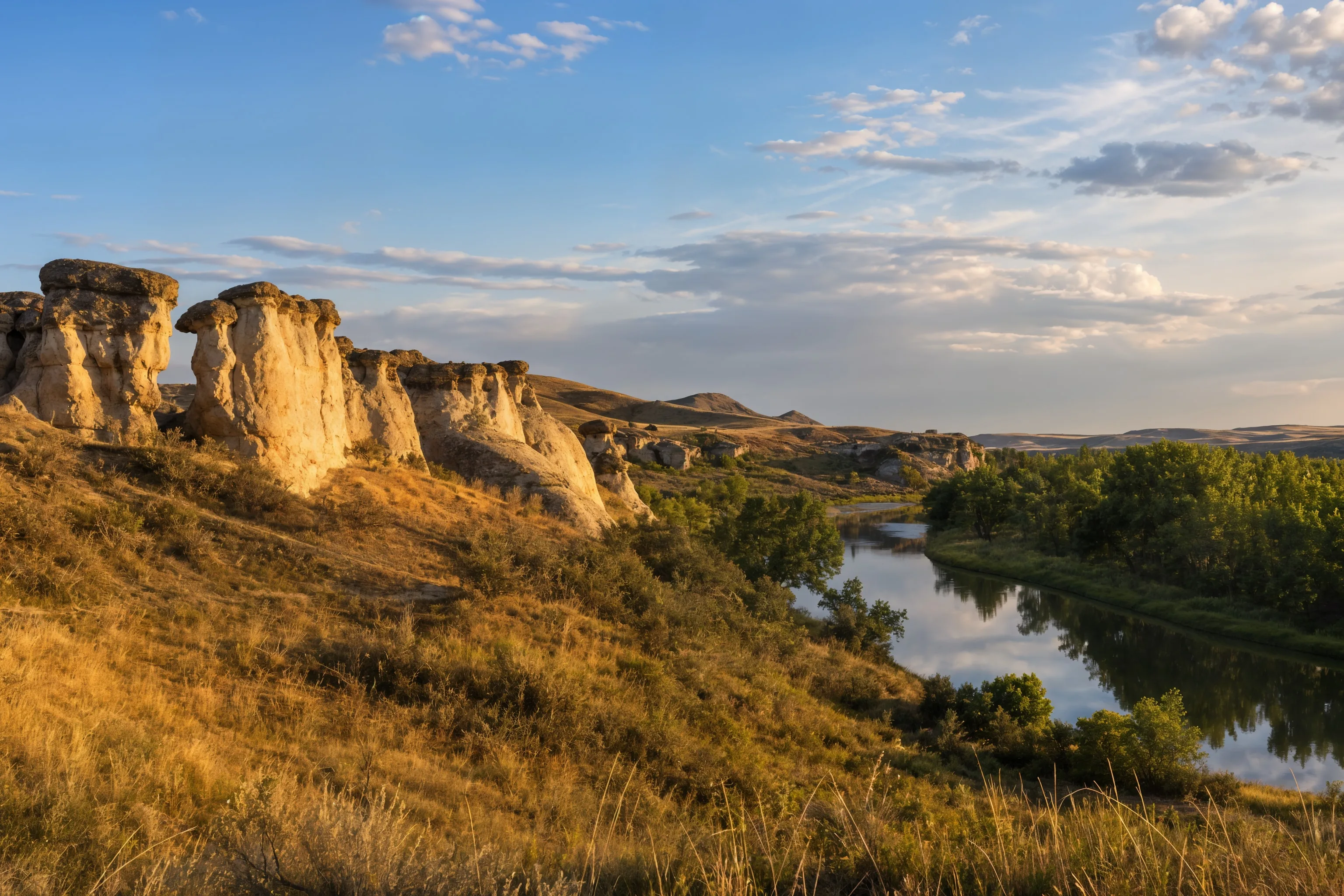
The economics rest on Alberta's Micro-Generation Regulation rather than any subsidy program. Any FortisAlberta customer in the MD is free to go grid-tied, send surplus power out, and bank a kilowatt-hour credit against later bills. At recent retail power prices, a well-sited Warner County array usually earns its cost back in roughly 10 to 16 years and then keeps producing for 25 to 30. There are no batteries, no special rate class, and no change to how you run the place. If you have driven Highway 4 past Writing-on-Stone Provincial Park on the Milk River, a UNESCO World Heritage Site since 2019, you have seen the kind of wide-open, cloud-free exposure that makes the numbers work here.
What Warner County Properties Actually Use
Every design begins from the 12-month usage graph on your FortisAlberta bill. Most MD properties fall into one of three types:
Irrigated Farm on Three-Phase Service
A working yard site between Raymond and Milk River that draws on pivot pumps, a shop, grain handling, and a residence. Irrigation makes summer the billing peak, with in-season months commonly $700 to $1,800 and winter $200 to $400, totalling 20,000 to 45,000 kWh annually. No property type in the MD benefits more from solar: heavy usage lines up with the sunniest months, three-phase service is already in place, and open ground accommodates a 15 to 25 kW ground mount.
Acreage with Shop and Well
Country-residential places along the range roads outside Stirling, Warner, and New Dayton, each with a house, a detached or heated shop, a well pump, and space to spare. Typical bills fall between $250 and $550 a month across the year, adding up to 12,000 to 20,000 kWh annually. A 10 to 14 kW array on the roof or on the ground offsets most of that, and seasonal credits absorb the remainder.
In-Town Raymond, Stirling, or Warner Home
An ordinary town service on a residential lot in Raymond, Stirling, or Warner, drawing 7,000 to 12,000 kWh a year with monthly bills of $140 to $300 shaped by heating and household size. On the roof, a 7 to 11 kW system handles most of that consumption, and the extra summer generation flows to the grid while the air conditioning runs.
Solar Pricing and Payback in the MD of Warner
Per-watt pricing in this territory comes to $2.25 to $2.85 installed for rooftop work and $2.50 to $3.50 for ground mounts, where trench length, racking, and distance to the service drive the spread. That figure covers panels, inverter hardware, racking, permits, the FortisAlberta micro-generation application, and commissioning. After the site assessment you receive one fixed installed price. Financing products are not part of our pitch.
Here is an honest worked example from that range. Picture a 12 kW ground mount on an acreage outside Stirling. If the trench is short and the ground cooperates, the $2.50 per watt end gives $30,000; a long trench run through rocky soil at $3.50 per watt gives $42,000. Against the NRCan yield of 1,272 kWh per kWp, yearly output is roughly 15,300 kWh. Valued at a realistic all-in residential rate near 17 cents per kWh, that trims about $2,600 a year from the bill, so simple payback lands between 10 and 17 years depending on where the install price falls. Irrigated farms with summer-heavy usage often beat that, since their consumption peaks exactly when production does. Before you commit to anything, we run this math against your actual bill.
| Property profile | Typical system | Est. annual production | Est. annual savings | Simple payback |
|---|---|---|---|---|
| Irrigated farm, three-phase yard site | 20 kW ground mount | ~25,400 kWh | $3,900 to $4,600 | 11 to 18 years |
| Acreage with shop and well | 12 kW ground mount | ~15,300 kWh | $2,400 to $2,900 | 10 to 17 years |
| In-town Raymond or Stirling home | 9 kW rooftop | ~11,400 kWh | $1,800 to $2,200 | 10 to 14 years |
These savings figures assume an all-in rate near 17 cents per kWh and full use of annual production. Your retailer, rate plan, and consumption pattern all move the result.
FortisAlberta Interconnection in the MD of Warner
Every address in the MD of Warner No. 5, from a Raymond bungalow to a farm service outside Milk River, is wired by FortisAlberta. The utility's AUC-approved municipal franchise schedule confirms it: both the Village of Warner (7 per cent) and the Village of Stirling (12 per cent) appear on FortisAlberta's franchise fee rider, and the Town of Raymond holds its own franchise agreement with the utility. All of it, the micro-generation application, the meter swap, plus any needed technical review, runs through FortisAlberta's customer generation process, regardless of whose name tops your bill.
Systems up to 150 kW connect under the streamlined grid-tied rules of the Micro-Generation Regulation, and exported surplus earns a kilowatt-hour credit that carries forward, bill to bill, for as long as twelve months. Our Master Electrician files the application, we manage the safety code filing, and we book the meter swap with the utility. Budget two to six weeks from submission to a swapped meter. A farm system above 10 kW fed by a single-phase line can prompt a technical review; we raise that possibility during design so nothing catches you off guard.
Working With an Airdrie Crew From 300 Kilometres Out
Reaching the MD of Warner takes commitment: roughly 300 kilometres from our Airdrie shop, about three and a half hours down Highway 2 past Calgary and Lethbridge. We make the trip because irrigated farmyards and open acreages under one of Alberta's best solar resources are exactly the work this crew wants, and because batching regional visits keeps the geography from inflating your quote.
Bill review by phone or email
Email or text us a photo or PDF of your FortisAlberta bill. From its 12-month usage graph we determine your rate class and service size and give you a straight answer on whether solar pencils out, all before anyone heads south.
Batched site assessment day
Warner County assessments get grouped into one trip. We visit your roof or ground-mount locations, inspect the panel condition and breaker capacity, and measure shading, then send a fixed installed price together with a production estimate within days.
Permits and FortisAlberta filing
The micro-generation application goes to FortisAlberta, and the electrical permit comes through whichever authority, the municipality or the MD, holds jurisdiction over your address.
Install and commissioning trip
Racking, the AC disconnect, APsystems microinverters, and LONGi panels all go in with one crew on site, followed by inspection and the utility meter swap to bi-directional. Most Warner County systems reach commissioning two to six weeks after the utility filing.
Warner County Solar Questions, Answered
See what our clients say
Real reviews from Alberta homeowners and farmers.
Get a Free Solar Assessment
We serve Warner County and surrounding areas. No obligation.
Also Serving Nearby Areas
Ready to Assess Your Property?
Send us a recent power bill and we will assess your consumption honestly, showing what solar could do for your Warner County property. There is no obligation.
Also Serving Nearby Communities