
About Redwater
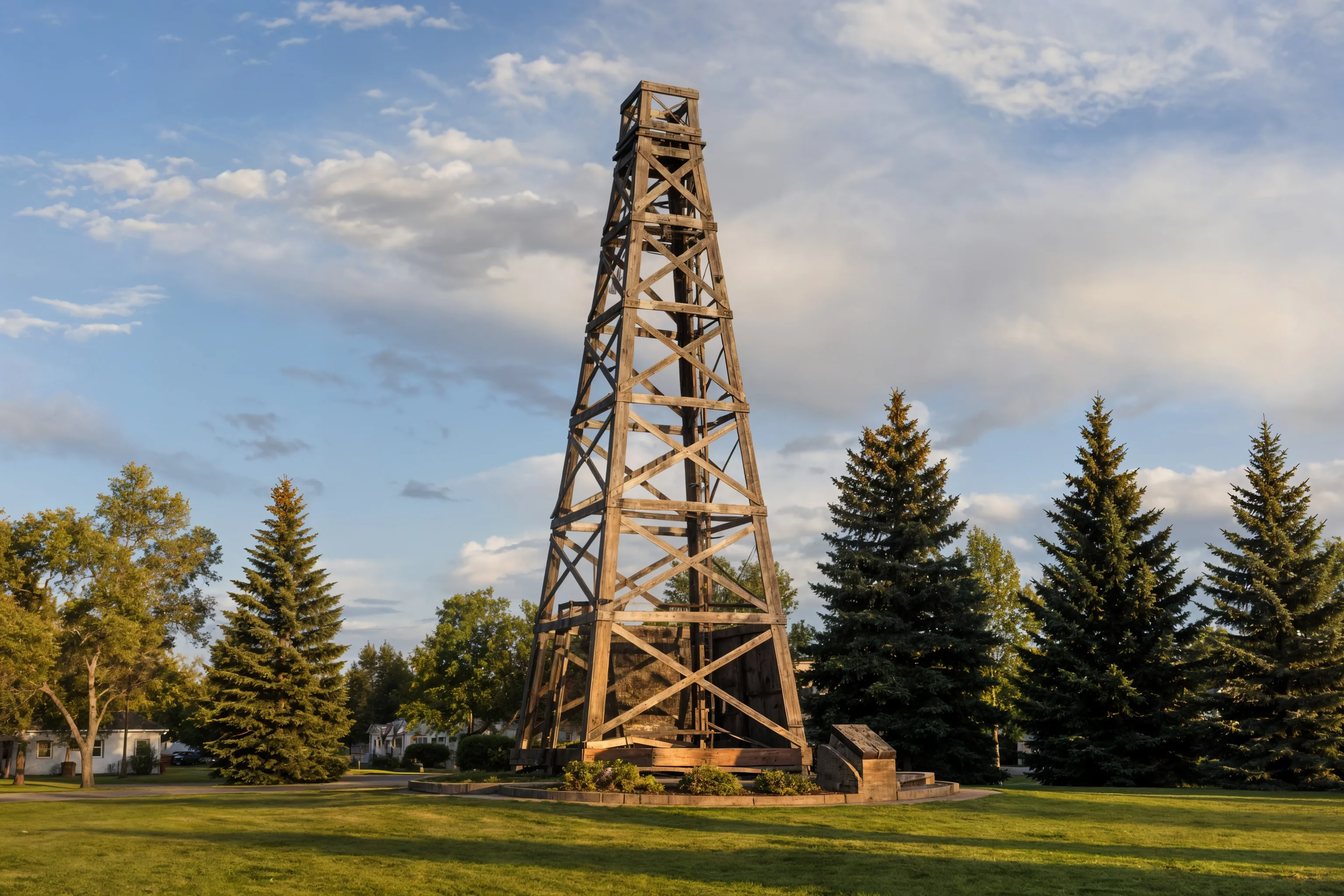
Redwater's modern story starts in the spring of 1948, when an Imperial Oil wildcat crew set up a rig on Hilton Cook's farm about two miles northeast of town. Oil blew in on August 30, 1948, the Discovery Well, Redwater #1, following on the heels of the 1947 Leduc find and setting off a boom that swelled the town from roughly 160 people to a reported peak of over 4,000 within a few years. The Redwater field went on to become one of Canada's largest oil fields for decades.
The original Discovery Well is preserved as a landmark in the town centre today, and Redwater commemorates the find every August during Discovery Days. The population has settled at roughly 2,115 people as of the 2021 census, up modestly from 2,053 in 2016, with the town now sitting inside Sturgeon County just north of Edmonton. The local economy is a mix of acreages, grain and livestock farms, and oilfield-service activity that traces straight back to 1948.
Solar Potential in Redwater
At latitude 53.95, Redwater draws on the same Edmonton-area estimate of about 2,345 hours of bright sunshine a year that we use for the rest of this corridor. That puts the yield around 1,275 kWh per installed kilowatt, which means a 7.6 kW system can be expected to turn out close to 9,690 kWh a year, easily matching what a typical household draws over twelve months. A larger 10 kW array moves that figure up near 12,750 kWh.
| Property type | Typical system | Installed cost range | Est. annual production |
|---|---|---|---|
| In-town Redwater home | 6-8 kW roof-mount | $13,500 - $22,800 | ~7,650 - 10,200 kWh |
| Oilfield-service shop or small business | 8-12 kW roof-mount | $18,000 - $34,200 | ~10,200 - 15,300 kWh |
| Sturgeon County farm or acreage | 10-15 kW ground-mount | $25,000 - $52,500 | ~12,750 - 19,125 kWh |
Pricing is a range because roof condition, panel count, and electrical work all move the final number. We confirm the exact figure at the site visit, not before.
Snow Load, Wind, and the Local Build
Structural design here uses an estimated snow load zone S2 and wind load zone R3, matching the same Edmonton-region figures applied to nearby Gibbons; moderate numbers, but they still drive the racking choice. Rooftop tilt is picked so snow clears within a day or two of sun, and on the ground-mount jobs common across Sturgeon County's acreages and farms, posts sit below frost depth so the ground cannot heave the array out of position over the years. Cold does the opposite of hurting output: because panels are semiconductors, a clear winter day in Alberta squeezes more watts out of every panel than a hot summer afternoon does.
For most Redwater homes and small shops, that means LONGi panels on APsystems microinverters; the bigger ground-mount arrays on larger Sturgeon County parcels typically move to Solis string inverters instead. The microinverter setup lets each pair of panels operate on its own, which actually pays off on a property with an uneven roofline or a shelterbelt casting partial shade across part of the array.
Grid Connection and Net Metering
Everything that carries power into and out of Redwater, and the Sturgeon County land around it, belongs to FortisAlberta. Getting your system exporting means a micro-generation application filed in your name, a technical review on their side, and finally a bi-directional meter swap, a process that typically closes out in two to six weeks once the paperwork is complete. Your array is physically finished and inspected well before that last step; it simply is not feeding the grid yet.
After the new meter is in, Alberta's net metering rules do the rest of the work: generate more than you use and the meter runs backward, draw more than you generate and it runs forward as usual. A strong Redwater summer typically banks more credit than the array needs, and that surplus simply applies against the leaner winter months, so what matters in the end is the yearly total, not any single bill.
Six Steps From Power Bill to Power Producer
Share a Power Bill
Your actual usage, month by month, is what sizes the system properly. A recent bill gives us that real pattern.
On-Site Walkthrough
We go out to the Redwater property itself and look at the roof or ground, the panel, any shading, and what the interconnection will take.
Design, Then a Fixed Price
You get a layout, a production estimate, and one price that holds, not a number that creeps upward mid-project.
Permits and the FortisAlberta Filing
Building and electrical permits get pulled, and we submit the micro-generation application to FortisAlberta under your name.
Install Day
Licensed electricians put in the racking, panels, inverters, and wiring, usually wrapped up in a day or two for a home system.
Inspection and Live Grid Connection
Final inspection, the meter swap, and FortisAlberta brings you online. From here you are generating, not just consuming.
Solar in Redwater, Common Questions
Nearby Communities We Serve
Our clients speak for themselves
Read what Alberta homeowners and farmers say about Range Road Solar.
Free Solar Assessment for Redwater
Rooftop or ground-mount. In town or on the farm. We will tell you what works best.
From the Discovery Well to the Quarter Section, We Know Redwater
Pass along a power bill and we will put honest numbers in front of you for your Redwater property, discovery-well history included.
Also Serving Nearby Communities